
Adelaide’s Campaign Against AI Text Generation
One city’s campaign to preserve human authorship


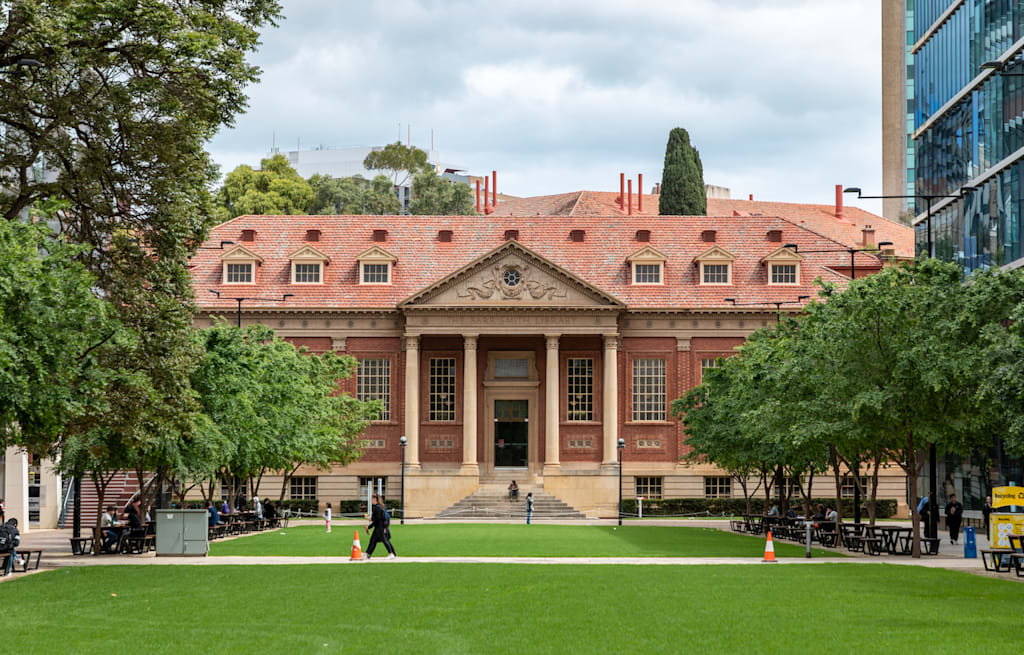
A pilot program has been introduced in the Australian city of Adelaide that has quickly become a sterling example of how to combat AI-generated text.
Last year, the city council founded the Adelaide Centre of Writing, to promote traditional human authorship and safeguard the local literary industry — one that has produced acclaimed authors such as JM Coetzee, Murray Bail, and Pip Williams — from the rise of artificial intelligence.
The program, quickly embraced as a revolutionary step to protect human intellectual capital, encourages young authors to step away from the digital world.
Watermarks and Van Gogh
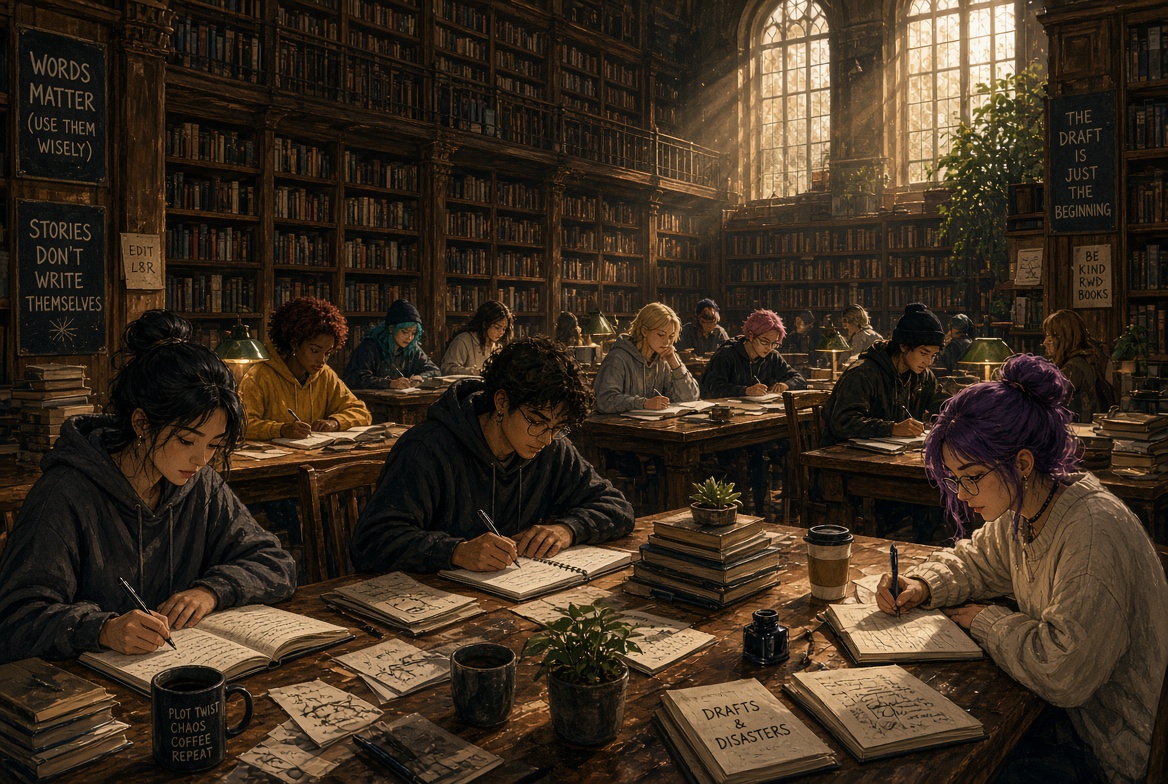
To ensure absolute creative authenticity, the Centre provides free of charge a dedicated writing hall where authors compose their manuscripts by hand. Municipal staff, designated as Literary Wardens, oversee the space to maintain a focused, distraction-free environment free of laptops and smartphones.
“We wanted to create a sanctuary where human creativity can flourish without the background noise of algorithms,” said Lead Literary Warden Gwen Ashbury. “By returning to the physical acts of writing, we help writers reconnect with the organic roots of storytelling.”
Writers are provided traditional fountain pen feathers. With fresh ink literally dripping onto the page, younger-generation authors quickly learn the art of traditional cursive script.
On each completed page, the Centre stamps a watermark confirming the authentic human effort used to create the sacred document.
Additional watermarks certify the provenance of works produced during a 12 or 24 hours continuous writing session, a memoirist or novelist’s equivalent of Van Gogh’s ear, but imprinted into the page.

Writing Worth the Paper It’s Written On
This month the Centre has transitioned from standard paper to thick, artisanal papyrus parchment.
Boosting a Grade 17 thickness, the material is so rough and abrasive it absolutely can not have been fed into a standard laser printer. It is, however, thick enough to wipe away tears of an exhausted writer.
Who Polices the Police?
To maintain the integrity of the program and guarantee to publishers that the work is entirely human-made, the council implemented a final compliance check.
Before leaving the facility, in a high-security basement, the completed pages are scanned and fed into a digital AI text detector. This certifies that no outside digital text was memorized or smuggled into the drafting process.
The strict nature of this verification phase has recently come to light following the disqualification of a historical romance manuscript by aspiring local novelist Heather.
Heather’s Story
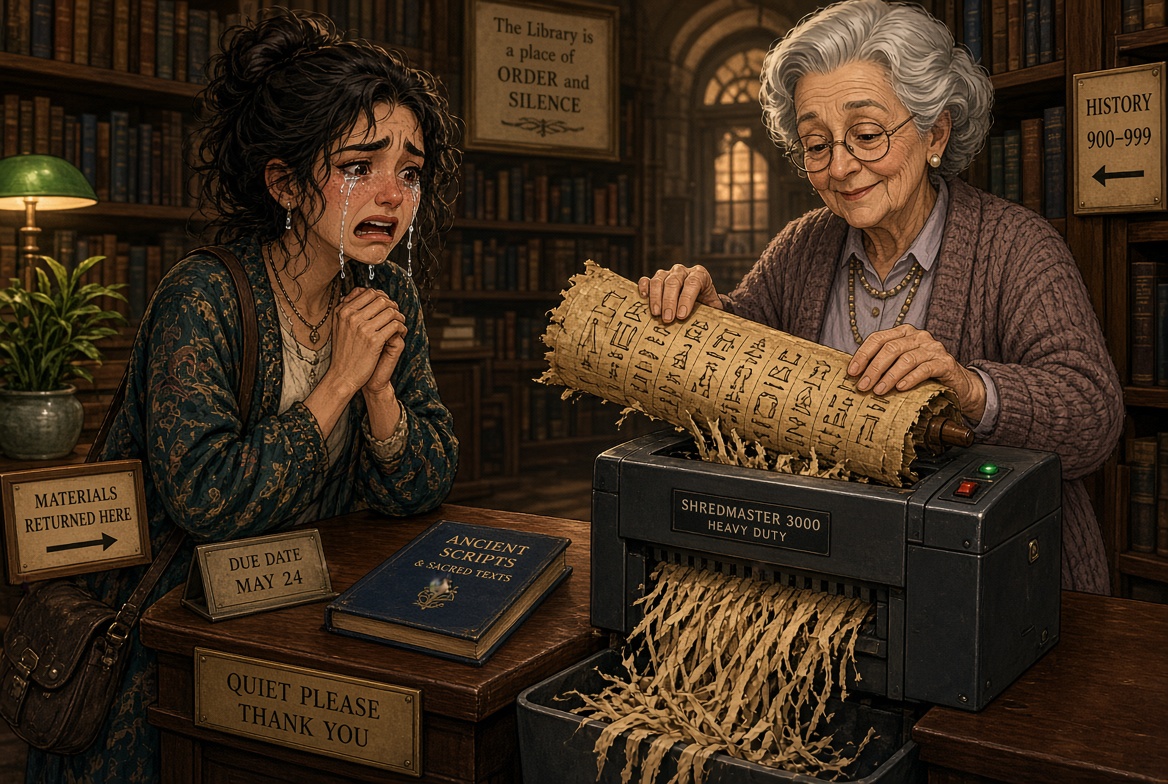
After spending seven months under the quiet supervision of the Literary Wardens, meticulously crafting her 90,000-word epic on papyrus sheets, Heather submitted her completed stack to the digital scanner room for routine certification.
“The system flagged a high-probability match in the first chapter,” Lead Literary Warden Ashbury explained. “The handwritten sentence, ‘The room smelled of ink and feathers,’ triggered a 99.8% AI probability rating.
According to the software, the phrase closely mirrors linguistic sequences commonly generated by Large Language Models trying to simulate historical realism.
Under the initiative’s guidelines, any text failing the scan is immediately rejected and sent to the facility’s carbon neutral recycling room to be shredded and repurposed as compost, leaving Heather without a copy of her original manuscript.
The incident sparked a quiet debate among local creators regarding the reliance on digital software to police an initiative designed to escape it.
Public Outrage
Local netizens who reviewed the news report on Heather’s tragic story in the Adelaide Gazette immediately flagged the article itself as 92% AI-generated, though none of them disputed that the events had actually happened.
Instead of disputing the facts of the story, commenters turned their fury on Heather, aggressively blaming her for the failure. Top-voted comments argued she had no one but herself to blame for failing to memorise the 800-page Compendium of Predictable Algorithmic Cliches. Readers agreed that if a writer hasn’t bothered to commit every banned, robot-sounding phrase to memory before picking up a quill, they justifiably deserved to have their writing sent to the shredder.
At the University of Adelaide, mathematician Johnathon Turner estimated that the probability of an author writing a unique, never-before-published six-word sentence using common words at 0%.
About the Creator
Scott Christenson🌴
Born and raised in Milwaukee WI, living in Hong Kong. Hoping to share some of my experiences w short story & non-fiction writing.
Enjoyed the story? Support the Creator.
Subscribe for free to receive all their stories in your feed. You could also become a paid subscriber, letting them know you appreciate their work.
Comments
There are no comments for this story
Be the first to respond and start the conversation.