
Your Attention Is the Only Thing You Own
The Tetris effect explains how your phone trains your brain, and how a slower internet can help you take it back.
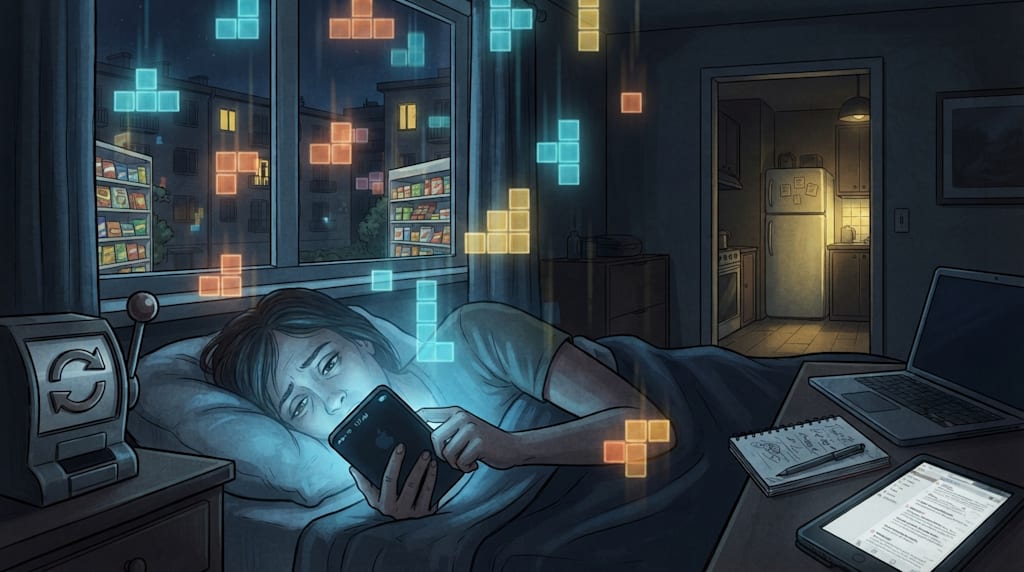
At 1:17 a.m., you open your phone to check whether pancake batter needs baking powder. Forty minutes later, you are watching the war in Iran, a stock market crash, and a cat push a glass off a table. Your thumb keeps moving. The ceiling is blue from the screen. You have forgotten the baking powder.
This is not random. Play Tetris for ten minutes a day, and after a few weeks you will see four-block shapes in clouds and window panes. Before sleep, they rotate and fall inside your eyelids. Whatever you look at repeatedly grows into your perception. Attention is not neutral. It works like a carving knife. Whatever you hand it to will carve you in return.
Years ago, going online meant opening bookmarks. One for video game news, one for tutorials, one for an anime blog that updated too slowly, one for a wiki about a 1990s TV series. Bad sites existed too, like Encyclopedia Dramatica and Rotten dot com, but you had to find them yourself. No one stuffed photos of dead bodies behind a pancake recipe. No one put far-right propaganda after a cat video. Now the default has reversed. You no longer choose what to look at. Someone else decides what is good for you.
YouTube knows you like cooking and art livestreams. It could give you only those. Instead, it also recommends stock market bubbles, global warming, and the war in Iran. Doomscrolling keeps you there longer. Staying longer means clicking a few more ads. Open a Spotify playlist, and the algorithm decides what you love to hear. Between real songs it inserts AI slop to avoid paying royalties to artists. LinkedIn buries a colleague’s promotion between strangers’ opinions. Those strangers are pitching whatever Microsoft is currently investing in. A coincidence. The Reddit users you want to ask may be large language models chatting with Russian trolls. I hope you do not take their opinions too seriously.
Doomscrolling works like a slot machine. The next refresh may bring something good, or nothing at all. Uncertainty itself is the reward. You stop asking, “What do I need to know right now?” You only ask, “What is next?” You think you are consuming information. Information is consuming you. You give up more than a few minutes. You give up the ability to organize experience and finish a sentence.
The Tetris effect flips here. Look at fragments repeatedly, and the world becomes fragments. Look at anger repeatedly, and the baseline of human relationships becomes hostility. Look at disaster repeatedly, and the future becomes a corridor with no exit. Look at other people’s highlights repeatedly, and your own life is never enough.
The intentional internet has not disappeared. Blogs, RSS, personal websites, forums, mailing lists, long tutorials, independent magazines, and niche wikis are still there. They sit under the corporate web, but they are not hard to find. You are reading this, so you probably know the way. The difference comes down to you. To return to blogs and RSS, to finish a long article instead of scrolling through a hundred short videos, you have to get used to a slower internet. It will not give you something new with every click. It is not infinite. It demands choice. It demands patience. That is how habits work. You keep reading. You keep subscribing. You keep a subject in your attention long enough, and something in your brain is triggered again.
Writers need to manage input even more carefully. Writing means organizing attention into structure. You write what you read. If every day you read only headlines, tweets, short-video scripts, and comment-section fights, your sentences become impatient. They break. They defend. You replace argument with assertion and observation with whatever is trending. Read long articles, books, papers, good novels, deep reporting, and your thinking gains depth. You learn how a sentence unfolds, how an idea is tested, how a story arrives slowly.
Writing is the Tetris effect in reverse. You repeatedly arrange words, arguments, images, and rhythm. Eventually they take shape in your mind on their own. You begin to see structure in chaos and hear sentences in silence. First you need whole attention. Long writing does not grow out of fragments. A complete worldview does not grow out of doomscrolling.
Protect your input. Build your own bookmarks and feeds. Do not hand your information sources over to platforms. Keep a stretch of every day free of algorithms. Read books. Read long articles. Take notes. Do not refresh. Before writing, read. Not trending searches. Read what slows you down. Treat attention as an asset, not a free gift. Whatever you invest it in will grow in your sentences.
At 1:17 a.m., all you wanted was to check baking powder. Now you close the recommendation feed. The room goes quiet. The refrigerator hums. You open RSS and finish one article. You write a note. The screen goes dark. You will look again tomorrow. This time, you decide.
About the Creator
Jin
Writer of reamstories
https://reamstories.com/jin
Enjoyed the story? Support the Creator.
Subscribe for free to receive all their stories in your feed. You could also become a paid subscriber, letting them know you appreciate their work.
Comments
There are no comments for this story
Be the first to respond and start the conversation.