
Why Modern Life Feels Strangely Lonely
Being Constantly Connected Doesn’t Always Mean Feeling Close

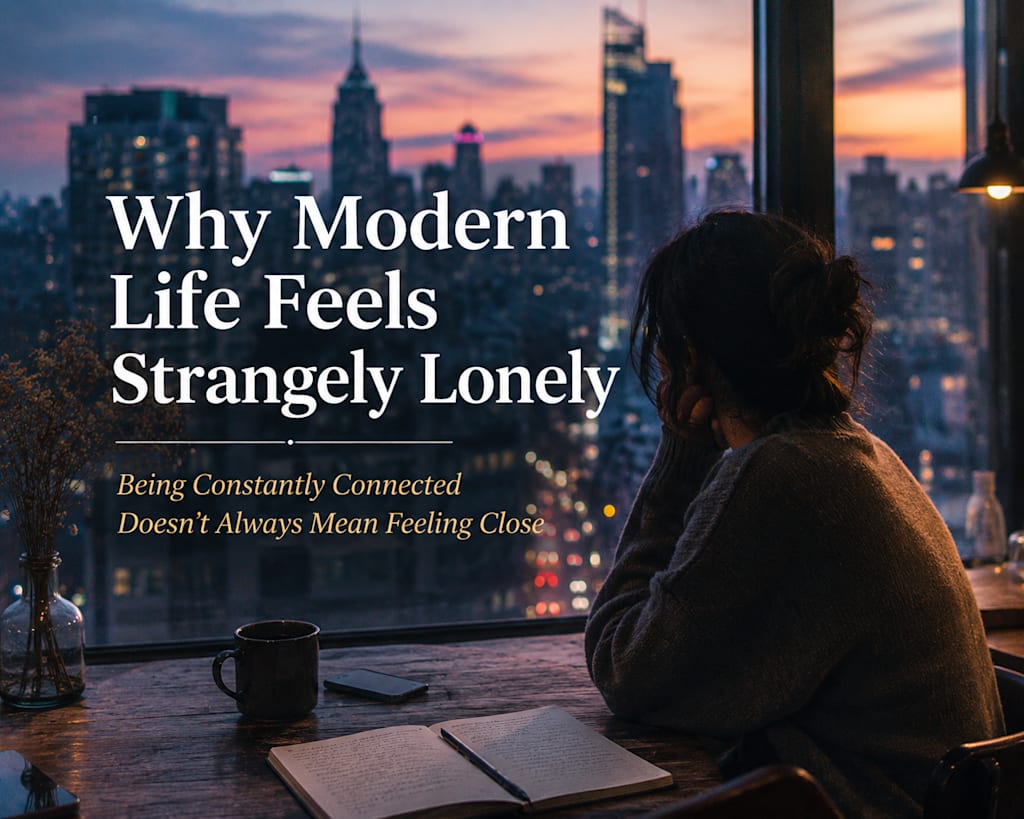
It’s strange how easy it has become to reach people, yet how difficult it sometimes feels to genuinely connect with them.
A message can travel across the world in seconds. Photos, thoughts, and updates appear instantly on screens throughout the day. Most people now carry constant communication in their pockets. Yet despite all of this connection, loneliness still seems to follow modern life in quiet and unexpected ways.
Not dramatic loneliness, necessarily.
Not the kind people usually imagine when they think about isolation.
Instead, it often appears in smaller moments. Sitting in a crowded café while everyone looks at separate screens. Scrolling through conversations without really talking to anyone. Watching people document experiences online instead of fully participating in them. There’s a subtle emotional distance that sometimes exists even when communication never stops.
A few months ago, I met an old friend for coffee after not seeing each other for almost two years. Before meeting, we had technically stayed “connected” online the entire time. We reacted to each other’s stories, exchanged occasional messages, and saw constant updates about each other’s lives.
But sitting across from each other in person felt completely different.
The conversation moved more slowly. There were pauses. We noticed each other’s expressions instead of emojis. At one point we spent several minutes simply talking about ordinary things that would never appear online — work frustrations, random observations, small anxieties about getting older.
The café itself was noisy and crowded, but somehow the conversation still felt calm.
Walking home afterward, I remember thinking how unusual that kind of conversation had become. Honestly, I didn’t even realize how much I missed uninterrupted conversations until that night.
Modern communication is incredibly efficient, but efficiency is not always the same thing as closeness.
Many digital interactions are designed for speed. Quick replies. Short reactions. Constant updates. Conversations become fragmented across notifications and multiple apps. People are always available, yet often mentally distracted at the same time.
Even friendships sometimes begin to feel compressed into highlights.
People share achievements, vacations, milestones, and carefully selected moments. Meanwhile, quieter emotions — uncertainty, loneliness, boredom, confusion — remain hidden because they do not fit naturally into the rhythm of online communication.
Of course, social media itself is not inherently harmful. It helps people maintain long-distance relationships, reconnect with old friends, and discover communities they may never have found otherwise. For many people, online spaces genuinely provide comfort and belonging.
Still, something about modern life often feels emotionally fragmented.
Part of it may come from how frequently attention is divided now. Conversations compete with notifications. Dinners compete with screens. Moments of silence are quickly filled with scrolling. Even when people spend time together physically, their attention is often partially somewhere else.
It is difficult to feel fully present with someone who is also half inside their phone.
That sounds harsher than I mean it to, because almost everyone does it now. Including me.
Sometimes I catch myself reaching for my phone during tiny moments of discomfort: waiting in line, sitting quietly, walking alone. Modern life trains people to avoid stillness almost automatically. But those quiet moments were once where spontaneous conversations or observations naturally happened.
Now they disappear before they even begin.
There is also something exhausting about constant visibility. Previous generations could disappear for a while without explanation. Today, silence itself sometimes feels socially noticeable. People feel pressure to respond quickly, stay updated, remain reachable, and continuously participate online.
The result is strange: people can become socially overwhelmed while simultaneously feeling emotionally disconnected.
And honestly, I think many people feel this more than they admit.
Not because they lack relationships, but because modern communication sometimes creates the illusion of closeness without always delivering the emotional depth people actually need.
Real connection usually requires slower things.
Time. Attention. Presence. Long conversations that wander naturally. Shared silence that does not feel uncomfortable. Moments where nobody feels the need to document anything.
Maybe everyone notices this eventually as they get older.
The conversations they remember most are rarely the fastest ones.
These experiences still exist, of course. But they increasingly feel intentional rather than automatic.
A lot of modern social interaction now happens in carefully controlled environments. Photos are edited. Replies are rewritten. Thoughts are shortened into captions. People learn how to present themselves continuously, even in casual spaces.
And maintaining that presentation can become tiring.
Sometimes the most meaningful interactions happen when people stop performing entirely. Sitting in someone’s kitchen late at night talking about nothing important. Walking through a city without constantly checking phones. Spending time together without needing entertainment every second.
Those moments often feel memorable precisely because they are becoming rarer.
I don’t think modern technology created loneliness entirely. Human beings have always struggled with isolation in different ways. But digital life has changed the texture of loneliness. It is now possible to feel surrounded by updates, messages, and endless communication while still feeling emotionally distant from other people.
That contradiction is difficult to explain unless someone has experienced it personally.
Maybe that is why many people are beginning to value slower forms of connection again. Long phone calls instead of endless texting. Dinner conversations without screens on the table. Small gatherings with close friends rather than constant online interaction.
Not because technology is bad, but because human attention is limited.
And attention is probably one of the clearest ways people show care for each other.
In the end, perhaps loneliness in modern life is not simply about being alone. Sometimes it is about feeling unseen in environments where everyone is constantly visible.
And maybe that is why genuine presence feels increasingly valuable now — because it has become surprisingly rare.
About the Creator
Cyprien Ganthier
Cyprien Ganthier is a behavioral systems researcher focused on structured decision logic, human-aware algorithms, and execution consistency in high-pressure environments.
Enjoyed the story? Support the Creator.
Subscribe for free to receive all their stories in your feed.
Comments
There are no comments for this story
Be the first to respond and start the conversation.