
Why Friendships Feel Different as We Get Older
Growing Up Often Means Growing Apart in Quiet Ways

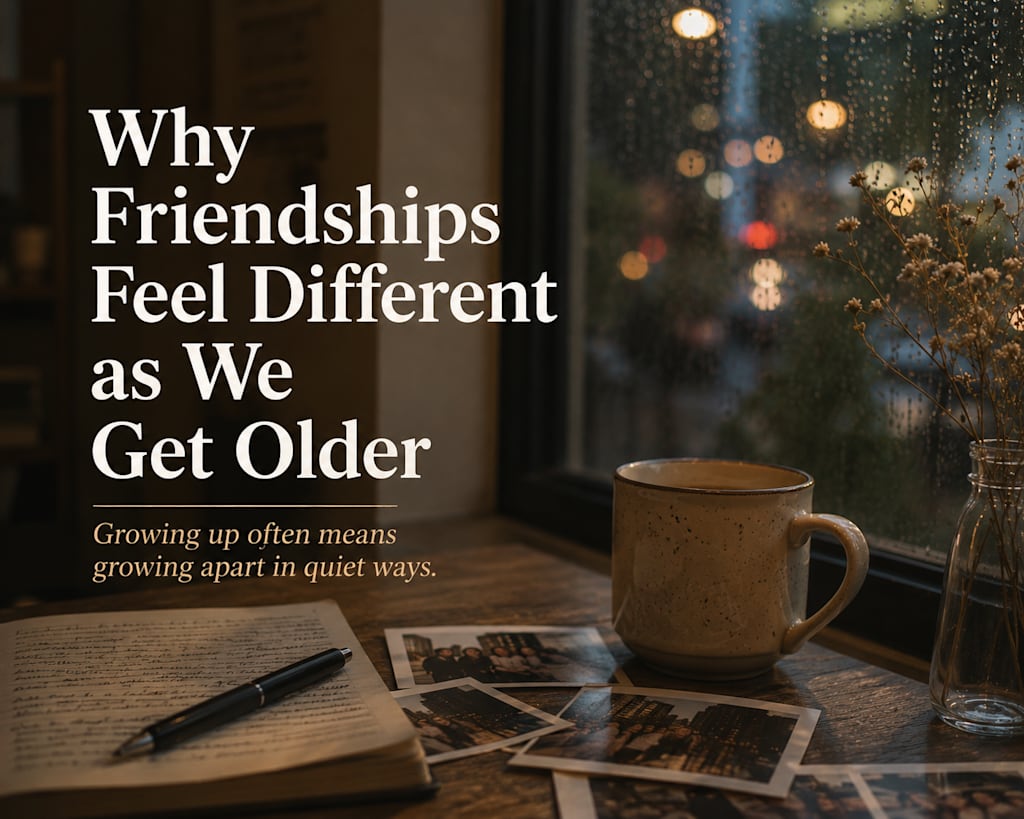
One of the strangest parts of adulthood is realizing how quietly friendships can change.
Not always through arguments or dramatic endings. Most of the time, it happens slowly. Messages become less frequent. Plans get postponed more often. Conversations that once lasted for hours slowly shrink into short updates every few weeks.
And somehow, nobody really notices when the shift officially happens.
A few years ago, meeting friends felt almost automatic. Someone would text at midnight asking if anyone wanted to grab food, and within thirty minutes people would be sitting together in a noisy restaurant talking about absolutely nothing important. Entire evenings disappeared without planning.
Now even scheduling coffee can feel complicated.
People are busy in completely understandable ways. Work schedules become unpredictable. Relationships, family responsibilities, finances, commuting, and exhaustion quietly take over daily life. Free time becomes limited, and when it does appear, many people are simply too mentally drained to socialize the way they once did.
I noticed this recently while scrolling through old photos on my phone. There were countless pictures of ordinary moments: late-night convenience store trips, crowded apartments, blurry group dinners, random walks through the city. None of those moments seemed important at the time.
But looking back at them now felt strangely emotional.
Not because life is necessarily worse now, but because certain kinds of closeness become harder to maintain as people grow older.
In school or university, friendships often develop naturally through proximity. People see each other constantly without needing to organize anything. Conversations happen between classes, during lunch breaks, while walking home, or simply because everyone exists in the same environment every day.
Adult life works differently.
Friendship begins requiring intention.
And intention becomes surprisingly difficult when people are tired all the time.
Sometimes I think adulthood introduces a kind of invisible scheduling fatigue into relationships. Even close friendships can slowly weaken under the pressure of logistics alone. One person is free on weekends. Another works late. Someone moves to another city. Someone else starts a family. Gradually, maintaining connection requires planning instead of spontaneity.
That shift changes relationships more than people expect.
The strange part is that affection does not necessarily disappear when distance grows. Many adult friendships exist in a quiet state of emotional continuity. People still care deeply about each other even if they rarely speak. Months can pass without conversation, yet the connection somehow still remains underneath daily life.
At least, that is what many people hope.
But there is also grief hidden inside growing older socially.
Not dramatic grief. Softer than that.
The realization that some friendships belonged to a specific version of life that no longer exists. Certain people were connected to particular routines, cities, apartments, jobs, or stages of growing up. Once those environments disappear, maintaining the exact same closeness becomes difficult no matter how much people care about each other.
Nobody really prepares you for that part of adulthood.
Movies and television often focus heavily on romantic relationships, but friendships quietly shape enormous parts of people’s emotional lives. Losing daily closeness with friends can feel surprisingly disorienting, even when nobody did anything wrong.
And honestly, I think many adults feel lonelier than they admit because of this.
Not necessarily isolated. Just socially fragmented.
Modern life creates strange forms of connection. People constantly see updates about each other online, yet rarely spend meaningful time together in person. Someone may know what another person ate for dinner without knowing how they are actually doing emotionally.
That kind of awareness is not always the same thing as closeness.
Social media also creates the illusion that everyone else is maintaining large, active social lives all the time. In reality, many adults are quietly struggling to balance friendship with exhaustion, work, stress, and limited energy.
Sometimes people genuinely want to reply to messages but feel too mentally tired to continue conversations properly.
Sometimes they cancel plans not because they do not care, but because they simply need rest.
Adulthood introduces a strange tension between caring about people and having enough energy to consistently maintain connection.
Still, some friendships survive these changes remarkably well.
Usually not because people communicate constantly, but because there is emotional patience underneath the gaps. Certain friendships become less dependent on frequency and more dependent on trust. Conversations resume naturally even after long silences. Nobody keeps score about who texted first. The relationship adapts instead of disappearing.
Those kinds of friendships become incredibly valuable over time.
I met an old friend for dinner earlier this year after almost eight months without seeing each other. Strangely, after the first fifteen minutes, the conversation felt almost identical to years earlier. We talked for hours about work stress, family problems, getting older, and how quickly time seemed to move now.
At one point we both stopped and laughed about how difficult it had been just to schedule dinner in the first place.
That felt painfully adult.
Walking home afterward, I realized something simple: adulthood does not necessarily destroy friendship. But it changes the conditions under which friendship exists.
People no longer build connection mainly through constant proximity. They build it through effort, patience, understanding, and small intentional moments inside increasingly busy lives.
Maybe that is why adult friendships can sometimes feel both weaker and more meaningful at the same time.
There are fewer spontaneous nights. Fewer endless conversations. Fewer moments where everyone is available at once.
But the friendships that survive often carry a different kind of depth.
Not based on convenience.
Not based on routine.
But based on people continuing to choose each other despite how complicated life becomes.
And honestly, that kind of connection may matter even more as people grow older.
About the Creator
James Walker
James Walker is passionate about technology, systems thinking, and continuous growth. He believes real progress comes from curiosity, discipline, and the ability to adapt in an ever-changing world.
Enjoyed the story? Support the Creator.
Subscribe for free to receive all their stories in your feed.
Comments
There are no comments for this story
Be the first to respond and start the conversation.