
Why Do We Identify So Much with Our Cars?
What does your vehicle say about you?

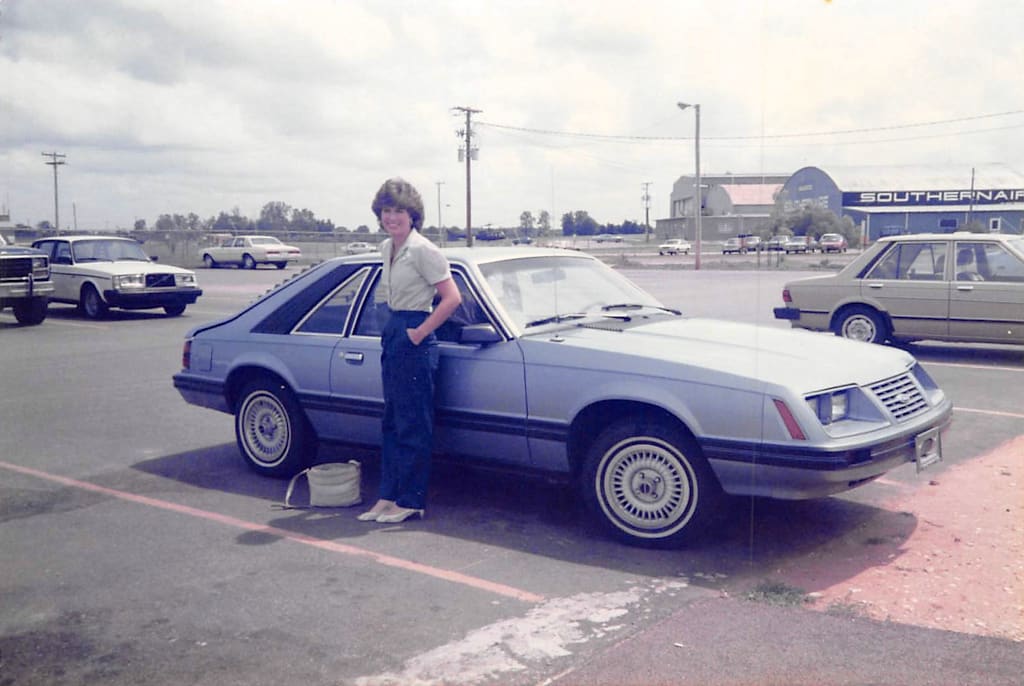
My dream right now is to live in a place where I don’t own a car and can walk everywhere. Decades ago, when this picture was taken, I couldn’t imagine a world where I was carless. And my dream was to own the most expensive sports car I could afford.
In the early 2000’s my husband and I bought a used Porsche Boxter. At the time, we thought we were living the dream. Until the thing kept breaking down, And the repairs kept getting more and more expensive.
We were so relieved when we sold it and bought a “practical” car. Never looked back. In fact, we hardly drive anymore. Maybe twice a week at the most. Honestly, we couldn’t be happier. I hate going to the dealership and dealing with maintenance. To me, vehicle ownership is a hassle.
But to others, it is a status symbol. Why is that?
In this article, Ira Israel LMFT, says the type of car you drive tells a lot about your social tribe:
“Cars are also potent carriers of status coding, imbued with symbolism that transcends utility or performance. Choosing to drive a Porsche instead of a Tesla—or a Bentley rather than an electric car—is more than a decision about transportation. It is a performative act inscribing one’s allegiance to historical and cultural narratives of power and identity. Our choices in cars are grounded cultural scripts that articulate which version of modernity we participate in.”
I’ll never forget driving off the lot in my brand new leased Mazda Miata. I was in my late 20’s living in Florida and having a blast. Then I moved back to Missouri. And before long, was spinning around in the ice and snow. I realized a Miata is perfect for Florida, but with no front wheel drive, not as practical for Midwest winters.
But when I went to trade it in for something again, more “practical” (A Toyota Tersel to be exact) I ended up owing money! I was in what’s called an Upside Down after putting too many miles on my leased car.
Why did I have to have that Miata? Obviously, I leased it because I couldn’t afford to buy the wheels outright. Was this simply a way to show off?
Ira says basically, yes:
“All of these signifiers—cars, handbags, wellness brands, grocery stores, etc.—converge into a sophisticated system of status coding, performing dual functions of inclusion and exclusion, affinity marking and boundary setting. Individuals engage in these operations both consciously and unconsciously, diving into ongoing semiotic rituals that negotiate their trustworthiness and belonging within chosen communities.”
Back then, I did care a lot more about what others thought of me. Now, with age comes a little wisdom. I realize that it doesn’t matter. My social circle is infinitely smaller and I only care about what my immediate family thinks.
And they don’t care what I drive. My husband and I had this conversation a few days ago. We remember a time when we couldn’t wait to drive our brand new car. We would pour over the brochures and dream about the new model that was debuting the following year.
Now, all we care about is getting from point A to point B, and how many more miles we can get out our current ride before we have to trudge over to the dealership and haggle for a new one.
The thought of having to deal with sticker shock and sales people and test driving makes my stomach turn. I think my hubby feels the same.
I know it sounds cliche, but we finally realize what is important in life…and cars aren’t even in the top 10.
About the Creator
Marie Dubuque
Welcome to my Hallmark world, where lattes rule and endings are always happy. Be sure to watch Hallmark Mysteries with Marie on Amazon Live!
Enjoyed the story? Support the Creator.
Subscribe for free to receive all their stories in your feed. You could also become a paid subscriber, letting them know you appreciate their work.
Comments
There are no comments for this story
Be the first to respond and start the conversation.