
Why 5D Relationships Feel Different From Ordinary Love:
7 Spiritual Beliefs Explained


Some connections feel unlike anything you have known before. There is no chasing, no mind games, and no constant fear of losing the other person. Instead, there is a quiet sense of safety, deep recognition, and a love that asks for nothing except honesty. Many people describe this as a 5D relationship.
In spiritual communities, the term points to a way of loving that comes from higher awareness rather than ego, need, or habit. Whether you take it literally or as a helpful metaphor, it explains why some bonds feel so different from ordinary love.
In this guide, you will learn what a 5D relationship means and the seven spiritual beliefs that explain why it feels the way it does. As you read, take what resonates and leave the rest.
Why 5D relationships feel different from ordinary love
What Is a 5D Relationship?
In spiritual teachings, the third dimension represents the physical world of separation, survival, and ego. Love in this space is often shaped by conditions: I love you if you meet my needs, fit my plans, and never trigger my wounds. The fifth dimension, by contrast, is described as a state of consciousness built on unity, compassion, and unconditional acceptance.
A 5D relationship, then, is a partnership where both people try to love from this higher awareness. It does not mean perfection or the absence of conflict. It means conflict is met with honesty and responsibility instead of control or blame. Partners see the relationship as a space for mutual growth, not ownership.
These ideas come from spiritual belief systems rather than scientific research, so they are best treated as a lens for reflection and self-awareness.
Many people first hear about 5D love during a spiritual awakening, when old relationship patterns suddenly stop feeling acceptable. They begin to crave depth, authenticity, and peace over excitement and drama. That shift in desire is often the first sign that a different kind of love is possible, both with a partner and with yourself.

Belief 1: Love Without Ego Games
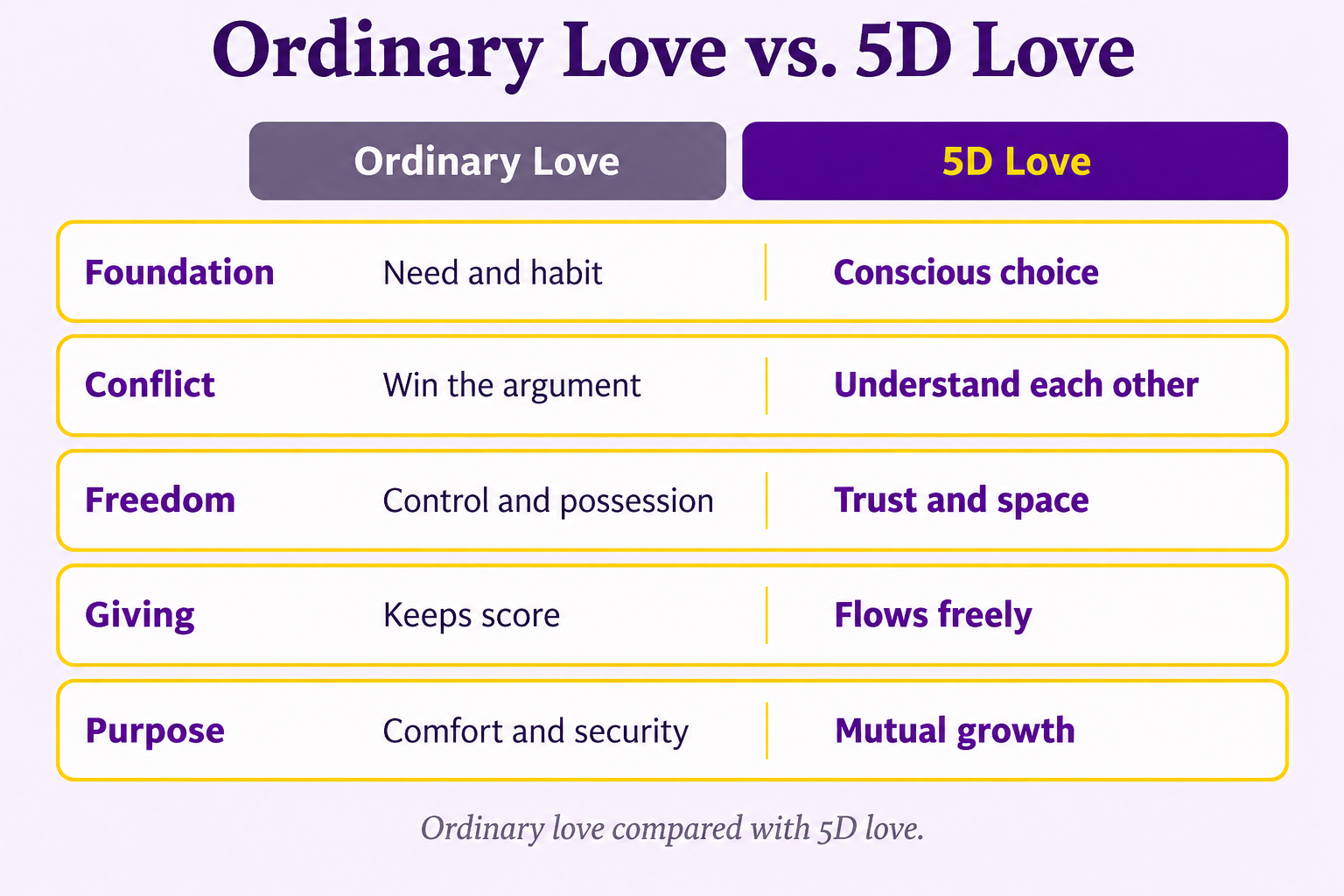
Ordinary love often gets tangled with ego: the need to be right, to be chosen, or to look good. Spiritual teachers describe 5D love as what remains when the ego loosens its grip. Partners stop keeping score, stop playing hot and cold, and stop using affection as a reward or a punishment.
Because nobody is performing, there is little to defend. Many people say this is why such connections feel peaceful. There is simply less drama to manage and more energy for real intimacy.
A simple sign of this belief in action is how you handle disagreements. Instead of asking who is right, partners ask what each person needs. Apologies come quickly, pride matters less, and the relationship stays safe even when emotions run high.
Belief 2: Soul-Level Recognition
A common belief is that 5D partners recognize each other at the soul level. It may feel like meeting someone you already know, with instant ease and a sense of coming home. Some traditions describe this as a soul contract or a shared journey across lifetimes.
Even if you hold this idea loosely, the feeling itself is real for many people: a deep familiarity that does not depend on shared history or years together.
Recognition is not the same as intensity. Ordinary attraction can feel electric and anxious, while soul recognition tends to feel calm and grounded. If a connection leaves you restless and uncertain, it may be chemistry or old attachment patterns rather than deep recognition.
Belief 3: Unconditional Acceptance
In ordinary love, acceptance often comes with fine print. In 5D teachings, love means accepting a person's wholeness, including their shadows, while still keeping healthy boundaries.
Unconditional does not mean tolerating harm. It means you are loved without having to become someone else, and you offer the same gift in return.
In practice, this looks like being able to share your fears, your past, and your imperfect days without being punished for them. Both partners feel free to be human, and growth is encouraged gently instead of demanded through criticism or ultimatums.
Belief 4: Radical Honesty and Emotional Transparency
Higher awareness is said to be incompatible with hidden agendas. Partners speak openly about fears, needs, and mistakes, and vulnerability is treated as strength rather than weakness.
Where ordinary relationships may avoid hard conversations to keep the peace, 5D relationships treat honesty as the foundation of trust. Difficult talks become a way to deepen the bond instead of a threat to it.
Honesty here is paired with compassion. It is not bluntness used as a weapon. It is the practice of telling the truth with care, listening without interrupting, and trusting that the relationship can hold whatever is real.
Belief 5: Freedom and Individual Growth
Possessiveness is considered a child of fear. In 5D teachings, partners support each other's purpose, friendships, and personal evolution. Two whole people choose each other, rather than two halves trying to complete each other.
Space is not seen as distance. It is seen as trust, and trust is what allows love to stay fresh and alive.
This belief also protects against codependency. When each partner keeps their own interests, friendships, and spiritual practices, the time they share feels chosen rather than obligatory. Independence becomes a gift to the relationship instead of a threat to it.
Belief 6: Energetic Harmony
Many spiritual practitioners believe partners connect energetically as well as emotionally. They describe feeling calm in each other's presence, sensing each other's moods, and syncing during meditation. Teachings about chakras, especially the heart chakra, suggest that open energy centers support deeper connection.
You do not need to accept this literally to notice its practical side. Calm, regulated people tend to help each other feel calm, a process psychologists call co-regulation.
Couples who value this belief often create small rituals, such as sitting in silence together, sharing a candle-lit evening, or practicing breathwork side by side. These moments build a felt sense of safety that words alone cannot always create.
Belief 7: The Relationship as a Spiritual Path
The final belief is that the relationship itself is a teacher. Triggers become invitations to heal, and challenges become lessons. Instead of asking, "How do I fix them?" partners ask, "What is this showing me about myself?"
Love becomes a practice of awakening, not just a source of comfort. This is perhaps the clearest difference from ordinary love, which often seeks safety first and growth second.
When a partner's behavior stirs an old wound, the 5D approach is to pause, breathe, and look inward before reacting. This does not erase accountability. It simply adds self-awareness, which turns repeating arguments into opportunities for real change.
How to Cultivate 5D Love in Your Own Relationship
You cannot force this kind of connection, but you can create the conditions for it. Consider these practices:
• Heal your own wounds first. Therapy, journaling, and shadow work reduce the old pain that often sabotages love.
• Speak honestly and kindly. Share feelings early, before resentment builds.
• Meditate or breathe together. Even five quiet minutes can create closeness without words.
• Keep healthy boundaries. Loving deeply and protecting yourself are not opposites.
• Release the need to control. Offer support without trying to manage the other person's choices.
• Practice daily gratitude. Notice and name what you appreciate about each other.
One caution matters. The label "5D" should never be used to excuse mistreatment, manipulation, or disrespect. Real higher love is consistent, kind, and safe, and red flags remain red flags.
Final Thoughts: Love From Awareness, Not From Need
A 5D relationship is not a fairy tale or a finish line. It is a way of relating that grows when two people choose honesty, freedom, and compassion again and again. Ordinary love is beautiful too, but it often runs on need, habit, and fear. Love from higher awareness runs on choice.
Whether you see these beliefs as literal truth or as meaningful symbols, they offer a useful question for any relationship: am I loving from fear or from presence? Begin there, and let your answer guide the next small step.
If you are single, these beliefs can still guide you. Learning to love yourself with honesty, patience, and freedom prepares you to recognize the same qualities in another person. If you are partnered, they invite gentle conversations about what both of you truly want from love and how you can build it together one choice at a time.
The love you seek often begins with the love you practice.
This article is for spiritual and educational purposes only and is not a substitute for professional mental health or relationship advice. If you are struggling, please consult a licensed therapist or counselor.
About the Creator
Wilson Igbasi
Hi, I'm Wilson Igbasi — a passionate writer, researcher, and tech enthusiast. I love exploring topics at the intersection of technology, personal growth, and spirituality.
Enjoyed the story? Support the Creator.
Subscribe for free to receive all their stories in your feed.
Comments
There are no comments for this story
Be the first to respond and start the conversation.