
When Fear of Accountability Returned
El Hishri in The Hague
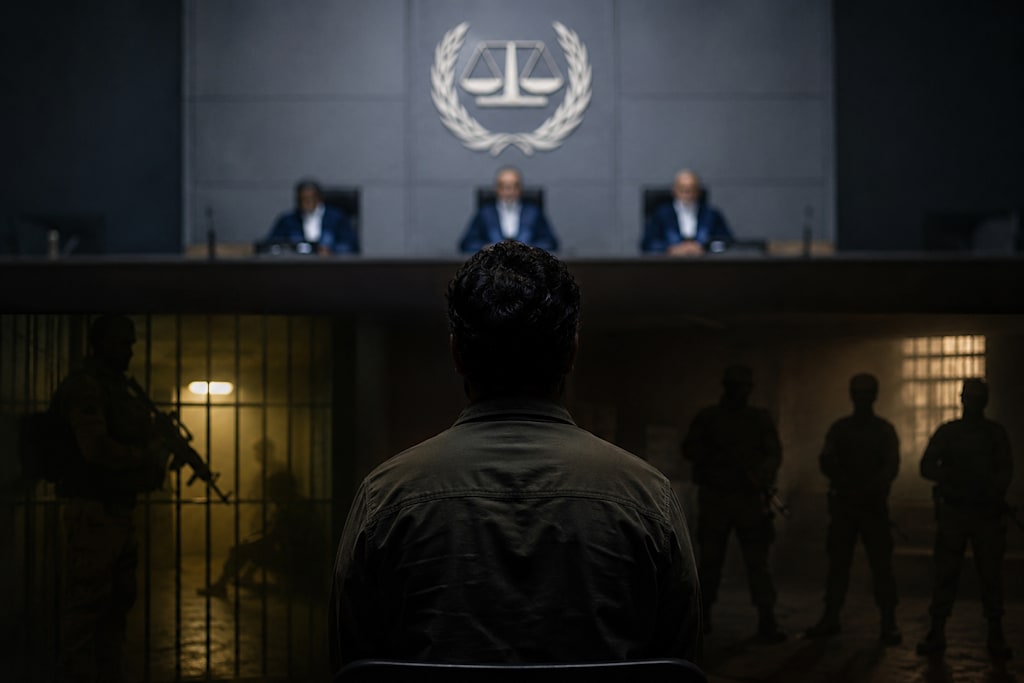
The most significant moment in the case of Khaled El Hishri, one of the leading figures in Libya’s Radaa militia and a man accused of war crimes and crimes against humanity, was not his arrival in The Hague or his appearance before the International Criminal Court. It was what happened inside Libya afterwards.
The moment El Hishri appeared in the courtroom, it became clear that the message had travelled much further than many expected. Suddenly, authorities and armed groups across eastern and western Libya began behaving as though they had only just discovered the existence of law and human rights. There was sudden talk of “reviewing detainee cases.” Committees appeared overnight. Institutions and armed factions that had spent years treating abuse as routine suddenly seemed eager to polish their image and distance themselves from violations that had long been woven into Libya’s political reality.
In eastern Libya, authorities announced the release of detainees from Garnada prison, the eastern counterpart to Mitiga prison, presenting the move as a humanitarian gesture. At the same time, committees were formed to review detention conditions, and officials began visiting facilities that had previously been untouchable. In western Libya, conditions inside Mitiga prison temporarily improved for some detainees. Local and international visits increased, and files that had long been deliberately ignored were suddenly reopened, including cases involving foreign detainees whose release or repatriation had been stalled for years.
Most of these steps still look more like attempts to contain mounting pressure around international accountability than genuine reform. But they reveal something important: the El Hishri case has created real anxiety inside Libya’s power structures and armed networks.
These developments may be limited and largely symbolic, and in many ways they are. But they expose a deeper truth. Simply seeing a senior figure from Libya’s armed establishment standing before the International Criminal Court was enough to trigger panic across the corridors of power, among warlords and militia leaders alike, whether large or small.
That alone is remarkable in a country that has lived for years under a culture of complete impunity.
On the other side of this story, the scene carried a very different emotional weight for victims, their families, and communities that have spent years living under the control of armed groups. For many of them, El Hishri’s appearance in The Hague was not just another news clip on television. It was a moment they had waited for for years, a moment that made accountability feel possible again.
The irony is difficult to ignore. The same image that brought a measure of relief to victims was enough to spread fear among those who hold power. And that alone says a great deal about the depth of Libya’s collapse, when the mere sight of an accused man in court becomes an extraordinary event capable of reshaping the balance between fear and reassurance across society.
That fear did not emerge out of nowhere.
For more than a decade, Libya’s problem has not simply been weak institutions, absent political will, or the failure to apply the law. The deeper problem has been the disappearance of any real expectation that anyone would ever be held accountable for what they had done. Successive authorities and the armed groups aligned with them, both east and west, learned to treat the Libyan judiciary not as an independent branch of power, but as an institution that could be pressured, bypassed, manipulated, or paralysed whenever necessary. As the state fragmented and institutions collapsed, some armed groups gradually evolved from forces operating outside the law into powers capable of placing themselves above the law itself.
That is why, in my view, the real fear was never domestic justice. It was international justice.
Inside Libya, these groups understand perfectly how the system works: who can be threatened, who can be pressured, which files can be buried through deals, political bargaining, or outright force. But The Hague is different. There, many of those tools begin to lose their value.
A man who once controlled the fate of others suddenly becomes a defendant sitting silently inside a courtroom, listening as accusations and testimonies are laid out in public. His image is no longer that of a feared commander, a “Haj,” a “Sheikh,” or an untouchable power broker within Libya’s political order. He becomes what he was never supposed to become: someone answerable to justice.
That is precisely where the symbolic and deterrent power of the El Hishri case lies.
The International Criminal Court has serious problems of its own. It has faced political pressure, American sanctions, especially during the Trump administration, and constant obstruction in Libya itself. Investigators have repeatedly been denied free access to crime scenes. Meeting victims and witnesses inside Libya has been extraordinarily difficult. Armed groups themselves pose a direct threat to any independent investigative effort.
And yet, despite all of this, the Court managed to achieve something many institutions inside Libya failed to do: it brought the fear of accountability back into the political landscape.
The ICC may not be capable of ending impunity in Libya. It may not be able, on its own, to dismantle the criminal structures that have taken shape over the past decade. But at the very least, it has delivered a symbolic and psychological blow to the idea of absolute immunity — the idea that armed groups and those clinging to power could continue indefinitely without consequence.
That is why the current anxiety within parts of Libya’s ruling circles is entirely understandable. For these groups, the real danger is not the El Hishri case itself. The danger lies in the possibility that accountability could become a continuing process rather than a single isolated trial.
And for any system built on impunity, that may be the most dangerous possibility of all.
About the Creator
Ali Alaspli
Libyan human rights defender and former prisoner of conscience. He lives in exile and serves as the Director of Libya Crimes Watch, an organisation documenting human rights violations and advocating for accountability in Libya.
Enjoyed the story? Support the Creator.
Subscribe for free to receive all their stories in your feed.
Comments
There are no comments for this story
Be the first to respond and start the conversation.