
What Is Ideology, And Why Does It Matter?
Part 1 of the Elucidation series. If you're new here, start with the series introduction.
Whether we realize it or not, every one of us already has an ideology. It shapes every decision we make, what we consider right and wrong, how we treat strangers, what we sacrifice for and what we refuse. Most of us simply never examine it.
We begin here: not with abstract philosophy, but with a practical observation. You are already living by a set of beliefs about reality. Shouldn't you know what they are?
The Everyday Problem
Take a simple example. An engineer designs a building. Based on that design and the calculations behind it, certain predictions can be made: the building will bear a particular load, withstand certain forces, stand for a certain length of time. If, years later, the building remains standing and performs as predicted, the design is validated. If it collapses, the design is refuted, not by argument, but by reality.
Ideological beliefs work the same way. Every belief system makes predictions about the world: about what makes a good society, about what fulfills human potential, about what leads to justice or injustice. And those predictions are tested, not in a laboratory, but across the long course of history and through the daily practice of human life.
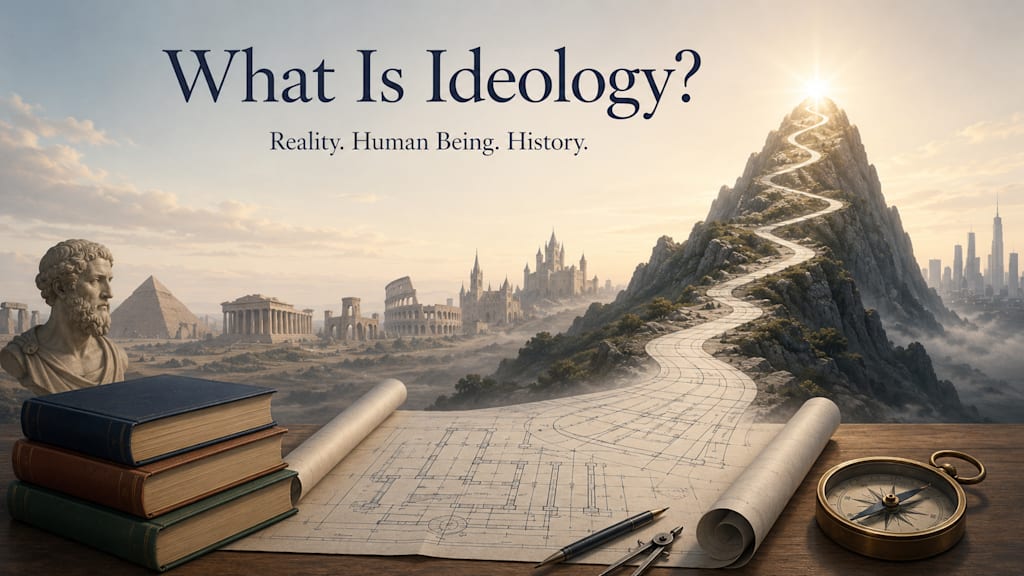
This is the first serious claim of the Elucidation lectures: ideology is not a luxury or an academic exercise. It is the blueprint by which we build our lives.
Good and Evil: Convention or Reality?
But the moment we take ideology seriously, we run into a much deeper question. One that has haunted philosophy for thousands of years.
Are good and evil real? Or are they just conventions?
Consider how values seem to shift across history. In the age of feudalism, blood ties and family bonds carried enormous importance. Loyalty to one's lord, honor in one's lineage, these were the supreme values. But when industrial capitalism arrived, those values faded. Individual enterprise, capital accumulation, market competition, these became the new standards. Values that were once honored, like loyalty and family bonds, came to be seen as old-fashioned. And behaviors that were once condemned by the feudal hierarchy, like the aggressive pursuit of personal wealth, became celebrated.
The ancient Greek philosopher Protagoras drew a bold conclusion from observations like these: "Man is the measure of all things." In other words, there is no objective standard. Values are whatever a given society, at a given time, decides they are.
If Protagoras is right, then ideology is just fashion. It changes with the times, and no set of beliefs is ultimately better or worse than any other.
But is he right?
Sartre's Student
The French philosopher Jean-Paul Sartre tells a story that sharpens the problem. During the Second World War, at the height of the struggle against fascism, a young student came to Sartre with a dilemma. The student's brother had been killed in battle. His mother, devastated by grief, was living only for him, her surviving son. He was everything to her.
The student wanted to join the resistance. He believed in the cause. But joining would mean leaving his mother alone, and it might well mean his death. What should he do? Stay and comfort the one person who depended on him? Or go and fight for his homeland?
Sartre's answer was: I cannot tell you. You must choose.
Now, this is an honest answer. But think about what it implies. If the greatest philosopher of the age cannot offer a standard by which to judge such a decision, then we are truly alone. This means that every moral choice is arbitrary. There is no right answer, only the answer you happen to pick.
We take this problem seriously but refuse to accept Sartre's conclusion. The argument is that the reason Sartre could not answer is not that answers don't exist, but that he was operating without a foundation, without a coherent picture of reality, human nature, and the direction of history from which answers could be derived.
The Question Beneath All Questions
This leads to what We can identify as the central question of philosophy: Does reality exist outside the mind?
It may seem absurdly basic. Of course the world is real. But pause for a moment.
If reality truly exists outside our minds, if the world has a real structure, a real direction, and real consequences, then good and evil are not just words. They correspond to something. A step toward the summit of existence is genuinely better than a step away from it. Truth and falsehood are not interchangeable. Right and wrong are not just preferences.
But if the world outside the mind is an illusion, if everything is subjective, constructed, relative, then there is nothing to ground any moral claim. Everything becomes opinion. And opinion, as history shows, is infinitely manipulable.
There is a vivid analogy. Imagine a mountain climber ascending a real mountain with a real mountain peak. Each step can be judged: does it go upward or downward? Does it bring you closer to the peak or farther away? The standard is not in the climber's mind. It is in the mountain itself. The peak exists whether anyone climbs toward it or not.
Now imagine the same climber, but with no mountain, just flat, featureless ground stretching in every direction. In that case, every direction is equal. No step is better than any other. The very concepts of progress and regress lose their meaning.
The same is true for existence as a whole. If reality has a structure and a direction, then our choices matter, objectively, not just subjectively. If it doesn't, then nothing we do ultimately matters at all.
Three Questions Every Ideology Must Answer
Once we accept that reality exists and can be investigated, we can identify three fundamental questions that every ideology, every coherent belief system, must address:
1. The question of existence. What is the nature of the world? Is it material or does it have a dimension beyond matter? Does it have a direction, or is it random?
2. The question of the human being. What is a human being? A sophisticated animal driven by instinct and environment? Or something more: a being with genuine choice, genuine responsibility, and a role to play in the larger story of existence?
3. The question of history. Where is humanity going? Is history cyclical, the same patterns repeating endlessly? Is it declining, each era worse than the last? Or is it progressing: moving, however painfully, toward something higher?
Every ideology, whether it knows it or not, gives answers to these three questions. Marxism answers them. Liberalism answers them. Buddhism answers them. So does nihilism, it simply answers all three with nothing.
The critical insight of the Elucidation lectures is that these three questions are not independent. They form a system. Your answer to the first (the nature of existence) determines what answers are available for the second (the nature of the human being), and both together constrain your answer to the third (the direction of history).
Get the first question wrong, and everything downstream collapses.
Why This Matters Now
We live in an age of profound ideological confusion. Traditional belief systems are under pressure. Modern alternatives, consumerism, individualism, technological utopianism, offer comfort but not coherence. Many people live with a patchwork of borrowed beliefs that contradict each other at the foundations.
This confusion is not accidental. It is the natural result of never having examined the foundations: of never having asked, clearly and systematically, what do I actually believe about reality, about myself, and about where all of this is going?
That examination is what this series is about. In the next article, we'll go deeper into the method: how should we actually investigate these questions? Why are some approaches doomed to fail? And what does a genuine search for truth look like?
• • •
Next article: The Difference Between Describing the World and Explaining It
Elucidation is a series of articles inspired by philosophical lectures given around 50 years ago. New articles are published weekly.
Part 1 of the Elucidation series. If you're new here, start with the series introduction.
About the Creator
Han Elucidation
Why do we exist? A searcher. Exploring existence, meaning, and what it means to be human through the Elucidation series.
Enjoyed the story? Support the Creator.
Subscribe for free to receive all their stories in your feed.
Comments
There are no comments for this story
Be the first to respond and start the conversation.