
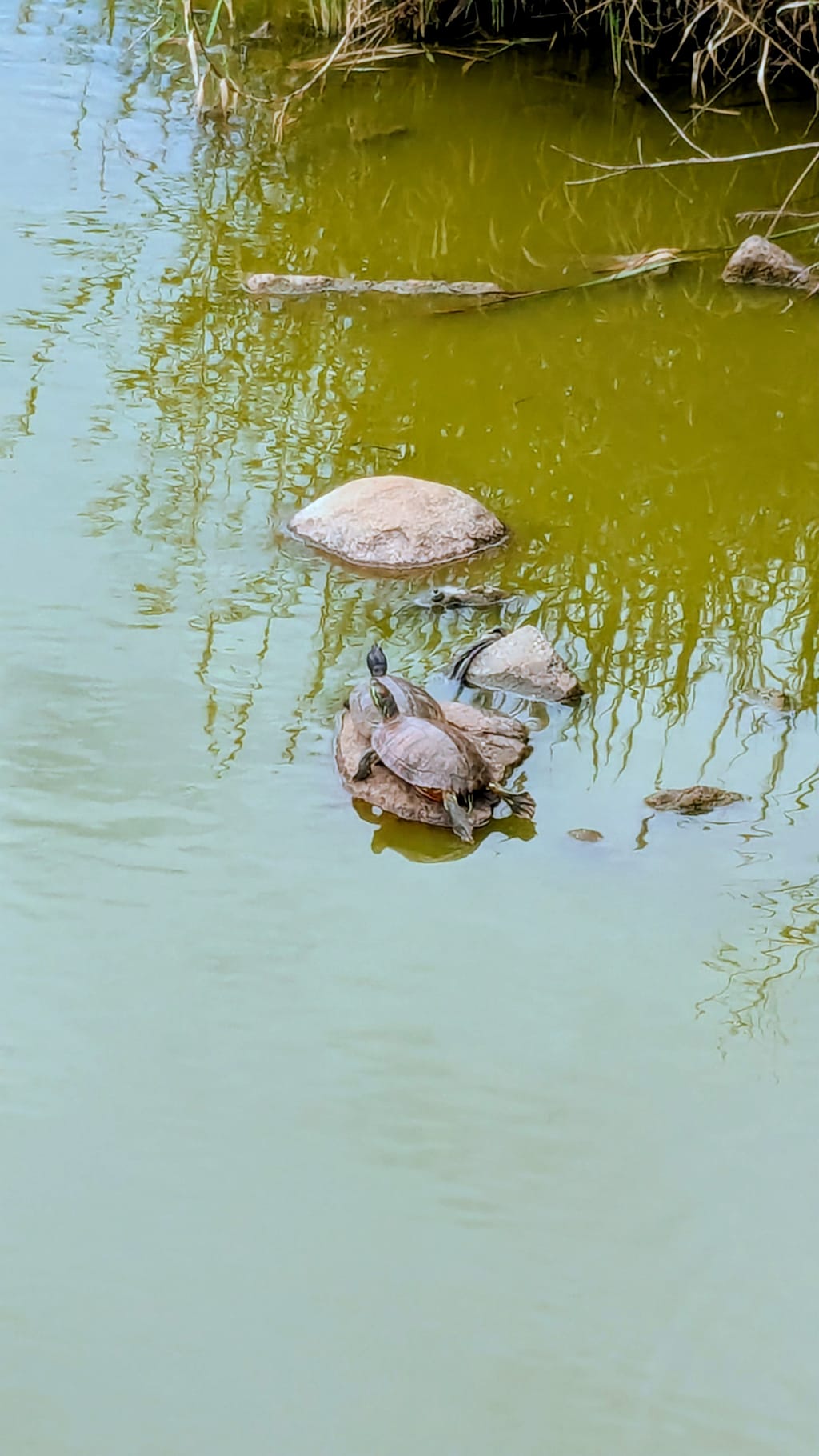
I was walking home that evening, passing a small pond with water tinted a yellowish-green, reflecting the wild grass and dry twigs along its edge. I almost walked right past it—until my eyes caught something moving slowly on top of a rock. Two turtles were basking there, stacked on top of each other, seemingly indifferent to everything except the last light of the afternoon sun.
I stopped. I watched them for a while, long enough to forget that I was actually in a hurry.
There is something calming about the way turtles move. Nothing pushes them. No schedule to chase, no notifications to answer, no foreman shouting from a distance. They simply climb onto a rock, stretch their necks toward the light, and stay there for as long as they please.
As a genba worker in Osaka, my life is far from slow. Every morning I wake before sunrise, put on my work uniform, and spend most of the day surrounded by steel, concrete, and the noise of machines. Time on site is counted strictly—every minute has its value, every delay can mean trouble. I've grown used to moving fast, thinking fast, finishing one task and immediately jumping to the next.
So when I saw those two turtles, one sitting on the other's back, heads tilted up toward the evening sky, it felt almost foreign to me. Not foreign because it was strange, but foreign because it had been a long time since I allowed myself to stop for that long.
Near them, other rocks were scattered across the water—some large and pale, as if placed there on purpose for basking, others small and nearly submerged. The water itself wasn't very clear, slightly murky with algae and the reflection of dry leaves along the bank. But that's exactly what made it feel real—not a perfectly manicured garden pond, but a small pond by the roadside that most people probably never notice.
It made me think: how many things like this do I miss every single day? How many turtles, how many small corners of life, pass by unnoticed because I'm too busy thinking about work, writing deadlines, or the trading chart rising and falling on my phone screen?
I took out my phone—not to open a trading app like usual, but to photograph them. Two turtles stacked on a rock, their necks stretched toward the same direction, as if enjoying the same sun, at the same moment, with nowhere they needed to rush to.
In Japan, I often hear about the idea of savoring small moments—the way people here appreciate the changing seasons, how they pause to watch cherry blossoms bloom or momiji leaves fall. At first I thought this was just a cultural habit, far removed from my world as a migrant worker here to earn a living. But that evening, standing in front of a small pond with yellowish-green water, I felt like I truly understood it for the first time.
That doesn't mean I should stop working hard. My wedding is getting closer, and I know that every yen I save, every essay I finish, every trading strategy I think through carefully, all of it is for the future I'm building. But those turtles reminded me that rest isn't a luxury to be postponed until every goal is met. Rest is part of the journey itself.
Turtles don't bask because they've finished dealing with everything life demands of them. They bask because their bodies need warmth, and they know when it's time to pause. Once they've had enough, they'll dive back in, search for food, continue their life beneath the murky water. But for a while, they choose to stay still on the rock, soaking up as much sun as they can.
I think maybe I need more moments like that too. Not the long vacations I can't realistically take amid my genba schedule and writing targets, but small pauses. Stopping for ten minutes in front of a pond. Watching how the light falls on the water. Letting myself be captivated by two turtles who have no idea they're becoming an important reminder for a tired migrant far from home.
When I finally continued on my way, the pond stayed calm behind me, its turtles still basking, indifferent to time, indifferent to whoever passed by. And I carried home something more valuable than just a photo—a simple reminder that a good life isn't only about how fast we reach our destination, but also about how often we allow ourselves to stop, even briefly, and feel the sun on our backs.
In Osaka, among the concrete and steel of the genba, among trading charts that never stop moving, I learned something from two turtles in a small pond that evening: sometimes, the best thing we can do is nothing at all—at least for a little while.
About the Creator
Enjoyed the story? Support the Creator.
Subscribe for free to receive all their stories in your feed.
Comments
There are no comments for this story
Be the first to respond and start the conversation.