
The True Golden Age for Indian Women Isn't in the Past. It’s Right Now
Why Dr. B.R. Ambedkar’s constitutional era represents the most profound paradigm shift for gender equality in Indian history.

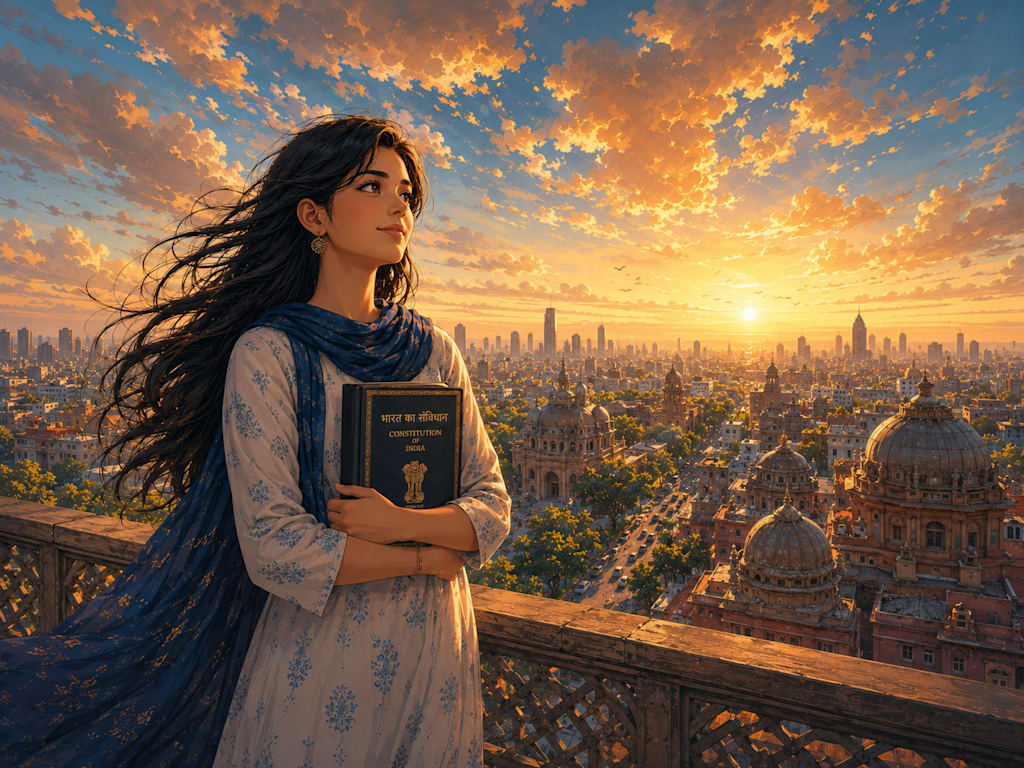
If you ask historians or flip through the pages of standard Indian textbooks, you will often find references to the Golden Age of women in the early Vedic period. We are taught to look backward to a time of scholars like Gargi and Maitreyi to find a civilization where women held intellectual and social authority.
But when we view history through the clear, unflinching lens of modern reality, a different truth emerges. That ancient golden age was a privilege afforded only to a select few from the upper echelons of society. For the vast majority of women, history has been an exhausting saga of systemic silence.
If we are searching for the true Golden Age for Indian women an era defined not by mythology or elite privilege, but by universal, undeniable rights we don't need to look back thousands of years. We only need to look at the era of Dr. B.R. Ambedkar and the Drafting of the Indian Constitution.
Here is why the post-constitutional era is the actual golden age of emancipation, and why understanding this is crucial for the modern Indian woman.
The Lone Crusader in a Room of Giants
To understand the magnitude of what women have today, we must look at the immense resistance it took to secure it.
In the years immediately following India's independence, the political landscape was dominated by stalwarts. Yet, when it came to fundamentally dismantling patriarchal laws, Dr. Ambedkar stood remarkably alone. Through the drafting of the Hindu Code Bill, Babasaheb sought to codify a radical new reality for women: the right to inherit property, the right to divorce, the right to marry by choice, and the banning of polygamy.
Today, these seem like basic human rights. But in the late 1940s and early 1950s, this was viewed as a cultural earthquake.
The resistance was fierce, and it came from all sides. Religious gatekeepers cried foul, claiming tradition was under attack. Political titans of the time, including Sardar Vallabhbhai Patel and Dr. Rajendra Prasad, strongly opposed the bill. Tragically, even many women conditioned by centuries of patriarchal upbringing protested against their own liberation.
It is a profound, often overlooked historical reality: the man who fought hardest for the liberation of Indian women was a Dalit man who knew intimately what it meant to be denied basic human dignity.
When the Hindu Code Bill was stalled and fragmented in parliament, Dr. Ambedkar did something practically unheard of in modern politics: he resigned from his post as India's first Law Minister. He gave up immense political power simply because the government refused to pass a bill guaranteeing equal rights for women.
Beyond Religious Dogma: The Security of the Constitution
There is a powerful realization that comes when we take off the heavy, culturally conditioned glasses of religious orthodoxy and look plainly at society.
For centuries, religious and traditional structures framed women's limitations as protection. But true security doesn't come from being sheltered; it comes from having agency.
Today, if a woman can walk out of an abusive marriage, travel across the world alone, choose a partner outside her community, hold a job of her choosing, and fight for her rightful share of her family’s property, it is not because tradition suddenly allowed it. It is because the Constitution of India (specifically Articles 14 and 15) stands as a shield behind her, guaranteeing equality before the law and prohibiting discrimination based on sex.
The modern era has shifted a woman’s worth from being dependent on the men in her life to being an independent, legally recognized citizen. The golden age is now, because for the first time in Indian history, a woman's freedom is a right, not a permission.
The Ultimate Equalizer: Education
Family upbringing is the foundation of character, but education is the most vital component of life.
You cannot demand rights you do not know you have. The visionary foundation laid by Mahatma Jyotirao Phule and Krantijyoti Savitribai Phule in the 19th century who opened the first schools for girls culminated in Dr. Ambedkar’s constitutional framework.
Education is what translates the words written in the Constitution into lived reality. It gives women the vocabulary to articulate their boundaries, the financial independence to walk away from toxic environments, and the intellectual power to reshape the very society that once tried to confine them.
The Baton is in Our Hands
Are things perfect today? Absolutely not. Society is a massive ship, and it takes time to turn. We still battle the ghosts of patriarchy in boardrooms, on the streets, and within our own homes. Some people understand the importance of this shift, and others will simply take more time.
But the architecture of freedom has been built.
The true Golden Age is right now because the ceiling has been shattered. Almost everything a woman wishes to achieve is legally and structurally within her grasp. She can stand up, she can fight, she can study, and she can lead.
Dr. Ambedkar and the framers of the Constitution fought the hardest battles so that today's women wouldn't have to start from zero. The rights are secured. Now, "It depends on them what they want to do."
History gave us the tools. The present gives us the opportunity. The future, entirely, is whatever we choose to write.
About the Creator
Arjun. S. Gaikwad
Curious mind exploring technology, society, and global change. I write on education, innovation, justice, and the future of humanity blending science, philosophy, and real-world insights to spark awareness, critical thinking, and hope.
Enjoyed the story? Support the Creator.
Subscribe for free to receive all their stories in your feed.
Comments
There are no comments for this story
Be the first to respond and start the conversation.