
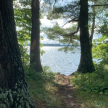

Katie took a deep breath to steady her nerves. She was met with the rich, familiar smell of rotting wood and leaf litter. All around her, birch and fir trees presided over thick underbrush. She stood in the center of a gravel road that was just wide enough for her, her two undergraduate assistants, and the lab truck, which was parked partway in the vegetation.
Attached to the truck’s tail end was a trailer carrying a boat unlike most others in the Wisconsin Northwoods. It was squat and stocky, like a tank, and two metal rods were strapped against its sides with bungee cords. Those rods, which were wired to an on-board generator, would extend off the boat’s bow like outstretched arms once it was in the water. Two floodlights hung off a guardrail at the front of the boat—for safety, they could only collect data for Katie’s dissertation at night, when fewer people were out on the water. That was the catch with electrofishing; the fish were unharmed by the electricity, only temporarily stunned, but every caution had to be taken to avoid sending a current through the water when anything larger was swimming in it. Thankfully, the current only traveled about ten feet out from the boat, and with their floodlights it was easy to avoid anyone out for a moonlit swim.
Still, Katie was anxious. Tonight was their first night back to work after a recent boating accident on property forced a period of safety evaluations, and something had gone wrong before they’d even left the remote field station. One of the floodlights on the front of the boat had broken off as the trailer bounced over the gravel road, and there was only one man around who knew how to fix it.
Hubert Halverson, or Hubs, as he was known among the researchers, stood on a step-stool that he’d placed on the ground near the front of their electrofishing boat. The strap of his welding mask ringed his balding head and sparks skittered across the gravel below the boat as he soldered the light in place. An extension cord for his torch ran along the ground behind him, to the cabin that had served as his home ever since his family donated the land to build the field station fifty years previously. He was a wealth of knowledge about life in northern Wisconsin, and was known around the station for his short sayings and bits of wisdom. He took new arrivals on tours of the property, helped researchers with their projects, and entertained them all with tales of famous Northwoods gangsters like John Dillinger, who used the area as a hideout in the early 1930s.
Of course, Hubs had changed since the accident. It wasn’t entirely unexpected; after all, he had been the one driving. These days, you could barely coax a smile out of him, and though he’d been an avid fisherman, he now wouldn’t even go near his boat.
“That should do it,” he said finally, flipping up his mask to reveal a face deeply carved by years of laughter and smiles. Today, he only wore a frown.
“Do you have any interest in coming with us tonight, Hubs?” Katie asked. “There are supposed to be some pretty big fish in Little Star Lake.”
Hubs waved the offer away. “That’s kind of you, Katie, but I’m fine here.” His eyes flickered up towards the sky, where dark clouds had already obscured the setting sun. “Be careful out there, though. I’ve learned these lakes have a sort of….tide. They give, but then they always take.”
Katie nodded. “We’ll be careful. Thanks for fixing that light.”
“Anytime.” He grabbed the step-stool and strolled back towards his cabin, his gaze still on the sky.
Katie and her two assistants, Marion and Ramsey, climbed into their truck and started down the gravel road, the boat rattling behind them. Katie flipped on the headlights.
“He misses her,” Ramsey said after a moment.
Marion nodded. “Probably misses his boat, too.”
“Can’t blame him,” Ramsey said. “I wouldn’t want to use my boat either if it had chopped up my wife—”
“Enough,” Katie said, cutting him off. She tightened her grip on the steering wheel.
______________________________________________________________
Darkness was complete by the time they reached the boat launch. As Katie swung the truck and trailer around to back the boat down the concrete ramp and into the water, her headlights barely penetrated the surrounding trees. Ramsey and Marion hopped out to guide her with their headlamps.
Her hands sweated as she backed the boat into the water. She’d been hoping Hubs would come along like he used to—having someone so experienced around lessened her anxiety. Still, all was going well so far. Once they launched the boat they extended its metal arms and attached a half dozen corrugated metal tubes to each one. These droppers dangled in the water, often dragging across the top layer of sediment, to deliver a current from the generator.
Katie flipped on the floodlights and started the motor to head across the lake. Little Star was one of a chain of ten lakes, each one connected to the others by narrow channels of water so that they splayed out like fingers on a hand. The water level in all the lakes was controlled by a dam at the chain’s drainage point. In the fall, the water level was lowered so that the thick ice which formed in winter wouldn’t damage the residents’ docks. In late spring, the water level was raised back to normal levels. Katie was researching if there was any effect of these changes in water level on the chain’s fish populations.
She stopped the boat near the shore in just a few feet of water. At the front of the boat, behind the guardrail, Ramsey and Marion strapped on their noise-canceling headphones and rubber gloves before picking up long, handheld nets. Each of them gave her a thumbs up and Katie gave the generator’s pull cord a sharp tug. It roared to life and she turned a dial to start pumping current into the water. Though they stood on a metal boat, there was no risk of a shock to them. The water was more conductive than the boat’s hull, and electricity always follows the path of least resistance.
Fish started floating to the surface of the lake. There were bass, bluegill, walleye, perch—each netted expertly by the two undergraduates. After they caught each fish they turned and flipped it out into a large tub of water they’d set up in the center of the boat. The fish recovered almost immediately.
Katie slowly drove the boat forward, following the shoreline. The droppers at the front slid across the sediment. She had to drive as shallow as she could without sticking the boat in the muck; the fish got closer to shore at night. As they progressed and she found her old rhythm, she could feel her nerves abating. Periodically they stopped to measure the fish, recording each one’s length in a small black notebook before releasing them.
But as the night progressed, the wind picked up and the clouds grew more ominous. A storm was coming.
“Let’s just do one last stretch of shore by the launch, and then we’ll head home,” Katie said. She turned the boat towards a shallow bay thick with muck and aquatic plants that they hadn’t planned on sampling.
The waves were larger now, and as they netted fish Katie was having trouble seeing into the water. Several times she had to dodge large stumps, remnants of the trees that the dam had long ago drowned. She could understand why nobody had ever shocked this bay before. Suddenly, Marion and Ramsey turned to face her, each of them waving their net-free arm frantically in the air, signaling for her to stop the boat.
Katie cut the electricity and shut off the motor, her heart thumping. She ripped her headphones off her head so she could hear them.
“There’s some sort of leather case,” Marion said, peering down into the water.
“The droppers dragged it out of the muck. I wasn’t sure what it was at first,” Ramsey added.
Katie joined them at the front of the boat just as thunder rumbled in the distance. She glanced at the sky. “We need to leave.”
“But look,” Marion said, pointing.
As the first drops of rain started falling Katie gazed into the water, where a brown briefcase hung suspended between the droppers. They had evidently dredged it out of the muck as they drove over it. “Let’s bring it in. Quickly, though.” The rain was falling harder.
They grabbed their nets and together managed to lift the case out of the water and into the boat. When it hit the deck its clasps, rusted from the lake, busted open. From inside spilled a dozen bundles of cash. They all gasped.
There was another crack of thunder, closer this time. The rain started falling harder. The three scrambled to gather the money and put it back in the case. Katie returned to the driving console and started the motor to head back towards the launch, her mind racing. They needed to show this to Hubs.
______________________________________________________________
“Twenty-thousand dollars…I spent years looking for this money,” Hubs said, a smile lighting up his face for the first time in weeks. It was the morning after the storm and the three researchers stood with him around his kitchen table, where the still-damp briefcase was laid open to reveal the cash within. “I read every newspaper story, followed every lead—I can’t believe I didn’t think of it. Imagine—it’s mid-April of 1934, John Dillinger is found by the FBI, and the famous shootout ensues. He takes off running along the beach created by the dam’s winter drawdown, stopping only to bury the case in a layer of lake mud.”
“The spring rise in water level from the dam could have submerged the case by the next morning!” Katie said.
Hubs nodded. “Exactly. Anyone could have swum over it and had no idea.” He laughed. “Nobody ever thought to search the lake.” He closed the briefcase and gently caressed the initials engraved on the front, J.D. “What are you going to do with the money?”
“Do you think we can keep it?” Katie asked.
Hubs nodded enthusiastically. “According to treasure trove law, as long as something is on public land—or in this case, in public waters—for a reasonable amount of time…well,” he grinned, “Then it’s finders keepers.”
Katie looked to both Ramsey and Marion in turn, who each nodded at her. She nudged the case forward. “In that case, Hubs, we want you to have this.”
His eyes grew wide and he started shaking his head. “No—I couldn’t. You three earned this. You found it during your work, using your equipment.”
Katie laughed. “Technically it’s not our equipment. It was purchased with university funding.”
“And the university doesn’t need twenty-thousand dollars, or at least as much as you might.” Ramsey chimed in.
“Hubs, we’ve talked it over, and we want you to buy a new boat with this,” Katie said. “It’s old cash—it might even be worth more than it was valued when Dillinger buried it. I’d bet the briefcase is even worth something.”
Hubs released a large sigh, uncomfortable with such a grand gesture, but he could see by their faces that he wasn’t going to get away with turning it down. “Okay,” he said finally, “I’ll take it.”
The three researchers beamed at him.
“It’s all yours,” Katie said, patting the case. They turned to leave.
“Wait,” Hubs said, and when they looked back at him they could see he had tears in his eyes. “How can I thank you?”
“These lakes have their own sort of tide,” Katie told him with a soft smile. “They take but then they always give back.”
About the Creator
Enjoyed the story? Support the Creator.
Subscribe for free to receive all their stories in your feed.
Comments
There are no comments for this story
Be the first to respond and start the conversation.