
The Summer We Nearly Got Married
The past is never quite the same when someone else was there.

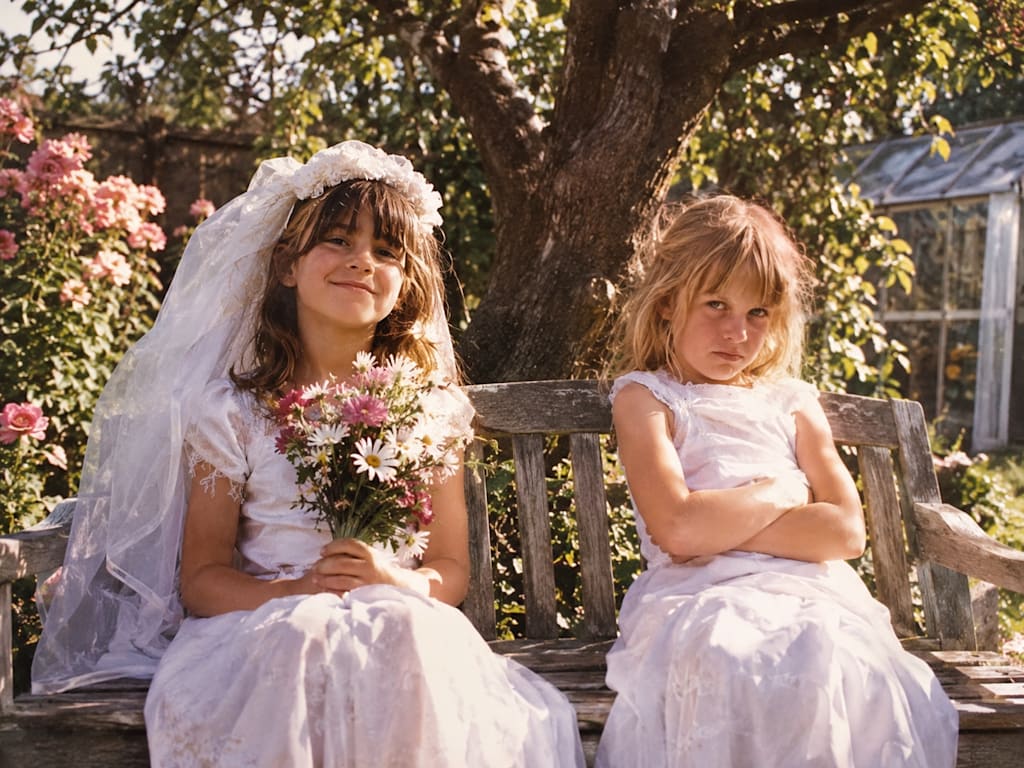
My sister Claire remembers the summer we nearly got married as the happiest three months of our childhood. I remember it as a period of sustained psychological warfare, conducted largely through felt-tip pens, stolen biscuits and a wedding dress made from a pillowcase.
We were nine and eleven, respectively, and the wedding was to take place in our grandmother’s garden, beneath an apple tree that had not produced edible fruit in years. Claire remembers that she was the bride, that I was her maid of honour, and that the entire family had been invited. I remember that I was the bride, that Claire was furious about this arrangement, and that the wedding was cancelled after she attempted to poison me with a glass of orange squash.
It is remarkable how much disagreement can be contained within a single afternoon.
The wedding, at least, is not in dispute. There are photographs. In one, Claire stands in the garden wearing a white pillowcase with two eyeholes cut into it, her hair arranged in a series of elaborate plaits. In another, I am holding a bunch of flowers that appear to have been stolen from our grandmother’s front garden. My expression is solemn. Claire’s is triumphant. We look like two children who have been left in charge of something important and have no intention of surrendering control.
The question of who was marrying whom remains unresolved.
Claire says the groom was a boy from school called Matthew, with whom she had been conducting a serious correspondence involving folded notes and an exchange of football stickers. I say the groom was imaginary, and that the wedding was intended to unite me with a character from a television programme. Claire says this is an invention designed to make me sound less ridiculous. I say that her version of events is based on a childhood misunderstanding of the word ‘marriage’.
Our mother, when consulted, remembers only that she had to wash the pillowcase afterwards.
This is how family history tends to work. The people who were there remember different things. The people who might have settled the argument are either uninterested or dead. The remaining witnesses become increasingly committed to their own versions, not necessarily because they believe them to be accurate, but because the stories have become part of their identities.
Claire has always been the better storyteller. She has a talent for taking an ordinary incident and giving it the structure of an anecdote, with a beginning, a middle and a punchline that usually involves me behaving badly. She remembers childhood as a sequence of comic injustices in which she was the patient elder sister and I was an unusually determined nuisance. I remember a childhood in which she was a self-appointed authority figure who routinely abused her position.
She remembers teaching me how to ride a bicycle. I remember her pushing me down a hill and shouting instructions as I went. She remembers lending me her favourite dress. I remember her refusing to let me wear it until I had promised not to breathe too heavily. She remembers that I followed her everywhere. I remember that she made me follow her everywhere, because she was incapable of doing anything without an audience.
It is possible that both accounts are true.
The wedding story has survived because it contains, in miniature, the entire structure of our relationship. Claire was always interested in ceremony. She liked rules, invitations, lists and the feeling that an event had been properly organised. Even as a child, she understood that the appearance of something was often as important as the thing itself. I was more interested in what happened when the rules were ignored.
Our grandmother’s garden was an ideal setting for this particular disagreement. It was a small, slightly untidy space, with a cracked birdbath, an old wooden bench and a greenhouse that smelled permanently of tomatoes. There were roses along the fence and a patch of grass that our grandmother insisted was a lawn, although it had more in common with a field. In the summer, the garden became the centre of family life. Women sat outside drinking tea. Children ran between the flowerbeds. Someone was always being told not to touch something.
It was Claire who proposed the wedding, although even this is disputed. She says the idea came to her while watching a programme about a royal wedding. I say she saw an opportunity to wear white without having to attend anyone else’s event. Either way, she took charge.
There was a guest list. There were flowers. There was a cake, which was actually a packet of iced buns arranged in a circle on a plate. There was an argument about music, because Claire wanted something classical and I wanted a song from the radio. There was also, according to Claire, a rehearsal.
I have no memory of a rehearsal.
She insists that we practised walking down the garden path several times, with our grandmother’s old umbrella serving as a ceremonial accessory. She remembers our mother laughing from the kitchen window. I remember our mother telling us to stop trampling the flowerbeds.
The most contentious issue concerns the dress.
Claire maintains that she made it herself, using an old pillowcase and a length of ribbon. She says she spent the entire morning cutting and sewing while I contributed nothing except criticism. I remember that the pillowcase belonged to me, that I found it already cut up, and that Claire refused to explain what she was doing with it.
The photographs suggest that Claire’s version is more likely. The pillowcase is clearly too large for me and fits her almost perfectly. But photographs are notoriously unreliable witnesses. They capture the final arrangement of things, not the negotiations that produced it.
There is another photograph, taken later that afternoon, which neither of us likes to discuss. It shows the two of us sitting on the garden bench, still dressed in our makeshift wedding clothes. Claire is looking directly at the camera. I am looking at her. There is something in my expression that resembles irritation, although Claire insists it is envy.
‘You were jealous,’ she told me recently.
‘Of what?’
‘Of the fact that I was getting married.’
‘To whom?’
‘Matthew.’
I laughed. She did not.
This is another feature of memory: the tendency for a joke to become less funny when it is repeated often enough. Claire has been telling the story for years, usually at family gatherings, where she describes me as the younger sister who attempted to steal her wedding. Everyone laughs. I laugh too, although I have never been entirely comfortable with the role I have been assigned.
There is a small but important difference between being remembered as a difficult child and being remembered as a jealous one. The first is a description of behaviour. The second is a theory about character.
For years, I accepted Claire’s version because it was easier. She was older, more articulate and considerably more persuasive. She could remember details I had forgotten and introduce new ones with such confidence that I sometimes wondered whether I had been present at my own childhood. When she told the story, I became the girl who wanted what her sister had. It was a neat explanation, and neat explanations are difficult to resist.
But when we were both in our thirties, something changed.
We were visiting our grandmother, who had moved into a smaller house and was preparing to give away some of her belongings. She had kept the photographs from our childhood in a biscuit tin, along with old birthday cards, school reports and several things that were probably supposed to have been thrown away decades earlier.
Among them was a folded piece of paper.
It was a list, written in Claire’s handwriting, with the title ‘Wedding’. Beneath it were the names of the people invited, a rough schedule and a list of things still required. The final item read: ‘Find someone for me to marry.’
I showed it to her.
She stared at the paper for a long time before laughing.
‘Well,’ she said. ‘That proves I was the bride.’
It did, in fact, prove very little. The list established that Claire had organised the event, but not that I had been her maid of honour, or that the groom was Matthew, or that I had attempted to sabotage the occasion.
Then I noticed something written at the bottom, in my own handwriting.
‘Wedding cancelled. Bride is horrible.’
Claire read it and burst out laughing.
‘You see?’ she said. ‘You were jealous.’
But there was another sentence, written in pencil beneath mine, which had been almost entirely rubbed away. I could just make out the words: ‘Bride must let her sister…’
The rest was illegible.
We spent the next twenty minutes trying to decipher it. Claire thought it said ‘be the princess’. I thought it said ‘have the flowers’. Our grandmother, who was sitting nearby, looked at the paper and said that she remembered the wedding very well.
We turned to her.
‘Your grandfather was supposed to marry you,’ she said.
We both laughed.
She did not.
Apparently, the wedding had been organised because our grandfather had made a joke about marrying Claire when she grew up. Claire had taken him seriously, or at least seriously enough to create an entire event around the idea. I had been involved because I wanted to be included, and the argument had started when Claire refused to let me stand beside her in the photographs.
Our grandmother remembered that I had become upset and that Claire had eventually given in. She remembered the orange squash, too, but insisted there had been nothing wrong with it. I had simply refused to drink it because I was angry.
Claire looked at me.
‘You told everyone I tried to poison you.’
‘I was nine.’
‘You were dramatic.’
‘You cut up my pillowcase.’
‘It was for the wedding.’
‘It was my pillowcase.’
Our grandmother shook her head and went back to sorting the photographs.
There was something unexpectedly moving about discovering that the story had been built around a misunderstanding of such modest proportions. We had not been fighting over a boy, or a dress, or even the right to be the bride. We had been fighting over a place in a photograph. Claire wanted to be the centre of attention. I wanted to stand beside her. Neither of us had the vocabulary to explain this, so we had done what children do: we had turned a small disappointment into a dispute of international significance.
The discovery did not settle the argument. In some ways, it made things worse.
Claire now maintains that I had been jealous because she was the bride. I maintain that she had been selfish because she wanted to be the only important person in the garden. Our grandmother’s recollection suggests that we were both partly right and partly wrong. The original event, which must have been perfectly clear to the people experiencing it, has dissolved into a collection of competing interpretations.
I have thought about this more than I expected to.
There is a temptation, when we revisit childhood, to imagine that we are recovering something. We look at old photographs, read old letters and ask the people who were there what happened. We assume that if we gather enough evidence, the past will eventually reveal itself in its original form.
But perhaps this is not how memory works. Perhaps the past is less like a room we can return to and more like a house that has been renovated several times without our knowledge. We remember the staircase, but not who moved the walls. We remember the garden, but not who planted the roses. We remember the people, but not always the versions of ourselves that they were standing beside.
Claire and I still tell the wedding story. She tells it at Christmas, usually when someone mentions our grandmother or asks whether we were close as children. She describes the pillowcase, the flowers and my alleged attempt to sabotage her special day. I usually interrupt to point out that the groom was our grandfather, which makes the whole thing considerably less romantic.
She says I am ruining the story.
I say she has been ruining it for thirty years.
Recently, she sent me a photograph of the two of us in the garden. It was the one taken on the bench. She had scanned it and enlarged it, and there we were: two little girls in their ridiculous clothes, sitting side by side beneath the apple tree. Claire looked pleased with herself. I looked as though I was considering my options.
Beneath the photograph, she had written: ‘The happiest day of my life.’
I sent back: ‘You were marrying Grandad.’
She replied with a laughing face.
Then, a few minutes later, she sent another message.
‘You know, I think you were supposed to be my bridesmaid.’
I looked at the photograph again.
Perhaps she was right. Perhaps I had been the bridesmaid all along. Perhaps I had been the bride, and she had simply taken over. Perhaps neither of us had understood the arrangement, which would be consistent with almost everything else we had done together as children.
I did not correct her.
The truth, if there is one, is probably written somewhere in that biscuit tin, between the faded birthday cards and the photographs of people whose names we can no longer remember. But I have stopped looking for it. The story belongs to both of us now, and it has become something more interesting than the original event.
Claire remembers a wedding. I remember a conspiracy. Our grandmother remembered two little girls who wanted to be loved equally and had found an elaborate way of making this everyone else’s problem.
We were all, in our own way, telling the truth.
And perhaps that is what I like most about the story now. Not that we have finally established what happened, but that we have discovered how much of our relationship was already there, in that small garden, beneath the apple tree.
Claire still insists she was the bride.
I still insist she was unbearable.
And somewhere between those two accounts, I suspect, is the memory we actually shared.
About the Creator
Tabby
Hello,
I am a singer-songwriter/creative from London. I am currently saving money to record my debut EP. I love telling stories through writing, acting, or song.
Enjoyed the story? Support the Creator.
Subscribe for free to receive all their stories in your feed. You could also become a paid subscriber, letting them know you appreciate their work.
Comments
There are no comments for this story
Be the first to respond and start the conversation.