

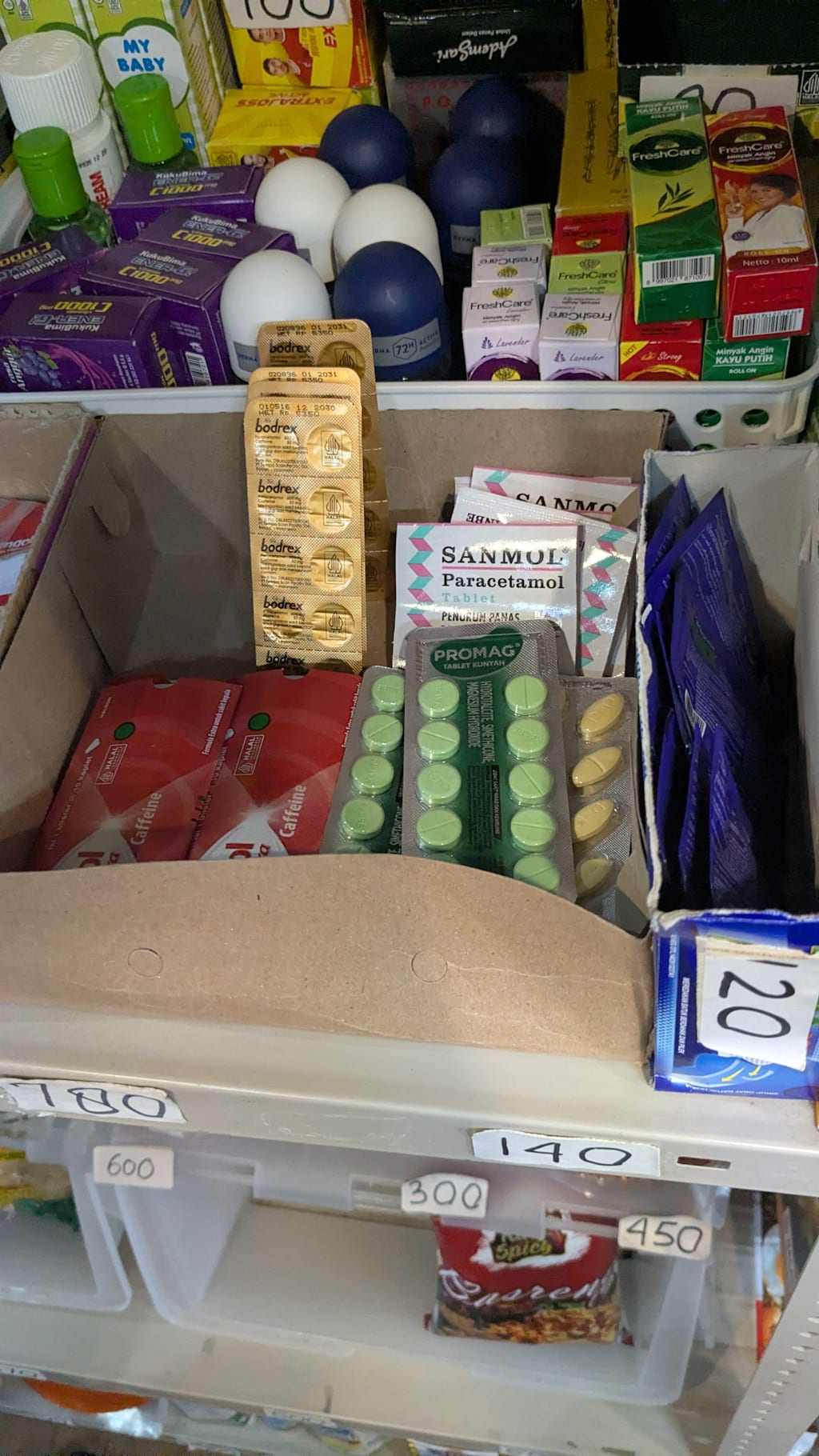
I found it on a Tuesday, tucked between a coin laundry and a bicycle repair shop in a corner of Osaka most tourists never walk through. A small toko Indonesia, no bigger than a convenience store aisle, run by a family who had been here longer than I had. I hadn't gone looking for it. I had gone looking for basil leaves for a soup that wasn't going to taste right no matter what I did, and instead I found a shelf that stopped me completely.
It was a medicine shelf. Nothing dramatic — plastic bins stacked on a metal rack, hand-written price tags in black marker, cardboard dividers that had clearly been cut and folded by hand more than once. But the labels were the ones I grew up reading. Bodrex, in its familiar gold blister packs. Sanmol, the paracetamol my mother kept in a kitchen drawer next to the rice cooker. Promag, green and chalky and exactly the shape I remembered pressing out of foil as a teenager with a stomach that couldn't handle spicy food two days in a row. Little bottles of Kayu Putih oil with the same worn-looking green caps. FreshCare roll-ons in lavender and menthol. KukuBima Ener-G in its purple box, the same one my father drank before long drives.
I stood there longer than I needed to. A man doing genba work doesn't usually have the luxury of standing still in the middle of a Tuesday, but for a few minutes I let myself do exactly that, reading price tags the way other people read old letters.
There's a specific kind of loneliness that comes with living far from home, and it isn't always the big, cinematic kind. It isn't always missing a wedding or a funeral or a birthday. Sometimes it's smaller and stranger than that. Sometimes it's not being able to find the right medicine when your head hurts, and having to describe symptoms in a language that isn't yours to a pharmacist who is trying their best but doesn't quite understand what you mean by "masuk angin" — that particularly Indonesian ailment that doesn't translate cleanly into "catching a cold" or "wind entering the body," because it's neither and both at once. You just know it when you feel it: the heaviness, the need for warmth, the instinct to reach for kerokan oil and a hot bath.
Standing in front of that shelf, I realized how much quiet negotiation goes into living abroad. You learn to substitute. You learn that ibuprofen from the drugstore down the street will do, mostly, even if it isn't Bodrex. You learn to read kanji on medicine boxes slowly, sounding out characters like a child learning to read again at thirty-something. You build a version of home care out of whatever the new country offers, and most days it's enough. But every so often you're reminded of what "enough" cost you to build.
That's what the shelf gave back to me, in a strange way. Not just the products themselves, though I did buy a strip of Bodrex and two sachets of Sanmol, more out of comfort than necessity. What it gave back was the permission to feel homesick without apologizing for it. Migrant life asks a lot of quiet toughness from you. You're expected to adapt, to integrate, to not complain too loudly about the things you miss, because you chose this, because the money you send home matters more than the ache of missing your mother's medicine cabinet. And most of the time, that toughness is fine. It's necessary. But it was strangely emotional to stand in a cramped aisle in Osaka and realize that someone else — some other family who left Indonesia before I did — had built a small outpost of home specifically so people like me wouldn't have to carry that ache alone.
I didn't need the medicine that day. My head didn't hurt, my stomach was fine, I wasn't sick. What I needed, it turned out, was just to see it all lined up like that — proof that somewhere in this enormous, efficient, sometimes overwhelming city, there was a shelf that understood exactly what I meant by masuk angin without me having to explain it at all.
I left with a small paper bag and an oddly full heart, walked past the coin laundry and the bicycle shop, and went home to finish the soup. It still didn't taste quite right. But that was fine. Some things you don't fix. You just sit with them, the way you sit with a shelf full of familiar boxes in an unfamiliar city, and let them remind you that home isn't a place you left behind so much as something you keep quietly rebuilding, one small purple box of KukuBima at a time.
About the Creator
Enjoyed the story? Support the Creator.
Subscribe for free to receive all their stories in your feed.
Comments
There are no comments for this story
Be the first to respond and start the conversation.