
The Salem Witch Trials
What Happens When Everyone Decides You’re Guilty?


The Salem Witch Trials were not only about witches. They were about what happens when fear becomes evidence and accusation becomes truth.
In 1692, something strange began happening in Salem Village, Massachusetts.
Several young girls started experiencing frightening fits. They screamed. and shook. They complained of strange sensations. Some claimed they were being attacked by some invisible forces.
The community wanted an explanation for these and, they found one.
Witchcraft!
Once the idea took hold, accusations began spreading.
One person accused another. Then another person was named. Then another.
Soon, being accused of witchcraft could put your life in danger.
But, here is where the story becomes even more disturbing:
Imagine being accused of something you didn’t do.
You stand before your community and say:
“I am innocent.”
But nobody believes you.
You try your best to explain yourself.
They interpret your explanation as a big fat lie.
You become really angry and they see your anger as evidence of guilt.
You become frightened.
They see your fear as suspicious.
You insist that you have done nothing wrong and somehow, your refusal to confess becomes another reason to condemn you completely.
This was Salem. Yes, this was Salem!
It should make us uncomfortable because the psychology behind it isn't as ancient as we like to believe.
It should make us very uncomfortable because the psychology behind it isn’t as ancient as we would like to believe.
One of the most dangerous things humanity has been doing so far is, confusing repetition with truth. This is sad.
An accusation can become a fact as follows;
Someone says something about you.
Another person repeats it.
A third person says, “I’ve heard that too.”
Soon, nobody remembers where the story began at all.
However, everybody believes it.
This often happens because our minds use other people’s reactions as shortcuts for deciding what is true or untrue.
“If so many people believe it, there must be something to it.”
But there doesn’t have to be, simply put.
Sometimes, there is simply one rumor that became very popular.
The Salem witch trials show us exactly what can happen when a community stops demanding evidence and starts rewarding accusation.
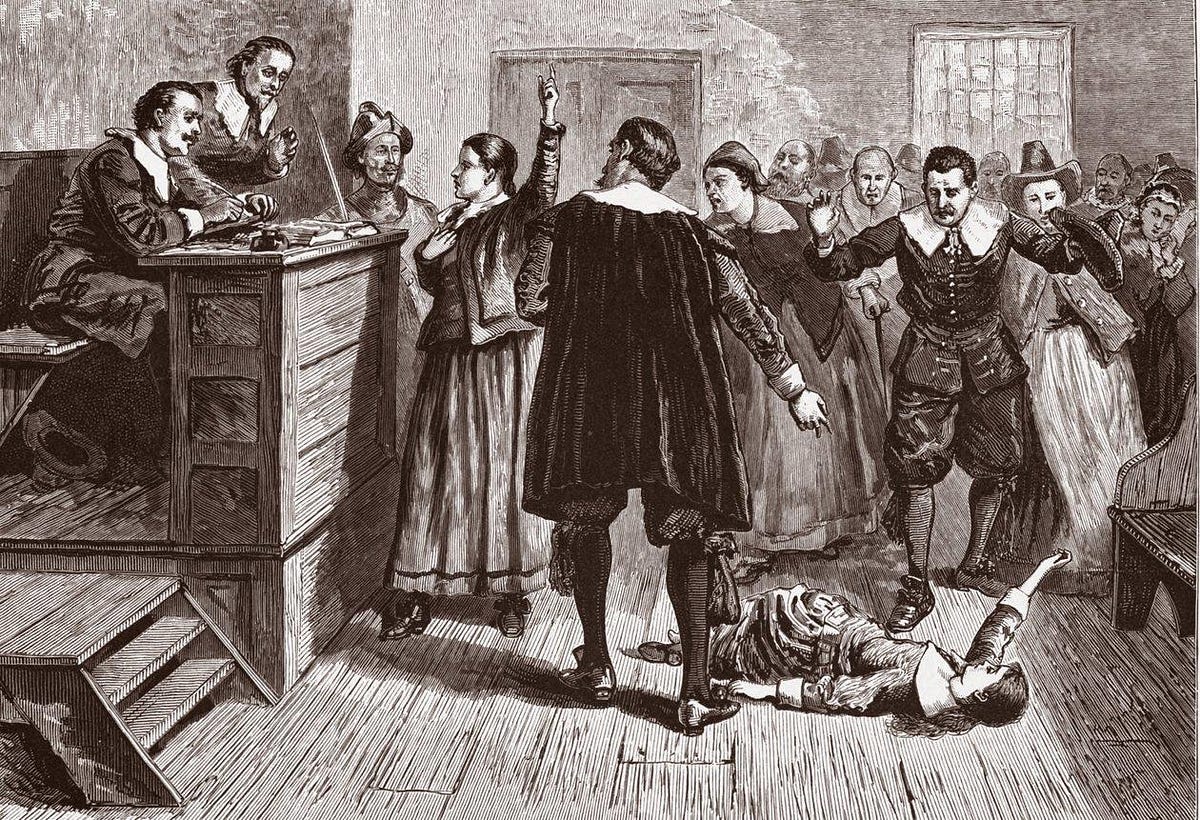
During the trials, authorities accepted forms of evidence that today would be considered deeply unreliable. One particularly troubling example was “spectral evidence” – claims that someone’s spirit or apparition had appeared to or attacked another person.
The result was very devastating.
People were imprisoned.
Families were destroyed.
Nineteen people were executed by hanging.
Giles Corey, who refused to enter a plea, was pressed to death.
And, the accusations kept spreading.
The incentive to accuse someone else was very terrifying.
Perhaps the most disturbing part of the story is what happened to some of the accused people who confessed.
In certain circumstances, confessing and accusing others could improve your chances of survival.
Think about that for a moment.
If you are accused of being a witch, you can say:
“I didn’t do it.”
Or you can say:
“Yes. I did it. And so did she.”
The second answer could be safer.
Suddenly, accusing someone else became a survival strategy.
That is how fear can create a machine that feeds itself in a society.
One accusation produces another.
The second accusation makes the first accusation look more credible.
The growing number of accusations convinces everyone that something terrible must really be happening.
Then, the number of accusations becomes the evidence for the accusations.
It is a perfect circle and a very dangerous one to say the least.
We still build smaller versions of Salem in present day society.
Most of us will never live through anything resembling the Salem witch trials.
But we don’t really need to.
The same human tendencies can appear in much smaller and quieter ways.
Think about the workplace where someone gets labeled “difficult.”
Maybe they questioned a decision and then someone tells another colleague, “She’s always very difficult.”
Soon enough, other people approach every interaction with that person expecting difficulty.
The person notices the coldness and becomes defensive.
Now everyone says:
“See? That’s exactly what we’re talking about.”
The label created the behavior everyone then uses to justify the label.
Or think about relationships.
Someone tells a friend:
“Your partner doesn’t really respect you.”
Maybe it was just a very simple misunderstanding.
Maybe they are projecting their own experience or they simply don’t like the person at all.
However, once the idea is planted, every disagreement can become and be treated as evidence.
“He didn’t call you back.”
“See?”
“He disagreed with you.”
“See?”
“He seems distant today.”
“See?”
The story starts interpreting reality instead of reality determining the story.
The truth is, we’re often in the prison of other people’s opinions.

I’ve become increasingly fascinated by how much of our lives can be shaped by things people think about us.
Someone can misunderstand you, dislike you, create an inaccurate impression of you and tell a story about you that isn’t true.
Sometimes, no amount of explaining will change their mind.
That realization can be very painful but, it can also be freeing.
The reason is, you eventually have to ask yourself:
How much of my life am I willing to spend defending myself against someone else’s version of me?
There is a difference between correcting an important misunderstanding and desperately trying to control everyone’s perception of you.
The first can be wise, the second can become exhausting.
You can explain yourself perfectly and still be misunderstood.
You can be kind and still be called selfish.
You can be honest and still be called a liar.
You can walk away from an argument and be called weak.
You can stand up for yourself and be called arrogant.
You can change and still be judged by who you used to be.
At some point, you have to accept this uncomfortable truth:
People are allowed to have opinions about you that are completely wrong.
The crowd isn’t always right
One of the great lessons of Salem is that a large number of people agreeing with one another does not automatically make them correct.
Ten people can repeat a lie, a hundred people can believe it, a thousand people can share it.
It is still a lie.
Popularity is not evidence.
Consensus is not always truth and confidence is certainly not proof.
History is full of moments when societies passionately believed things that later generations recognized as deeply wrong.
That doesn’t mean we should distrust everyone, no.
It means we should have the courage to ask questions such as;
What is the evidence?
Who started this story?
What would prove it wrong?
Have we actually heard the other side?
Are we looking for truth or simply looking for someone to blame?
These questions can save us from something even more bigger than historical disasters.
They can save relationships, careers, reputations, families and sometimes even our own peace of mind.
Be careful when the crowd finds a villain
There is something emotionally satisfying about finding someone to blame but does that solve the real problems? No!
If something goes wrong, we want an explanation.
If a team fails, we want to know who caused it.
If a relationship collapses, we want to know who was wrong.
If something frightening happens in society, we want someone responsible.
A villain always gives chaos a face but sometimes, the villain is imaginary.
Sometimes, the situation is far more complicated than we know.
Sometimes, everyone contributed something.
Sometimes, nobody fully understands what happened and sometimes, we simply don’t know.
As humans, we need to realize that; “I don’t know” is a much harder answer to live with than “It’s their fault.”
It is often the more honest one, yes.
The Salem witch trials ended centuries ago but the lesson hasn’t expired.
Before you believe a story about someone, pause.
Before you repeat an accusation, pause.
Before you join a crowd that has decided someone is guilty, please, pause.
Stop for a while and ask yourself whether you actually know what happened.
Once a person becomes the villain in everyone’s story, it becomes surprisingly difficult for them to become human again.
People stop seeing the individual.
They see the label; the witch, the liar, the difficult employee, the selfish friend, the bad parent, the arrogant person and the failure.
Once the label becomes stronger than the person, evidence doesn’t matter anymore.
The real danger is not the witches, ghosts or even Salem.
It is what human beings can do when fear, certainty, and groupthink become more powerful than real evidence.
Perhaps the question we should carry with us from Salem is a simple one:
Are we searching for the truth or are we simply looking for someone to blame?
About the Creator
Ajan Lori A.
My mind screams, I write!
(Author exploring education, identity, human behavior, life between cultures, business and entrepreneurship)
Find my writing on Medium: https://medium.com/@loriaa
My books on amazon: amazon.com/author/loriaa
Enjoyed the story? Support the Creator.
Subscribe for free to receive all their stories in your feed. You could also become a paid subscriber, letting them know you appreciate their work.
Comments
There are no comments for this story
Be the first to respond and start the conversation.