
The Problem With Drawing Humanity
A reflection on identity, symbolism, and the challenge of representing 249 nations within a single vision of humanity.
Human beings have spent thousands of years trying to understand themselves.
We have written histories, built monuments, created religions, drawn maps, and developed entire systems of philosophy in pursuit of a surprisingly simple question:
Who are we?
The challenge is that humanity is almost impossible to see in its entirety.
We experience the world through fragments.
A family.
A city.
A nation.
A language.
A culture.
Even our understanding of history is usually local. We inherit stories from the communities around us and gradually build an image of reality from those pieces.
Yet somewhere beyond these individual perspectives exists something larger—a collective human story that belongs to all of us.
The difficulty is finding a way to visualize it.
Imagine trying to create a portrait of humanity.
Where would you begin?
Would you start with geography?
Culture?
Language?
Religion?
History?
Every choice immediately excludes something else.
Any attempt to reduce humanity to a single image quickly encounters a problem: humanity is too diverse to fit comfortably inside one symbol.
And yet, there remains a powerful desire to try.
Perhaps this is why civilizations have always created monuments.
Monuments are not merely objects. They are attempts to make ideas visible.
Some commemorate victories.
Others preserve memory.
The most ambitious attempt to capture something larger than a single lifetime.
In many ways, the challenge of representing humanity is monumental in exactly this sense.
It requires thinking beyond individual identities without erasing them.
It requires acknowledging difference while searching for connection.
This is where symbolic systems become interesting.
A single symbol can only communicate so much. A system of symbols, however, can contain relationships. It can reveal patterns. It can suggest how seemingly separate elements belong to a larger structure.
Consider the world itself.
At first glance, nations appear divided by borders, languages, histories, and political interests. Yet beneath those distinctions lies a remarkable reality.
Every society asks similar questions.
How should we live?
What should we value?
What do we owe future generations?
What does it mean to belong?
Different cultures may answer these questions differently, but the questions themselves are universal.
Perhaps humanity is less a collection of separate stories than a conversation unfolding across centuries and continents.
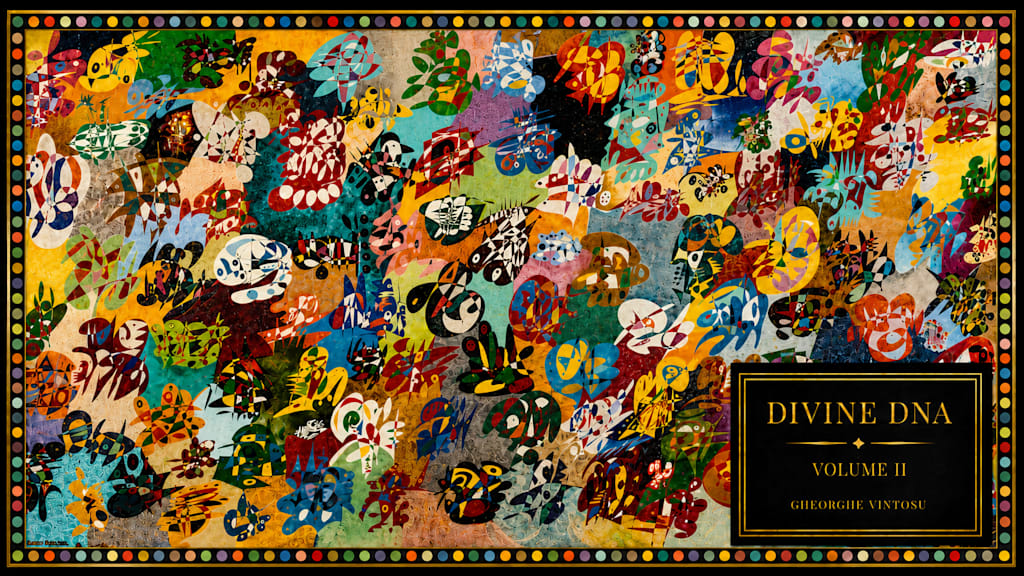
This perspective inspired the concept behind Divine DNA, a monumental artistic project incorporating references to the 249 nations and territories recognized at the time of its completion.
The project approaches humanity not as a political map but as a symbolic structure. Each nation becomes a component within a larger visual system, contributing its own identity while participating in something greater than itself.
The idea is compelling because it mirrors a truth often overlooked.
Individual identities do not disappear when they become part of a larger whole.
A cell remains a cell within a living organism.
A note remains a note within a symphony.
A nation remains a nation within humanity.
The relationship is not one of replacement but participation.
Seen this way, diversity and unity are not opposing forces. They are dependent on one another.
The number 249 therefore becomes more than a statistic.
It becomes a reminder.
A reminder that humanity is not singular.
It is a vast network of histories, beliefs, achievements, failures, languages, memories, and aspirations that continue to interact and evolve.
No single image can fully contain such complexity.
Perhaps no artwork can.
Yet the attempt itself remains valuable.
Because every effort to visualize humanity forces us to confront the same realization:
We are different in countless ways.
But we are participating in the same story.
For readers interested in the symbolic framework and research behind Divine DNA, the publication Divine DNA Volume II explores the project in greater depth.
At a time when division often dominates public conversation, perhaps the more interesting question is not what separates us.
Perhaps it is whether humanity can learn to see itself as a whole without losing sight of its many parts.
About the Creator
Daniel Varzari
American art curator.
Enjoyed the story? Support the Creator.
Subscribe for free to receive all their stories in your feed.
Comments
There are no comments for this story
Be the first to respond and start the conversation.