
The People We Walk Past
Why listening, sharing, and treating people with dignity may be just as important as any policy in helping those who have fallen through the cracks.

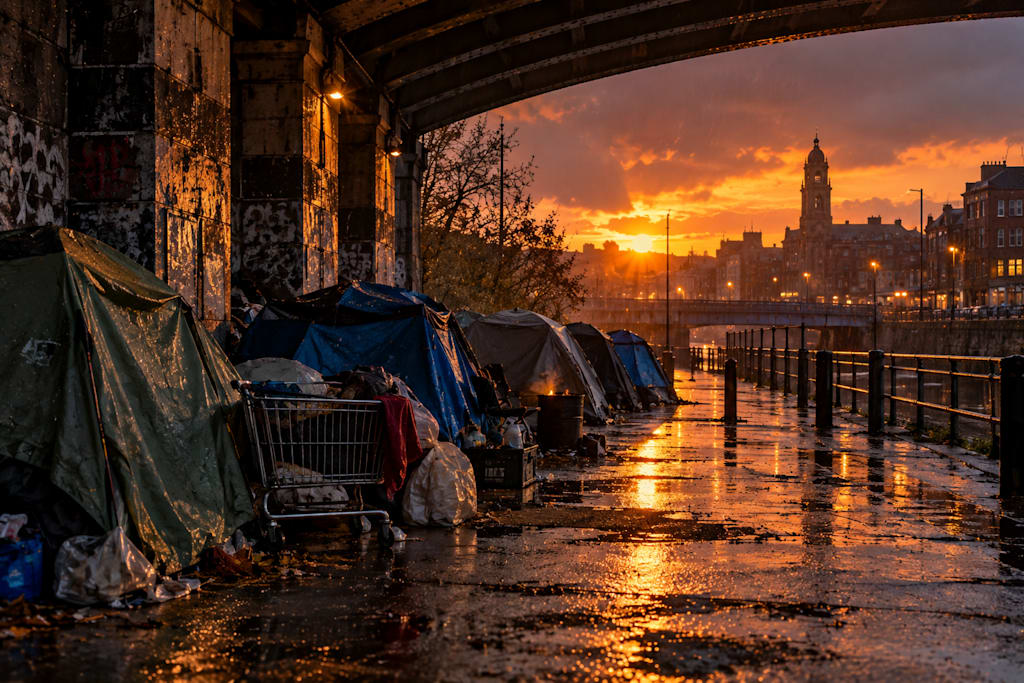
Every time I walk through a town or city, I notice people that most others walk straight past. Some are sitting on benches, some are sheltering in doorways, and some are carrying everything they own in a rucksack or a torn shopping bag. Most people see a homeless person. I see a person first.
Over the years, I’ve stopped and chatted with quite a few homeless men and women. I’m not a social worker, and I don’t claim to be an expert on homelessness. I simply believe that everyone has a story worth hearing if someone is willing to listen.
As both an author and a journalist, listening to people is part of what I do. But it goes beyond that. I've always been genuinely interested in people's lives, their experiences, and the things they've been through.
Many of those stories are hard to hear. Some people lost their homes after losing a job, while others struggled with illness, family breakdowns, or addiction. In many cases, several problems came crashing down at the same time, turning a difficult situation into a crisis.
One thing I’ve learned is that homelessness rarely comes down to a single mistake. Life is usually far more complicated than that. A series of setbacks, bad luck, poor timing, or personal struggles can gradually push someone into a place they never imagined they would end up.
People sometimes ask me why I talk to homeless people who are battling drug addiction. The answer is fairly simple. Addiction is something a person lives with, but it is never the whole of who they are.
Behind every addiction is a human being with a past. Sometimes there is trauma, sometimes grief, and sometimes years of disappointment and loneliness. I don’t pretend to have all the answers, but I do believe that listening is a good place to start.
Many homeless people spend their days feeling invisible. People avoid eye contact, cross the street, or act as though they aren’t there at all. After a while, being ignored can hurt just as much as being poor.
That’s why a conversation can matter more than many people realise. Sometimes I simply listen to whatever someone wants to talk about. Sometimes I try to encourage someone who feels they’ve reached the end of the road, and sometimes I help them think through a problem they’re facing right now.
Not every problem can be solved. Not every story has a happy ending. Even so, small acts of kindness can make a difference in someone’s day.
There have been occasions when I’ve allowed homeless people to stay overnight at my home when the weather was particularly harsh and there were few alternatives available. I’ve helped people wash their clothes and use my bathroom so they could shower, shave, and feel comfortable in their own skin again. These things might seem ordinary to most of us, yet they can mean the world to someone who has been sleeping rough.
A clean shirt doesn’t solve homelessness. A hot shower doesn’t magically provide permanent housing. However, these simple things can restore confidence and dignity, and they can help someone approach employers, landlords, or support services feeling more like themselves.
Another encounter took place outside a nightclub in Barnsley. I was standing outside having a cigarette with two mates when a homeless man approached me. He looked slightly embarrassed and asked whether I could exchange some euro coins for British pounds.
At first, I was a bit surprised by the request. Then he showed me a handful of euro coins that people had given him throughout the evening. For someone living on the streets of South Yorkshire, those coins were practically useless because local shops and businesses wouldn’t accept them.
I didn’t need long to think about it. I reached into my pocket and handed over all the British coins I had on me. Since I usually pay by card, the change wasn’t doing much for me anyway, and he handed me the euros in return. To be honest, he came out of the deal far better than I did. The exchange rate certainly wasn’t accurate, and he probably received something close to a one-for-one swap. I was perfectly happy with that because he was the one who actually needed the money.
What stayed with me afterwards was the reason he had all those euro coins in the first place. I’ve never understood why some people think it’s amusing to give homeless people money they can’t actually spend. Some may see it as a joke, while others might simply want to get rid of spare holiday change without thinking about whether it’s useful.
Whatever the reason, the result is often the same. The person receiving the coins is left holding something that offers very little practical help. For someone already struggling to get by, it can feel like yet another reminder that some people see them as a nuisance rather than as a fellow human being.
Sadly, this sort of thing is part of the reality many homeless people face. They are often exposed to ridicule, insults, and behaviour they have very little power to challenge. Experiences like this have reinforced my belief that kindness should be practical and based on what people actually need.
One experience during the Covid pandemic remains especially vivid in my memory. I met a young street musician and his seriously ill girlfriend, both of whom were struggling to survive during an exceptionally difficult period. Before the pandemic, he earned enough through busking to pay for nights in a shelter and keep a roof over their heads when needed.
When the lockdowns arrived, the city centres became quieter and the crowds disappeared. As a result, his income virtually vanished overnight. Suddenly, two people who had just about managed to get by found themselves facing the possibility of sleeping outside.
We started talking, and I bought them a meal. As we sat together, they told me about their worries and the uncertainty they were facing. By the end of the conversation, I decided to pay for two nights of accommodation for them.
Ironically, the money came from government Covid support that I had received. While I was fortunate enough to be financially secure, a street musician who worked hard for his living was struggling to find somewhere safe to sleep. Helping them felt like the right thing to do.
One reason I feel so strongly about this issue is that homelessness is not an abstract social problem. It is a matter of life and death.
For most people in Hamburg, the winter of 2025/2026 was simply a season of snow, icy roads, and freezing mornings. People complained about slippery pavements, delayed trains, and scraping ice from their car windscreens before work. For those sleeping rough, however, the same winter became a daily struggle for survival.
Week after week, heavy snowfall, bitter temperatures, and biting winds turned the city's streets, parks, and railway stations into dangerous places to spend the night. Every cold evening brought another challenge, and every freezing morning was another day that someone had managed to survive.
By the end of January, at least 18 homeless people had already lost their lives. By the end of March, that number had risen to 47 deaths among homeless and rough sleeping people. Behind every statistic was a human being with a story, a past, hopes, disappointments, and people who cared about them.
Hamburg did not simply ignore the crisis. During the coldest periods, the city booked hotel rooms and required participating hotels to take in homeless people who would otherwise have remained on the streets. Emergency shelters expanded their capacity, while outreach teams worked throughout the winter helping people find somewhere warm and safe to stay.
Many ordinary Hamburg residents stepped up as well. People donated warm clothing, blankets, sleeping bags, food, and hot drinks. Volunteers spent countless hours supporting those who needed help most, often without recognition or publicity.
Their actions demonstrated something important. They showed that compassion is not limited to governments, charities, or official organisations. Ordinary people can make an extraordinary difference when they choose to act.
Despite all these efforts, the winter still claimed dozens of lives. The harsh weather served as a painful reminder of how dangerous life becomes when someone has no secure place to call home. A warm room, a hot meal, or a dry bed may seem ordinary to most of us, yet for others they can mean the difference between life and death.
Now another winter is drawing closer. The snow will return. The freezing temperatures will return. The question is whether more lives can be protected before they do.
That question does not belong only to politicians, councils, charities, or outreach workers. It belongs to all of us. Every blanket donated, every warm meal shared, every conversation held without judgement, and every act of kindness has the potential to help someone survive another day.
As a writer, I’ve also tried to support social causes through my work. Over the years, my stories and poems have appeared in anthologies that raised money for charitable projects. I believe literature can do more than entertain because stories have the power to raise awareness and encourage people to take action.
Homelessness exists in every modern society. People still fall through the cracks, even when support systems are available. No government, charity, or institution will ever be able to solve every problem for every person. I don’t blame politicians for every individual tragedy. Governing a country means balancing countless interests, priorities, and competing needs. No system will ever be perfect, which is exactly why personal responsibility remains so important.
The question isn’t only what governments should do. The question is also what we should do as individuals and as communities. Each of us has the ability to make someone’s life a little easier, even if only for a short time.
The answer will be different for everyone. Some people can donate money, while others can give their time. Some can offer practical support, and others can simply listen without judgement.
Every act of kindness matters. Every act has value, no matter how small it may seem. We don’t need to save the world on our own in order to make a difference.
We simply need to remember that the people we pass in the street are people. They have lives, memories, fears, hopes, and stories just like the rest of us. Sometimes the first step towards helping is as simple as stopping for a moment and asking a question.
“How are you doing today?”
Thank you so much for reading! If you enjoyed this content, don’t forget to subscribe to my channel for more. Your support—whether through tips, pledges, or simply hitting that subscribe button—directly fuels my growth and helps bring exciting new projects to life. Join me on this journey and be part of something special!
About the Creator
Christian Bass
I am a German author and storyteller, publishing since 1999. I write horror, social mystery, supernatural fiction, literary drama, and children's stories, often exploring identity, loss, folklore, and the human condition.
Enjoyed the story? Support the Creator.
Subscribe for free to receive all their stories in your feed.
Comments
There are no comments for this story
Be the first to respond and start the conversation.