
The Night the Hospital Almost Stopped
A meaningful story about the people quietly working behind modern healthcare systems.

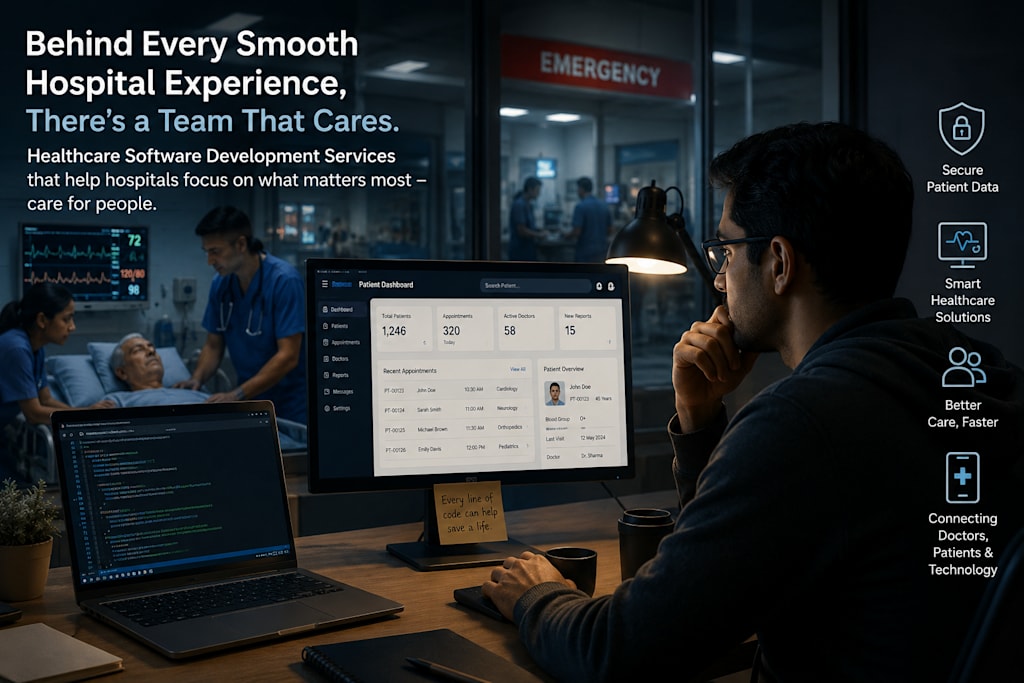
Rohan had not slept properly in three days.
The coffee beside his laptop had gone cold hours ago, but he did not notice. His eyes stayed fixed on the screen while lines of code moved in front of him.
Outside the office window, the city was quiet. It was nearly 2 a.m.
Most people were sleeping.
But inside a small healthcare software company, the lights were still on.
Because somewhere across the country, a hospital was struggling.
And if the software failed tonight, real people could suffer tomorrow morning.
Rohan leaned back in his chair and rubbed his tired eyes.
“How bad is it?” his manager asked softly.
Rohan looked at the monitor again.
“The patient records are loading too slowly,” he said. “Doctors are waiting too long to access reports.”
The room became silent.
For many businesses, a slow system means frustration.
For hospitals, it can mean something far more serious.
A delayed report.
A missed allergy warning.
A doctor losing precious minutes during an emergency.
That was the part most people never understood about Healthcare Software Development Services.
People think it is just coding.
But sometimes it feels closer to protecting lives.
Rohan joined the company four years earlier because he loved technology. Back then, he imagined building beautiful apps and smart dashboards.
He never expected the work to become emotional.
But healthcare changes people.
Especially after you begin hearing real stories.
Stories from tired nurses.
Stories from worried families.
Stories from doctors trying their best while hospitals become more crowded every year.
Rohan remembered one conversation clearly.
A few months earlier, his team visited a hospital to understand how staff members used their software.
Near the emergency room, he met a nurse named Kavita.
She looked exhausted.
Dark circles rested under her eyes, and her hands moved quickly between patients and paperwork.
Still, she smiled politely.
“You people made the new system, right?” she asked.
Rohan nodded nervously.
Kavita pointed toward a computer.
“Before this software,” she said, “we spent so much time searching through files. Sometimes patients waited while we looked for reports.”
She paused for a moment.
“Now we find information in seconds. It gives us more time to actually care for people.”
Those words stayed with him.
More time to care for people.
Not better profits.
Not bigger numbers.
Just more human time.
That night in the office, Rohan thought about Kavita again.
He opened another system log.
The issue was becoming worse.
Hospitals from different cities were sending complaints.
Doctors could not access patient histories quickly.
The support team’s phones would not stop ringing.
His manager stood beside him quietly.
“Can we fix it before morning?” she asked.
Rohan looked around the office.
Half the team was still awake.
One developer was checking server traffic.
Another was testing emergency backups.
Someone else was calling hospital administrators.
Nobody complained.
Nobody talked about overtime.
Because everyone in the room understood something important:
When healthcare systems stop working, hospitals do not simply lose data.
People lose confidence.
Patients become anxious.
Doctors become slower.
Nurses become overwhelmed.
And sometimes, small delays create big consequences.
Around 3:30 a.m., Rohan finally found the problem.
A database update had overloaded one part of the system.
His fingers moved quickly across the keyboard.
The team tested the fix once.
Then twice.
Then again.
Finally, the loading time improved.
Five seconds.
Three seconds.
One second.
The room became still.
Everyone stared at the screen.
Then the first hospital confirmation arrived.
“System working normally.”
Another message appeared seconds later.
Then another.
Someone in the office quietly clapped.
Another person laughed with relief.
Rohan closed his eyes for a moment.
For the first time all night, he breathed properly.
The next morning, while driving home, he stopped near a small tea stall.
The city was waking up.
Children waited for school buses.
Shopkeepers opened shutters.
Hospitals were already busy again.
Rohan held a warm cup of tea in his hands and suddenly thought about how strange life can be.
Most patients entering hospitals that morning would never know his name.
They would never see the developers behind the software.
They would never know how many people stayed awake all night to make sure their reports loaded correctly.
And honestly, that was okay.
Because Healthcare Software Development Services are not really about recognition.
They are about responsibility.
About building systems people can trust during difficult moments.
About helping doctors focus on patients instead of paperwork.
About helping nurses feel less overwhelmed.
About helping families receive answers faster when they are scared.
Rohan once believed technology was only about innovation.
Now he understood something deeper.
The best technology quietly helps people during the worst days of their lives.
Years later, Rohan still worked in healthcare software.
The projects became larger.
The systems became smarter.
Artificial intelligence entered hospitals.
Remote patient monitoring became common.
Online consultations became normal.
But one thing never changed.
Every time his team launched a new healthcare platform, he remembered that long night in the office.
The silence.
The pressure.
The tired faces.
The relief when the hospital systems finally recovered.
And every single time, he asked himself the same question:
“Will this help real people when they need it most?”
Because behind every healthcare app is a patient waiting for answers.
Behind every hospital dashboard is a doctor making difficult decisions.
And behind every successful healthcare system is a team of ordinary people quietly working to make care a little more human.
About the Creator
Enjoyed the story? Support the Creator.
Subscribe for free to receive all their stories in your feed.
Comments
There are no comments for this story
Be the first to respond and start the conversation.