
The Man Who Hit His Head and Woke Up a Musical Genius
Miracle Monday Edition

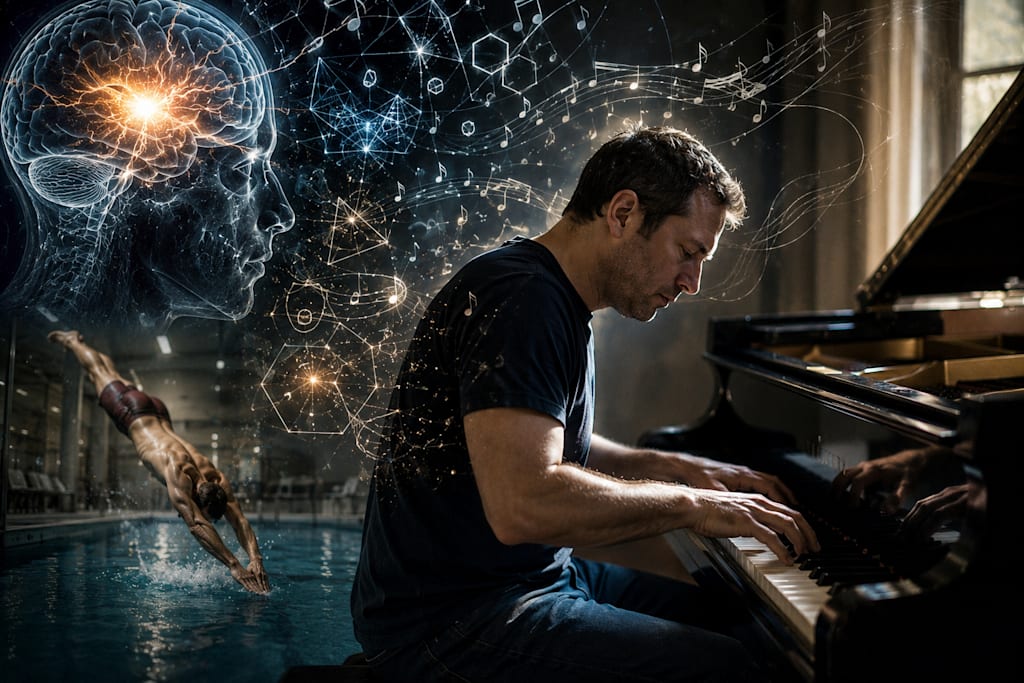
There are moments when reality becomes so strange that it begins to resemble mythology. Stories that seem impossible at first glance, tales that sound less like documented events and more like the kind of legend whispered late at night, between people struggling to make sense of mysteries buried in the human mind. The story of Derek Amato is one of those rare accounts that blurs the boundaries between science and myth.
In 2006, Amato was an ordinary man living an unremarkable life. He had no formal musical training, could not read sheet music, and was neither a pianist nor a composer, certainly not a latent prodigy awaiting discovery.
Then, one afternoon, a seemingly innocuous dive into a swimming pool altered the course of his existence. Everything changed in an instant.
The accident itself was brutally simple. At a gathering with friends, Amato dove headfirst into the shallow end of a pool. His skull struck the bottom with devastating force, leaving witnesses to recall blood in the water and the chaos that followed as he surfaced, dazed and injured.
The impact caused a severe concussion, but the physical injuries were only the beginning. In the days that followed, Amato began experiencing strange symptoms. His hearing became hypersensitive, ordinary sounds grew overwhelming, and he suffered headaches, memory lapses, and emotional disorientation, classic signs of traumatic brain injury.
Then something even stranger happened. He became obsessed with music. Not casually interested, but compulsively drawn toward it.
Prior to the accident, Amato had no meaningful experience with the piano. Yet, after the concussion, he described perceiving the world differently, as though patterns and structures once hidden had abruptly become visible to him. Most bizarre of all were the images.
Amato reported seeing black-and-white geometric shapes constantly appearing in his mind, as if fragmented architectural blueprints were moving across invisible surfaces. He later described these patterns as flowing and shifting in ways directly connected to sound and rhythm.
Music had somehow become visual. Or perhaps the visual world had become musical. Even he could not fully explain it.
Eventually, driven by a mixture of curiosity and compulsion, Amato sat down at a piano.
And according to numerous accounts, he began playing. Not random banging. Not awkward experimentation. Music. Complex, emotional, structured compositions emerging from someone who should not have possessed the ability to create them.
He later described the experience as if the music already existed somewhere deep inside him, waiting to be accessed. His hands moved instinctively, translating the geometric patterns in his mind into sound, as though guided by an internal blueprint.
The transformation stunned not only friends and family but also neurologists and researchers.
Because, while extraordinarily rare, Derek Amato appeared to fit the profile of something scientifically documented yet still deeply mysterious: Acquired savant syndrome.
Savant syndrome itself has fascinated scientists for decades. Most people associate it with individuals born with extraordinary abilities in areas such as mathematics, music, memory, or art, despite developmental disabilities or neurological differences. But acquired savant syndrome is different.
In these cases, extraordinary abilities appear suddenly after injury or trauma.
- A concussion.
- A stroke.
- A lightning strike.
- A neurological event.
And afterward, somehow, the brain reorganizes itself in ways nobody fully understands.
Some people suddenly demonstrate advanced mathematical calculation skills. Others develop artistic talents seemingly overnight. A few acquire astonishing memory capabilities or musical perception that they never possessed before. The rarity of these cases makes them difficult to study. The implications make them impossible to ignore.
For centuries, human beings have assumed talent follows relatively predictable paths.
- Practice.
- Education.
- Discipline.
Years of repetition slowly shape expertise. And in most cases, that is absolutely true. Which is precisely why acquired savant syndrome feels so unsettling. Because it appears to violate the normal rules entirely.
Derek Amato did not spend twenty years mastering piano scales. He hit his head. And afterward, music arrived like an unlocked door.
The scientific community remains divided on exactly what causes these transformations.
Some neurologists believe the brain contains dormant capacities normally filtered or suppressed by higher cognitive systems. In everyday life, the brain prioritizes efficiency over raw perception. It edits, simplifies, and narrows incoming information so humans can function without becoming overwhelmed. But traumatic injury may sometimes disrupt those filters.
In essence, damage to one area of the brain could unintentionally “release” access to abilities previously buried beneath ordinary consciousness.
Other researchers argue that acquired savant cases may reflect extreme forms of neuroplasticity. The brain’s astonishing ability to reorganize itself after trauma. When injured, the brain desperately attempts to reroute functions and establish new pathways. Occasionally, those pathways may produce unexpected results.
Still others admit something deeply uncomfortable: We simply do not know. And perhaps that uncertainty is what makes stories like Amato’s so haunting.
Because once you accept the possibility that the brain can radically reorganize perception after trauma, larger questions begin to emerge. Dangerous questions. Questions that linger long after the story itself ends. What if human beings are capable of far more than we consciously realize?
What if extraordinary abilities exist in latent form within many people, hidden behind neurological systems designed to keep perception manageable? What if genius is not always created, but occasionally uncovered?
The deeper one travels into the neuroscience surrounding acquired savant syndrome, the stranger the territory becomes.
There is something almost poetic about the nature of Amato’s transformation, specifically.
Music is often described as mathematical emotion, a structured language existing somewhere between logic and feeling. Yet Amato did not describe his new abilities in technical terms. He described patterns, shapes, movement, and flow.
As though music had become visible architecture inside his mind. That detail alone feels almost impossible to shake. A man suffers a concussion and suddenly begins perceiving hidden geometric structures that transform into piano compositions. It sounds less like medicine and more like science fiction. And yet it happened.
Not all consequences of the injury were positive, however. That is another important part of the story often overshadowed by fascination.
Traumatic brain injuries are devastating. Amato reportedly continued struggling with memory problems, sensitivity to sound, emotional challenges, and lingering neurological symptoms long after the accident itself.
The same injury that appeared to unlock musical abilities also fundamentally disrupted his life. That duality matters.
Because stories like this can easily drift into fantasy if stripped of their human cost. Acquired savant syndrome is not a superpower origin story. It is the result of profound neurological trauma.
And perhaps that makes it even more emotionally complicated. The gift and the damage arrived together.
Every Iron Lighthouse story eventually reaches a point where the strange historical or scientific details give way to something deeper and more personal. Here, that moment arrives quietly.
It emerges from the terrifying realization that the human brain may still be one of the least understood frontiers on Earth.
We have mapped oceans, walked on the moon, split atoms, and built artificial intelligence. And yet the three-pound organ sitting inside the human skull still holds mysteries that leave scientists speechless.
Especially when it breaks. Or changes. Or reveals something hidden beneath the surface.
Cases like Derek Amato’s force us into uncomfortable territory because they challenge assumptions people rely upon to make sense of themselves.
Most of us believe we understand where our abilities come from. We believe identity is stable. That talent develops predictably. The mind follows rules. Then a story like this appears, reminding us that consciousness itself may be stranger than we are prepared to admit.
A concussion becomes a doorway. An injury becomes a transformation. And suddenly the line between damage and discovery grows disturbingly thin.
Today, acquired savant syndrome remains incredibly rare, with only a small number of documented cases worldwide. Scientists continue studying these individuals in hopes of better understanding neuroplasticity, creativity, memory, and hidden cognitive potential.
But even with modern brain imaging and advanced neuroscience, the mystery remains largely unsolved. Perhaps that is why the story continues resonating so deeply with people. Not because it offers answers. But because it opens possibilities.
The possibility that the human mind contains hidden rooms. The possibility that perception itself is far more flexible than we realize. And the possibility that somewhere inside ordinary people may exist extraordinary capacities waiting silently behind locked neurological doors.
Doors most of us will never open. And doors that, in Derek Amato’s case, may have swung open all at once beneath the surface of a swimming pool in 2006.
Changing everything with a single impact...
About the Creator
The Iron Lighthouse
Where folklore meets freeway. A guide to the strange heart of the American backroads...
Enjoyed the story? Support the Creator.
Subscribe for free to receive all their stories in your feed.
Comments
There are no comments for this story
Be the first to respond and start the conversation.