
The Man Who Carried a Bag Full of Medical Papers
A simple story about how technology removed the burden from patients and brought humanity back to healthcare.

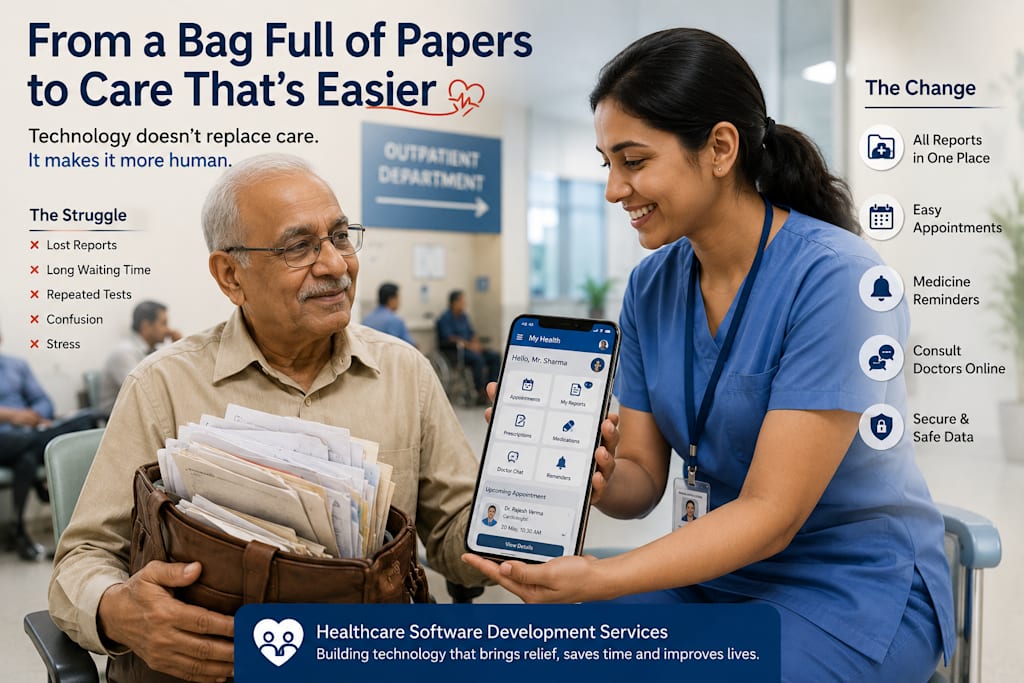
This version is written in a more awareness-driven and meaningful storytelling style so it feels different from normal business blogs and better aligned with Vocal Media storytelling expectations.
The Man Who Carried a Bag Full of Medical Papers
Every month, Mr. Sharma traveled nearly 70 kilometers to visit the city hospital.
He was sixty-two years old.
His knees hurt while walking, his eyesight had become weak, and he carried a worn-out brown bag everywhere he went.
Inside that bag were hundreds of papers.
Old prescriptions.
Blood test reports.
Medicine bills.
Doctor notes.
X-ray copies.
Some papers were folded.
Some were torn.
Some had faded so badly that even he could not read them anymore.
But he carried them carefully because his life depended on them.
At the hospital, the same thing happened every time.
A nurse would ask for his reports.
Mr. Sharma would slowly open the bag.
Then he would begin searching.
One paper after another.
People waiting behind him often became impatient.
Doctors became busy.
Sometimes reports went missing.
Sometimes old prescriptions could not be found.
And sometimes, Mr Sharma forgot which medicine he was currently taking.
One afternoon, after waiting nearly four hours, he quietly said something to the doctor.
“I feel tired before the treatment even starts.”
The doctor looked at him silently.
Because the truth was painful.
Healthcare was becoming harder for ordinary people.
Not because doctors did not care.
Not because hospitals were bad.
But because the system itself had become too heavy.
Too much paperwork.
Too many patients.
Too much confusion.
And not enough time.
That same evening, in another part of the city, a young woman named Neha sat inside a software company office.
She was part of a team providing Healthcare Software Development Services.
Most people thought her job was simple.
“Just coding,” they called it.
But Neha knew something many people did not.
Behind every hospital problem was usually a human problem first.
And technology could either make life easier…
Or harder.
Her company had recently started working with local hospitals.
Their goal was not to create flashy apps or expensive systems.
Their goal was simple:
Help hospitals care for people better.
During one hospital visit, Neha noticed something that stayed in her mind for days.
An elderly man was sitting quietly near the reception desk.
A brown paper bag rested beside him.
The papers inside were falling out.
Nobody noticed him.
But Neha did.
She walked toward him and helped gather the scattered reports.
The man smiled weakly.
“These papers are my memory now,” he said softly.
Neha did not know why, but those words hurt her deeply.
That night, she could not stop thinking about him.
How many people carried their medical history like a burden?
How many patients felt lost inside hospital systems?
How many doctors wasted valuable time searching through files instead of helping people?
And how many families silently struggled because healthcare had become too complicated?
The next morning, Neha’s team started discussing solutions.
Not complicated ones.
Simple ones.
Digital patient records.
Online appointment systems.
Medicine reminders.
Easy report access.
Doctor consultation apps.
Systems that even older people could understand.
Because good Healthcare Software Development Services are not about showing advanced technology.
They are about solving human problems with care.
Months later, the hospital launched the new system.
At first, many people were nervous.
Some older patients said they did not understand mobile apps.
Some nurses worried they would make mistakes.
Some doctors feared technology would slow them down.
But slowly, things changed.
Patients no longer carried heavy bags full of papers.
Reports became available within seconds.
Appointments became easier to manage.
Doctors spent less time searching and more time listening.
The waiting rooms became calmer.
And people felt less stressed.
One morning, Neha visited the same hospital again.
Near the reception desk, she saw a familiar face.
Mr. Sharma.
This time, there was no brown paper bag in his hands.
Only a small mobile phone.
He smiled proudly.
“My reports are all here now,” he said while showing the screen.
Neha smiled back.
For a moment, the hospital felt different.
Not because machines had taken over.
But because technology had quietly removed some of the burden people carried every day.
That is the part many companies forget.
Healthcare technology is not only about software.
It is about dignity.
It is about helping tired patients feel less helpless.
It is about giving doctors more time to care.
It is about reducing stress for nurses.
It is about making healthcare feel human again.
Today, many hospitals use Healthcare Software Development Services to improve speed, organization, and patient care.
But the real success of healthcare software cannot always be measured by numbers or reports.
Sometimes success looks like an old man no longer carrying a heavy bag of papers across the city.
Sometimes success is a mother getting a faster appointment for her child.
Sometimes success is a doctor finally having enough time to truly listen.
Technology becomes meaningful only when it makes human life easier.
And in a world where healthcare often feels stressful and confusing, even small digital solutions can quietly change thousands of lives.
About the Creator
Enjoyed the story? Support the Creator.
Subscribe for free to receive all their stories in your feed.
Comments
There are no comments for this story
Be the first to respond and start the conversation.