
The Light Was Gone from My Eyes—Then a Coffee Shop Note Changed Everything
What a half-cold milk tea, a game-theory essay, and a handwritten message taught me about sincerity that bites back.
Alex set his coffee cup down on the desk and stared at the screen for a while.
Three months. He had been at this company for three months. First one in, last one out. Receipts neatly taped to expense reports. Never said no when a colleague asked for a hand. Last month, when a small mistake surfaced in the project, he wrote a two-page mea culpa email and copied the whole team.
Friday's performance reviews came out. The promotion went to Carl.
Carl, who started two months after him, whose receipts had never seen the right side of a stapler, but whose PowerPoint decks sparkled, who could crack a joke with the director to her face, who had dodged two major slip-ups by pinning them squarely on an intern.
Alex didn't complain to anyone. He just sat at his desk with one thought looping in his head: Was everything they taught me in school completely useless?
His high school homeroom teacher had once written in his graduation yearbook: "Hold on to your sincerity. The world will repay you." He had shoved that yearbook into the bottom drawer of his wardrobe.
For the next six months, Alex read things he used to look down on. On the subway, he scrolled posts titled "How to Protect Yourself at Work." During lunch, he browsed game-theory explainers. Before bed, half a chapter of How to Win Friends and Influence People. He even bought a secondhand copy of The Prince. Couldn't get through it, but left it on his nightstand anyway. Felt like he should at least try.
It worked, sort of. He learned to open meetings with "I want to flag the risks on this." Learned to push unreasonable requests back through email, paper trail firmly in place. Before, when a colleague said "Hey, can you help me out?" his mouth moved faster than his brain and out came "Sure." Now he paused. "I've got a deadline right now—let me get back to you tomorrow." That pause took him a month to nail.
His year-end performance did go up. But he couldn't tell whether he was happy or not.
It felt like he'd grown an extra shell. Safe inside. Also stuffy.
Mia from the next cubicle bought him a milk tea one afternoon. He caught himself doing the math—she'd asked him for two favors last week, this cup cost $4.50, was a third favor coming? By the time he realized what he was calculating, the tea had gone cold.
That Chinese New Year he went home. His mother made his childhood favorite, sweet and sour ribs, and set the plate down on the table. "You've lost weight," she said. "The light's gone out of your eyes."
He said nothing. He picked up a rib and chewed for a long time.
It was on a sleepless night that he came across the long essay on game theory. The writer described an experiment with a strategy called Tit-for-Tat, hammering the same conclusion into his forehead over and over: In the long run, the players who go the furthest are neither the purely kind nor the purely ruthless. They are the ones who "start with cooperation, retaliate immediately when harmed, and are willing to trust again the moment the other side shows sincerity."
He read it three times. On the third read, birds were singing outside his window.
He didn't figure it all out overnight. It came piece by piece over the months that followed, in small, concrete moments.
March. Carl tried to dump another mess on the whole team. Before, Alex would have either swallowed it in silence or pushed back hard and then stewed at his desk all afternoon. This time, he went through Carl's proposal line by line, marked it up in red, and wrote in an email copied to the manager: "The above is my assessment based on current data. If the direction has shifted, we can align in a meeting." No emotion, no accusation. Just a boundary.
Carl did not reply to that email.
May. A new intern was crying in the break room, saying she felt like she didn't know anything. Alex was making coffee nearby. He didn't offer any "believe in yourself" talk. He set his cup down, rummaged through a drawer, pulled out an old notebook, and flipped it open to a certain page. "Mistakes I made in my first month," he said, handing it over. "Way worse than yours."
The intern laughed through her tears. "Alex," she said, "your handwriting is terrible."
July. The director called him into her office and said she wanted him to lead a new project by year's end. Alex walked out, stood in the hallway for half a minute, and noticed that he felt neither euphoric nor vindicated. Just a normal heartbeat. Normal footsteps. He walked back to his desk and kept working.
That afternoon Mia asked in the group chat if anyone had a band-aid—her new shoes were killing her. Alex pulled two waterproof band-aids from his drawer and handed them over. "Wow, you actually have those?" Mia said. "I've been there," he said. "I know it hurts."
He suddenly remembered something.
The year he graduated high school, his teacher had written an extra line on that yearbook page, in smaller handwriting. He'd never noticed it. That night he dug the book out and read it under the desk lamp.
"Hold on to your sincerity. The world will repay you. But the world's way may not be the way you expect. You'll get taken advantage of first. Then you'll learn to protect yourself. And in the end you'll discover that sincerity and sharp edges were never opposites."
He put the yearbook back in the wardrobe. Not on the bottom shelf.
Second shelf from the top.
Friday after work, Alex passed the new coffee shop downstairs from his office. A handwritten poster was taped to the window: "Opening week special: say 'Today is a good day' and get a free size upgrade."
He thought the marketing gimmick was pretty dumb.
He walked in anyway.
The girl behind the counter looked up, waiting for the passphrase. He hesitated one second, then said the four words out loud.
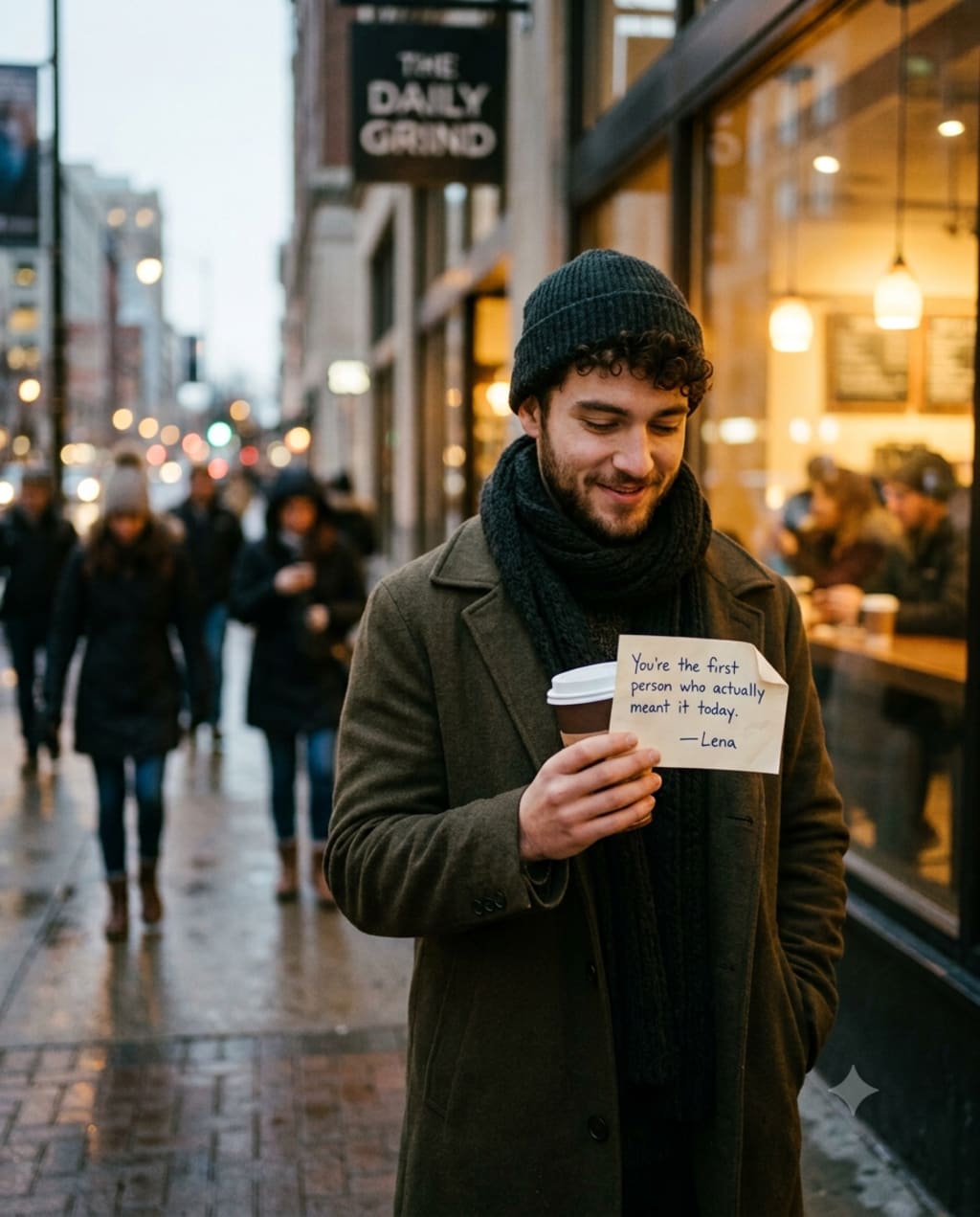
She smiled and stuck a note on his cup. He took the coffee, walked out the door, and only looked down once he was outside.
The note didn't say "Today is a good day."
It said: "You're the first person who actually meant it today. Thank you. —Lena"
He stood by the curb for a moment.
Then he tore open a sugar packet and poured it into his coffee. He usually drank his Americano black.
Today he added one.
People moved past on the sidewalk—someone on a call, someone scrolling, someone holding a dog's leash at a red light. He lifted the lid, and steam rose to his face. The early-winter evening air had a bite to it. He tugged his scarf up a little.
His phone buzzed. Mia in the group chat: Who's bringing coffee for Monday's meeting?
He typed one-handed.
I'll bring it.
He locked the screen, picked up his cup, and turned into the subway entrance. The note on the side of the cup had curled up at one corner. He didn't peel it off.
About the Creator
Jin
Writer of reamstories
https://reamstories.com/jin
Enjoyed the story? Support the Creator.
Subscribe for free to receive all their stories in your feed. You could also become a paid subscriber, letting them know you appreciate their work.
Comments
There are no comments for this story
Be the first to respond and start the conversation.