
The Last Generation of Human Workers
How artificial intelligence is systematically eliminating entire professions and which jobs are disappearing faster than anyone predicted.

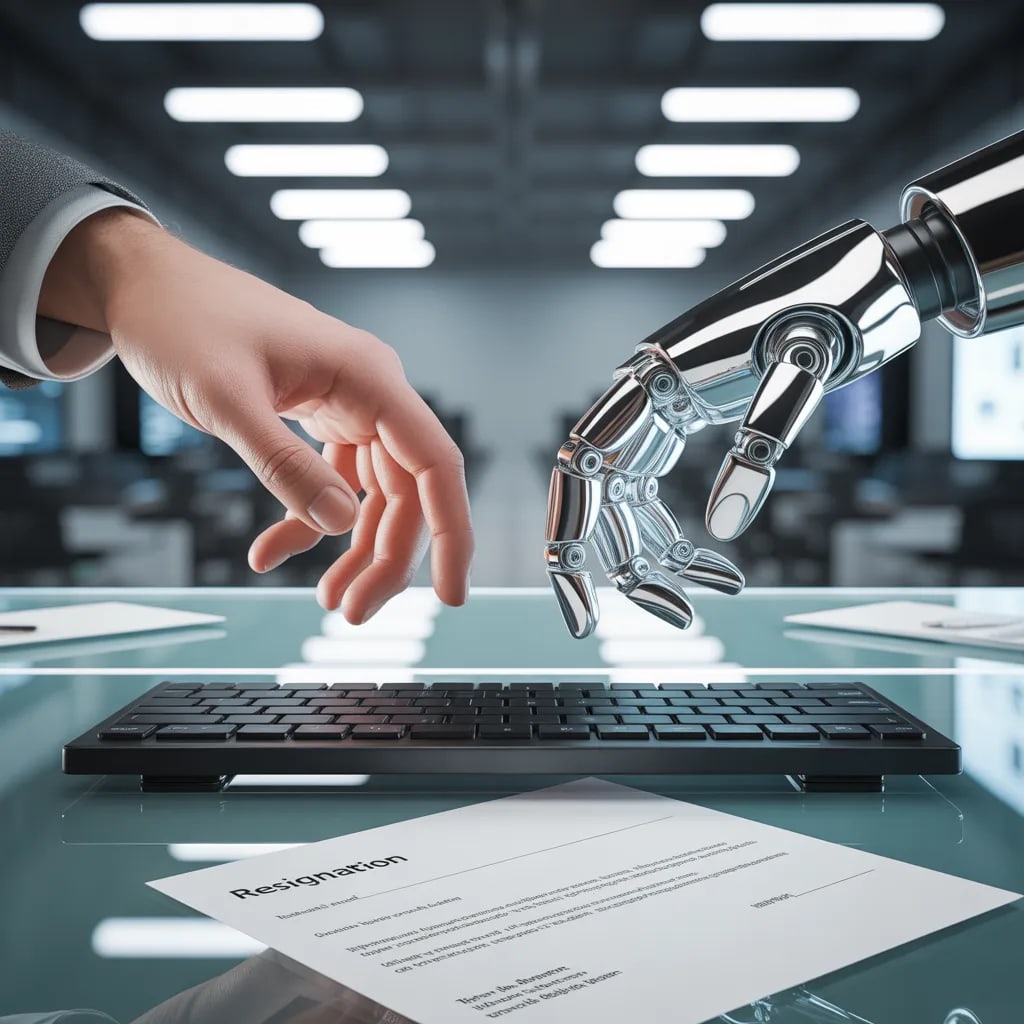
In February 2026, Mustafa Suleyman, the chief executive of Microsoft AI, sat down for an interview with the Financial Times and said something that reverberated across boardrooms, newsrooms, and kitchen tables simultaneously. White-collar work, the kind performed sitting at a computer, the kind that a generation of workers was told would be safe from automation, would, in his estimation, be largely automated within twelve to eighteen months.
"So white-collar work, where you're sitting down at a computer, either being a lawyer or an accountant or a project manager or a marketing person," Suleyman said, "most of those tasks will be fully automated by an AI within the next 12 to 18 months."
He was not speaking in the abstract. He was describing the present trajectory of technology that already exists, already deployed, already changing the arithmetic of employment in measurable ways. The question is no longer whether artificial intelligence will reshape the global workforce. The evidence for that is already accumulating. The question that matters to the hundreds of millions of people whose livelihoods depend on the answer is how fast, how completely, and who bears the cost.
The Numbers Behind the Shift
The data on AI-driven job displacement is, at this point, substantial enough to resist easy dismissal.
The World Economic Forum's Future of Jobs Report 2025, drawing on surveys of over one thousand employers representing more than fourteen million workers worldwide, projected that 92 million roles will be displaced by 2030, while 170 million new roles will emerge—a net gain, on paper, of 78 million jobs. That headline figure has been widely cited as evidence that AI is ultimately a job creator rather than a job destroyer. What receives less attention is the accompanying finding: that 41 percent of employers globally plan to reduce their workforce in areas where AI can automate tasks within the next five years.
Net creation and mass individual displacement can coexist. The new jobs may not be in the same sectors, at the same wage levels, or accessible to the same workers as the jobs being eliminated. The macroeconomic totals offer cold comfort to a paralegal whose entire function has been absorbed by a large language model or a financial analyst whose entry-level role no longer exists for a new graduate to fill.
McKinsey's research, published in late 2025, added a figure that demands careful reading: today's existing AI technology could, in theory, automate approximately 57 percent of current United States work hours. That is not a projection about future capabilities. It describes what is already technically possible with systems currently deployed. The gap between technical possibility and economic implementation is real, but it is closing faster than most labor market models have historically anticipated.
Meanwhile, the more granular picture is already visible at the occupational level. Research by Frey and Osborne at Oxford University, which has become the most widely cited academic analysis of automation risk, found that 47 percent of United States occupations are at high risk of automation over the next ten to twenty years. The highest-risk roles include telemarketers, data entry operators, and insurance underwriters, all facing automation probability estimates above 98 percent. These are not niche occupations. They represent millions of workers.
The Professions That Assumed They Were Safe
For much of the twentieth century, the standard framework for understanding automation risk was relatively simple: machines replace physical labor, and cognitive labor is safe. This assumption underpinned decades of career advice, educational investment decisions, and policy responses to technological disruption. It is no longer defensible.
The current wave of AI development is specifically targeting cognitive work, the reading, analyzing, writing, summarizing, and decision-support functions that define professional employment. This distinction matters enormously, because it means the workers most exposed to the current phase of displacement are not factory operatives or warehouse workers. They are lawyers, accountants, financial analysts, radiologists, software engineers, and marketing professionals.
In legal services, AI systems are already performing document review, contract analysis, legal research, and the drafting of routine legal instruments at a fraction of the cost of junior associates. A 2025 report by Thomson Reuters confirmed that lawyers, accountants, and auditors are using AI for document review and routine analysis with measurable productivity improvements. Multiple Fortune 500 companies reported in 2025 and early 2026 that they had reduced headcount in entry-level legal and financial analysis roles after deploying AI systems while retaining senior staff whose judgment and client relationships remain, for now, human-dominated.
The pattern is consistent across sectors. AI systems have passed bar examinations in the top percentile of performance. They have outperformed junior analysts on financial modeling tasks in controlled comparisons. They have produced marketing copy rated superior to human-written material by blind evaluators. In software engineering, Suleyman's own example: Microsoft engineers reported in early 2026 that AI-assisted coding now accounts for the vast majority of their code production. The relationship between the engineer and the work has changed fundamentally, in his words, within the space of six months.
The downstream consequence of this shift is perhaps more significant than the direct displacement it produces. Entry-level professional roles, the positions through which a generation builds the experience and judgment that eventually justifies senior employment, are the first to be absorbed by AI systems. When the entry-level pipeline disappears, the entire career ladder is disrupted, not just the bottom rung.
The Sectors Where Displacement Is Already Measurable
While the debate over long-term projections continues, near-term displacement is already documented in several specific sectors.
Customer service has experienced the most rapid and visible transformation. Research classifies customer service representatives as facing an 80 percent automation rate by 2025, and the evidence from actual deployment supports that estimate. AI-driven chat systems, voice response tools, and automated case resolution platforms have absorbed a significant share of what was previously a major category of employment, particularly for workers without college degrees entering the workforce for the first time.
Retail has undergone structural change at a pace. Retail cashiers face a 65 percent automation risk from self-checkout and computer vision systems, with Walmart's self-checkout expansion alone estimated to affect thousands of positions. The acceleration of AI-powered checkout adoption across major retailers suggests this displacement will continue regardless of regulatory response.
Manufacturing, long the canonical example of automation-driven job loss, is entering a second and more severe phase. MIT and Boston University research indicates that AI-driven robotics will have replaced approximately 2 million manufacturing workers globally by 2026. Oxford Economics projects that global manufacturing could lose up to 20 million jobs by 2030. The communities most affected are those that were already recovering from the first wave of automation and offshoring, regions where manufacturing employment was the primary economic anchor.
In the technology sector itself, a significant indicator emerged in the first half of 2025: 76,440 tech positions were eliminated, with AI cited as a contributing factor. This is notable because the technology sector had been, until recently, predominantly a beneficiary of AI investment rather than a target of AI-driven displacement. That appears to be changing as AI coding tools reduce the headcount required to maintain and develop software systems.
The Invisible Displacement: Hiring Suppression
One of the most significant and least discussed mechanisms of AI-driven labor market disruption operates not through layoffs but through what economists describe as hiring suppression.
Research from the Federal Reserve Bank of Dallas, reviewing wage and employment data through early 2026, found that in jobs with significant AI exposure, wages were not uniformly declining, suggesting that for many current workers, AI is currently augmenting rather than immediately replacing their output. However, research from Anthropic's own team, which developed a measure of AI displacement risk based on actual tool usage data rather than theoretical exposure, found evidence that high-AI-usage occupations are beginning to see measurably slower hiring rates.
Goldman Sachs described this pattern as employers integrating AI to avoid adding headcount rather than immediately firing existing workers. The arithmetic is straightforward: if a team of ten analysts can, with AI assistance, do the work previously requiring fifteen, the company does not lay off five people. It simply does not replace them when they leave and does not hire the additional five it would otherwise have needed as the business grew.
The consequence is a labor market in which experienced workers retain their positions while the entry-level roles that would train the next generation of professionals quietly cease to exist. For a young person graduating with a law degree, an accounting qualification, or a marketing credential in 2026, the market they are entering looks structurally different from the one their professors trained them for, not because AI has replaced the senior lawyers and accountants, but because the junior roles that were always the first step no longer need to be filled by humans.
The Counterargument and Its Limits
The standard optimistic response to evidence of AI-driven displacement invokes historical precedent: technological revolutions have always disrupted existing employment while creating new categories of work that did not previously exist. The Industrial Revolution displaced agricultural and artisanal workers while creating factory employment. Computerization displaced clerical workers while creating a vast information technology sector. The argument concludes that AI will follow the same pattern, displacing some jobs while generating others and leaving the labor market roughly intact over time.
The argument has historical support and should not be dismissed. It is also subject to limitations that its proponents do not always acknowledge.
The speed of this transition is without historical precedent. Previous technological transitions played out over decades, giving labor markets, educational institutions, and policy frameworks time to adapt. The current AI transition is compressing disruption that would historically have unfolded across generations into a period of years. Workers displaced by the Industrial Revolution had time to retrain or allow their children to enter new occupations. Workers whose roles are automated in the current transition face a labor market that is simultaneously eliminating their existing skills and creating new ones that require entirely different foundations.
The geographic and demographic distribution of disruption is also highly unequal. Research indicates that women face disproportionate exposure: 58.87 million women in the United States workforce occupy positions classified as highly exposed to AI automation, compared to 48.62 million men. Workers in lower-wage roles face four times the automation risk of high-wage workers. The new jobs created by AI in AI development, data infrastructure, and advanced technical analysis require qualifications and geographic access that are not uniformly available to the workers being displaced.
What the Evidence Actually Supports
A balanced reading of the available evidence supports several conclusions that sit between the extremes of panic and complacency.
AI is not eliminating work uniformly across the economy. It is automating tasks within jobs, eliminating some roles entirely, suppressing hiring in others, and creating new categories of work in the technology sector and in roles that involve managing, evaluating, and directing AI systems. The net employment effect at the macroeconomic level may ultimately be positive, as historical analogies suggest. The distribution of that net effect will be deeply unequal, and the transition period, which most analysts place between 2025 and 2030, will produce genuine and significant hardship for specific categories of workers.
The workers most immediately at risk are those in routine cognitive roles at the entry and mid-levels of professional services: junior lawyers, financial analysts, customer service professionals, data entry operators, and content producers. Senior professionals whose work requires irreducible judgment, complex interpersonal navigation, and accountability for consequential decisions face meaningful but less immediate pressure.
The workers least at risk, at least in the near term, are those whose work involves physical presence in unpredictable environments: trades, healthcare delivery, social work, and skilled manual work in construction and infrastructure. These roles have proven consistently resistant to automation, not because the work is simple but because the physical and contextual variability involved exceeds the current capabilities of robotic and AI systems.
A Structural Problem Requiring Structural Responses
What is missing from most public discussion of AI and employment is a clear-eyed acknowledgment that the mechanisms currently in place for managing labor market transitions are not calibrated for the speed or scale of what is unfolding.
Unemployment insurance systems were designed for cyclical job loss, not structural displacement caused by technological obsolescence. Retraining programs have consistently underperformed in previous waves of automation, reaching a fraction of the workers who need them and providing skills that sometimes become obsolete before the training is complete. Educational institutions, from community colleges to universities, operate on timelines that are poorly matched to the pace of AI capability development.
The policy gap is real. It is also, at this point, documented well enough that ignorance is not a credible excuse for inaction.
What effective responses would require investment in transition support systems that match the scale of anticipated displacement; reform of educational and credentialing pathways to accelerate access to roles that AI is creating rather than eliminating; serious engagement with the distributional consequences of automation, particularly for women, lower-wage workers, and geographically vulnerable communities; and honest public communication about what the current evidence actually shows.
The last of these may be the most difficult. The political economy of AI is dominated by actors with strong financial incentives to emphasize the opportunities while minimizing discussion of the costs. The workers most exposed to displacement have the least influence over the policy frameworks that will determine whether the transition is managed or simply endured.
Conclusion
The question of whether this is the last generation of human workers in the traditional sense is one that current evidence cannot definitively answer. What it can answer is whether the disruption is real, whether it is accelerating, and whether it is being managed with the seriousness it deserves.
On all three counts, the evidence is uncomfortable.
The disruption is real and measurable in hiring data, employment statistics, and the direct testimony of companies that have reduced headcount after deploying AI systems. It is accelerating the timeline between AI capability development and economic deployment, compressing, not extending. And it is not, at present, being managed with the urgency that the scale of potential impact would seem to demand.
This does not mean the outcome is predetermined. Labor markets are not physics. They respond to policy choices, institutional investments, and collective decisions about how the gains from technological progress are distributed. The history of technological disruption includes examples of transitions that were managed relatively well and examples of transitions that produced decades of concentrated suffering before equilibrium was restored.
Which category this transition falls into is not yet determined. But the window for making choices that meaningfully shape the outcome is open now, and it will not remain open indefinitely.
About the Creator
Enjoyed the story? Support the Creator.
Subscribe for free to receive all their stories in your feed.
Comments
There are no comments for this story
Be the first to respond and start the conversation.