
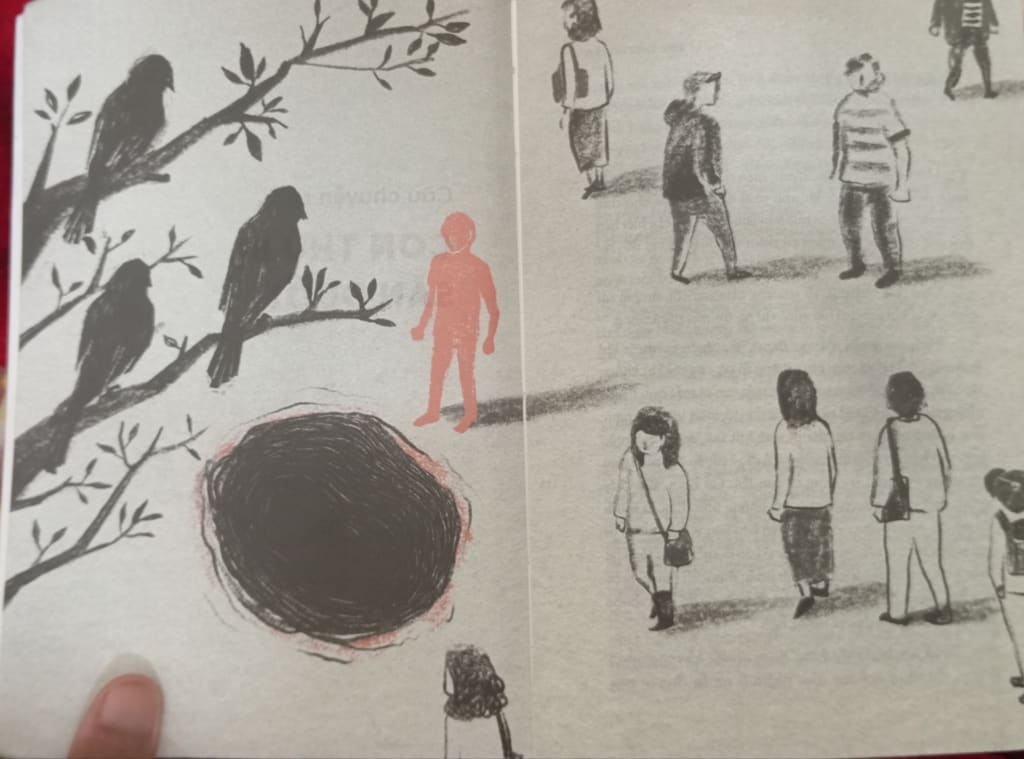
(Thanh, 32 years old, engineer) When he found out his wife was pregnant, Thanh knew he couldn’t put it off any longer. It was time for him to name his condition, to understand what was wrong with him. He needed to know whether his future child might receive something “garbage” from him. It had started six or seven years ago, but last year, when he was twenty-seven, it became serious. Sitting in the office, Thanh found himself holding his breath from an unfounded tension, until he couldn’t take it anymore, gasping like a fish out of water. There were also days when he hiccupped constantly, causing his entire chest to feel crushed. Going up the stairs, he was out of breath, in meetings he often felt dizzy, his ears buzzed, and he often had to hide his hands under his thighs because they kept shaking. One day, he found himself sitting by the lake in the rain and couldn’t remember how he got there. He became obese due to water retention, frequent diarrhea, and insomnia. Doctors said he had a disorder of the autonomic nervous system. Every day, he took laxatives, digestive enzymes, bone and joint supplements, vitamins, eye supplements, brain supplements, painkillers, and sleeping pills. Thanh endured silently. No one around him noticed anything, only his wife was often surprised that many new things had happened that he had forgotten. He used cigarettes and coffee excessively to stimulate himself. Outside, he still attended meetings, communicated with customers and made a good impression. Inside, he was immersed in frustration, annoyance, unreasonable and strange anger. Every day was an extraordinary "rope-walking" effort, a constant struggle to control himself. Thanh felt like he was going crazy or dying from some strange incurable disease. Last month, during a discussion at the company, he angrily threw a glass of water against the wall, shocking everyone. He called it an explosion. Late one afternoon, Thanh went to Mai Huong Daytime Psychiatric Hospital. He had prepared himself mentally, but when he saw the sign on the gate, he still paused for a second. Mental illness, that word rang like a metallic sound in his head, making him dizzy. And it was daytime too. He was slightly angry, could it be that people were only allowed to be crazy during office hours? They gave Thanh some test papers. The female employee sitting at the next table urged, “Hurry, hurry! Time is almost up... I told you to do this test first, this test will take a long time...” Then she put her wallet and phone in her bag, zipped it up, and put it on her lap. When the results came out, the female doctor looked at it and said to the person next to her, as if Thanh was a sandbag in front of her, “Hey, with such a heavy weight, he should have lost control, right? Why is he still conscious?” Turning to him, she raised her eyes, “Where are my family members? Why is there no family member with me?” “I’m... normal.” Thanh stammered, “I left work early today to come here.” He emphasized the word as if he wanted her to understand that he was still in the community, that he had not been excluded. But the doctor didn't listen to him, she bent down, swish swish, and wrote a long prescription. Severe depression with generalized anxiety disorder. Buy the medicine now, it's three million, buy as much as you have, if you don't have enough, come back tomorrow to buy the rest. Outside the gate, Thanh looked at the back of the doctor who was pushing the bike in front of him and threw the prescription away. He felt like a cow being pushed onto a conveyor belt with no way down, he wasn't ready to take the medicine. Thanh's second outburst happened almost two years after the day he came to Mai Huong. That night, he was about to go out to take his drunk younger brother home when his father blocked the door, his breath was strong from alcohol, "Let him fucking die!" For a split second, Thanh lost his mind. He grabbed his father's hair and pushed him down. Until now, Thanh still believes that his father is a good person, loves his wife and children. He silently took care of his family, patching inner tubes, pumping up his son's tires, changing light bulbs, fixing faucets. But for a long time, Thanh wished his father would die, that would be a relief for him and everyone in the family. For a long time, he had seen his father hardly eat or drink, but he still had two beers every day like clockwork. After graduating from university, he quit his government job because he couldn't make ends meet, and after a period of smuggling from the North to the South went bankrupt, he switched to opening an iron workshop. Between beers, he would sit bending and shaping iron, always with a glass of white wine by his side to "treat". The two things he couldn't live without, the two things that allowed him to bury himself in were work, more than ten hours a day, and alcohol. Later, when he had cancer, he could be treated in the morning, and at night he would still take out his tools. Every day after school, the young Thanh would take a deep breath, as if preparing to dive into a swamp. Would the house be destroyed today? Hearing the sound of his father's motorbike from afar, he could guess his condition. The throttle was uneven and unstable, his father was drunk, he would deliberately crash the motorbike into the door, would come into the house and play loud music, would terrorize and destroy things. The two brothers' childhood was a sea of mixed sounds. His workplace was right above Thanh's bedroom, he often called him up to help by banging hammers or iron frames on the floor. There were nights, when he was just out of kindergarten, Thanh was woken up to install shelves. Even now, any loud sound makes him jump and shiver. In his story, Thanh returns to his father as a big mystery in his life. Why didn't he hire more helpers, but always nagged his wife and children, "I work like a dog, but you guys...?" Why did he force his children to work with him, but when he brought home a mask with an activated carbon filter because he couldn't stand the smell of paint in the closed room, he threw it against the wall with all his might, then stuck a pair of scissors in his face, "Are you trying to teach me a lesson?" Why did he beat and curse him so fiercely just because he took off the front basket of his motorbike without asking, but the next day he generously sent him off, saying, "Buy this, buy that?" Why is there a person who both earns money and builds a family, and also tortures his relatives in such a comprehensive way? Thanh grabbed his father's hair, held him down, and shouted the question that had been in his head for years, "What do you want now?" Thanh punched like a machine. He could not understand this sickness. What did he want from his mother and son? What did he want from this family, from this life? Along with the beat of his fists was the sound of his father's head hitting the floor and his indignant cry, "You die! What do you want? You die! What do you want?" Those were the cries of despair. The incident of beating his father happened during the time when Thanh often saw a psychological counselor. She was very patient, very attentive, and Thanh felt comfortable having someone to help him sort out the mess in his head. The very next day, he and his wife went to see her. All three of them understood that he had crossed the threshold, and now needed another solution. The fact that he continued to live in a toxic environment made the counselor's efforts not yield much results. Thanh had been at home for a year now, although he had originally planned to take three months off work to recover from the pressure at work and the chaos at home. His daughter was one year old, she needed a healthy father. Thanh became very impatient. He wanted to be cured. He was ready to overcome his skepticism and fear of drugs. Thanh was introduced to a psychiatrist, a veteran in the field. Two weeks after taking his medicine, he became an emotionless bag. He sat numbly in his room and noted two moving things, in the corner of the house was the fan, in front of him was his child. He realized that he looked at those two things with the same emotion - indifference. A few days ago, he held his child and stood on the sidewalk while his wife was busy doing something next to him. The child cried loudly. A feeling of discomfort rose in Thanh, he looked at the lump of flesh in his hand, it struggled and made piercing sounds. The discomfort grew, turning into anger. In his mind, he saw himself throwing the child onto the street, where vehicles were passing by. Thanh called the doctor, who had never warned him about the side effects of the drug. He said he was limp, his hands were limp, his steps were dragging. He lay in his room all day, the phone ringing to remind him to take his medicine as if from a faraway place. If a relative came into the room, pulled the curtains and turned on the light, he would be scared and angry and chased him out. The doctor said curtly, "Do you want to change the medicine? The next one will be stronger, okay?" Thanh said that at night, his eyes would roll up and not close. At mealtimes, he tried to stuff food into his mouth but felt like he was eating garbage. He lost the ability to drive a motorbike and generally had no control over his body. "Then go to the inpatient hospital," the doctor said shortly. Thanh said he felt he could not continue. "You can stop taking the medicine if you want, it's not my problem." Several times later, he still answered the phone and still answered the same way. Thanh had met many people like that. In front of others, they expressed a narrow range of emotions like a mechanic would with a motorbike. People like him were pharmacists. After four months, he stopped taking the medicine. It was late at night, the hospital room was quiet, only occasionally there was a delirious mumble. Sitting by his father's bed, Thanh looked at his father's hunched back. He was breathing evenly, his face only a few centimeters from the feet of the patient lying upside down on the same bed. When was the first signal appearing in him? (to be continue)
About the Creator
Enjoyed the story? Support the Creator.
Subscribe for free to receive all their stories in your feed.
Comments
There are no comments for this story
Be the first to respond and start the conversation.