
The Hospital Visit That Changed Ravi’s Life
A meaningful story about grief, healing, and the human side of healthcare technology.

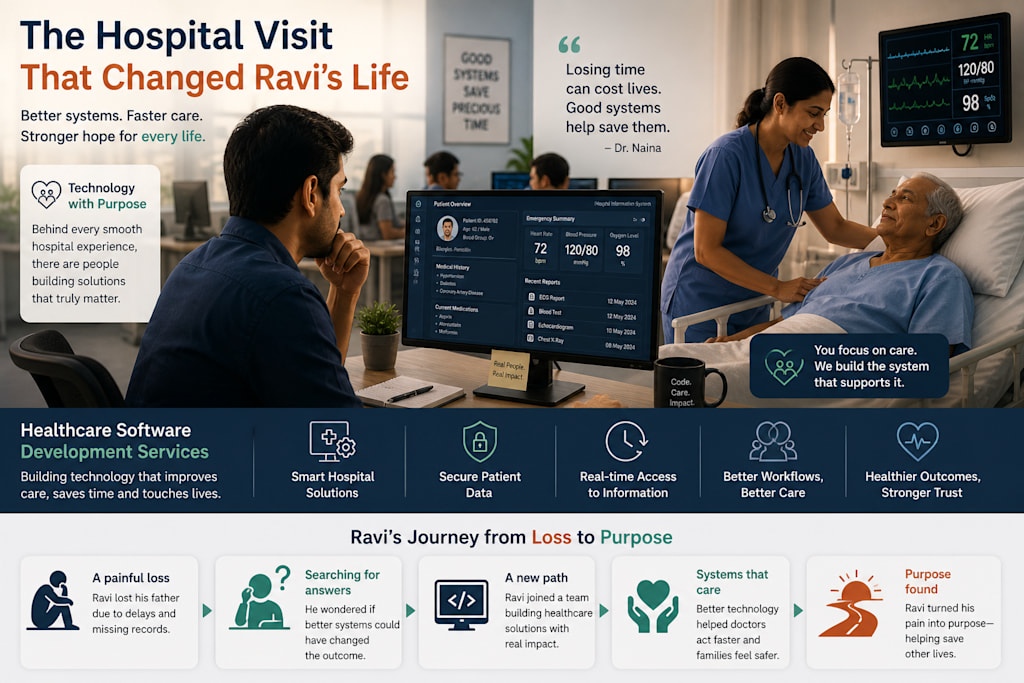
Ravi hated hospitals.
Not because of the smell.
Not because of the long waiting lines.
And not even because of the fear people carried in their eyes.
He hated hospitals because that was where he lost his father.
Five years earlier, Ravi had stood helplessly outside an emergency room while doctors searched for missing medical records.
His father had heart problems for years.
Different hospitals.
Different medicines.
Different reports.
But during the emergency, important information was delayed.
And sometimes, in healthcare, delays become permanent regrets.
After his father passed away, Ravi stopped talking about hospitals completely.
He buried himself in work instead.
As a software engineer, he spent most of his time building business applications for retail companies.
Inventory systems.
Payment dashboards.
Customer analytics.
The work paid well, but it never meant much to him.
Every day felt the same.
Until one unexpected phone call changed everything.
A former college friend named Mehul contacted him one evening.
“I joined a healthcare technology company,” Mehul said excitedly. “We are working on Healthcare Software Development Services for hospitals.”
Ravi almost laughed.
“Hospitals and software?” he replied. “Sounds stressful.”
Mehul became quiet for a second.
Then he said something Ravi never forgot.
“Stressful, yes. But meaningful too.”
Those words stayed in Ravi’s mind for days.
Meaningful.
It had been years since his work felt meaningful.
A few weeks later, Ravi visited Mehul’s office.
The place looked different from typical tech companies.
There were no loud celebrations or flashy presentations.
Instead, people spoke carefully.
Seriously.
A team discussed emergency response systems.
Another group tested patient monitoring alerts.
One developer was fixing a delay issue inside a hospital dashboard.
Someone else was reviewing patient data security.
Ravi noticed something unusual.
Nobody there talked about “users.”
They talked about patients.
Families.
Doctors.
Lives.
That difference mattered.
During the office visit, Mehul introduced Ravi to a woman named Dr. Naina.
She worked closely with the software teams to improve hospital workflows.
She asked Ravi a simple question.
“Do you know what doctors fear the most during emergencies?”
Ravi shook his head.
“Losing time,” she answered.
She explained how delayed records, slow systems, or missing information could create chaos inside hospitals.
“Technology cannot replace doctors,” she said softly. “But good systems can help doctors move faster and make better decisions.”
For the first time in years, Ravi thought about his father again.
Not with anger.
But with understanding.
Maybe the problem had never been careless doctors.
Maybe the system itself had been broken.
That night, Ravi sat alone in his apartment thinking deeply.
What if someone had built better systems earlier?
What if hospitals had faster access to records?
What if emergencies were handled more smoothly?
Would his father still be alive?
He would never know the answer.
But for the first time, Ravi felt something he had not felt since losing his father.
Purpose.
Three months later, Ravi left his old job and joined the healthcare technology company.
His friends thought he was making a mistake.
“The workload is too intense.”
“Healthcare projects are complicated.”
“You’ll burn out.”
Maybe they were right.
The work was difficult.
Hospitals needed systems that could not afford failure.
Doctors demanded speed.
Patients expected safety.
Even small software issues carried serious consequences.
But Ravi stayed.
Because every project now felt connected to real human lives.
One evening, nearly a year later, Ravi visited a hospital using the platform his team had built.
Inside the emergency department, everything moved quickly but calmly.
Doctors checked patient histories within seconds.
Nurses received instant alerts.
Families got appointment updates on their phones.
No giant paper files.
No confusion at the reception desk.
No desperate searching during emergencies.
Near the hallway, Ravi noticed an older man sitting beside his daughter.
The man looked weak, but peaceful.
The daughter spoke softly to a nurse.
“Thank you,” she said. “Everything happened so quickly today. We were so scared.”
The nurse smiled gently.
“Our systems helped us access his history immediately.”
Ravi stood silently a few feet away.
The words hit him deeply.
Because years earlier, he had once been that frightened son standing outside an emergency room.
Except his story had ended differently.
For a moment, Ravi felt tears filling his eyes.
Not from sadness this time.
But from knowing that maybe, somewhere, another family had been spared the pain he carried for years.
That night, while driving home, Ravi finally understood why Healthcare Software Development Services matter so much.
Not because of technology alone.
Not because hospitals are becoming digital.
But because better systems can change human experiences during the most difficult moments of life.
Technology cannot erase loss.
It cannot remove pain completely.
But it can reduce confusion.
It can save precious time.
It can help doctors focus faster.
And sometimes, it can give families hope when they need it most.
Years ago, Ravi walked away from hospitals carrying grief.
Now he walked back into them carrying purpose.
And in many ways, that became the most important transformation of his life.
About the Creator
Enjoyed the story? Support the Creator.
Subscribe for free to receive all their stories in your feed.
Comments
There are no comments for this story
Be the first to respond and start the conversation.