
The Hagure Duck: Finding My Voice in a World Where I Pretend to Be Human
My life as a Japanese woman searching for her own truth beyond the "normal."

1. Introduction: A Quiet Life in New Zealand
Hello, Vocal community. My name is Hagure Duck.
I am a 29-year-old Japanese woman currently living amidst the serene landscapes of New Zealand on a working holiday.
In three months, my journey here will conclude, and I will return to Japan.
People often ask me why I travel alone or why I seem so content in my own company.
The truth is, I find my greatest peace in solitude — drinking tea alone, watching clouds move, reading ingredient labels for ten minutes in supermarkets, and not having to pretend I understand group conversations.
While the world celebrates “connection,” I celebrate quiet moments where my mind can wander freely. Sometimes that means observing people in supermarkets like a confused anthropologist. Sometimes it means standing in kiwi orchards, completely distracted by birds instead of work.
2. My Identity: A Duck Pretending to Be Human
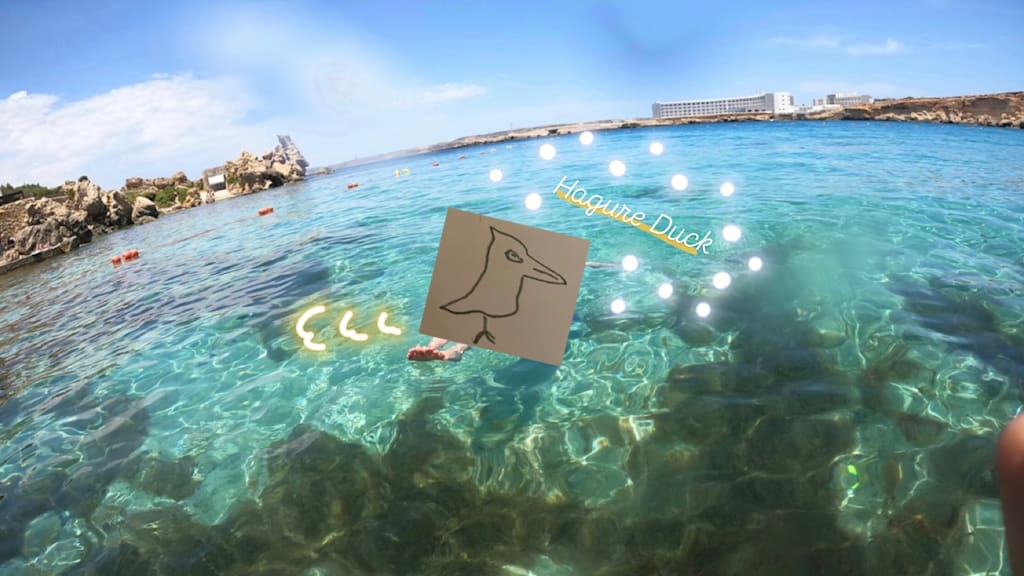
The name “Hagure Duck” is not just a cute moniker; it reflects my daily struggle with identity.
In Hans Christian Andersen’s famous fairy tale, the ugly duckling discovers he is a swan. But my reality feels different. I feel more like a clumsy duck that has spent its entire life desperately pretending to be human.
Growing up in the rigid environment of Japanese private girls’ schools, from elementary through high school, I often felt like I was wearing a heavy, ill-fitting costume of “normality.” I mimicked social cues, followed unspoken rules, and carefully studied how people interacted, almost like memorizing choreography.
Even now, I sometimes joke to myself:
“I’m doing my best to act like a human again today.”
Some days I succeed. Other days I accidentally spend twenty minutes thinking about existentialism after a casual conversation and then hold a “one-person reflection meeting” in my room afterward.
3. From Hospital Corridors to Mediterranean Sun
My professional journey began in the sterile, high-pressure corridors of a university hospital as a radiologic technologist.
Then the COVID-19 pandemic arrived.
I became trapped in a cycle of exhausting labor, low wages, emotional fatigue, and the suffocating pressure of hospital hierarchy. After three years, the “human costume” I had been wearing for most of my life finally began to tear.
I could no longer go on.
So I fled to Malta, a place I had dreamed about for years, intending to stay for only three months in a language program.
Instead, Malta became a two-year chapter of my life.
I studied there, worked locally, met people from all over the world, and slowly began dismantling the mask I had worn for decades. For the first time, I realized that my pace of living was simply slower than most people’s — and maybe that was not a flaw.
I also realized that my definition of success is very different from what I was taught growing up. I do not dream of becoming rich or important. I simply want to live in a way that allows me to feel peaceful inside my own mind.
4. Philosophy and Observation: My Mental Sanctuary
Because I spend so much energy observing the world, verbal communication can sometimes feel exhausting.
I prefer the edgier side of philosophy and psychology. Recently, I have been reading Arthur Schopenhauer’s Aphorisms on the Wisdom of Life. His unapologetic honesty about solitude felt strangely comforting to me.
My mind is constantly wandering — questioning social systems, human behavior, and even food ingredients. I am health-conscious to the point that I sometimes stand in supermarkets silently reading the back of food packages while other shoppers pass by like I’m conducting scientific research.
I know it probably looks strange.
But these small observations are where my writing begins.
My articles will not be typical travel guides. They will be reflections from a duck’s-eye view of Japanese culture, modern loneliness, overseas life, and the strange performance we call being “normal.”
5. Conclusion: Let’s Connect as Humans (or Ducks)
I believe that by sharing my authentic self — an awkward duck trying to navigate a human world — I can show that there are many ways to be Japanese and many ways to be happy.
I value sincerity, curiosity, quietness, and natural living far more than status or social performance.
I may move slowly, but I am moving toward a truth that feels right to me.
And honestly, even ducks sometimes want someone to send strange thoughts to at midnight.
So if you have ever felt out of place in this world, perhaps we are already speaking the same language.
I look forward to reading your stories and meeting others who also feel a little bit like they are wearing costumes.
Let’s explore the world together, one word at a time.
Please take care of Hagure Duck.
Note on Content Creation:
This article was written based on my personal experiences and thoughts, with assistance from AI for English translation and structural formatting.
About the Creator
Hagure Duck
Sifting through the fragments of a fading Japan. Moving between Tokyo & the West to unpack culture, trends, and literature through a well-researched, personal lens.
Open for freelance writing.
Enjoyed the story? Support the Creator.
Subscribe for free to receive all their stories in your feed.
Comments
There are no comments for this story
Be the first to respond and start the conversation.