
The Energy Illusion: How I Looked Like I Never Slept
I was not gifted. I hid the naps, the call room, and the trade that made the day cheap.
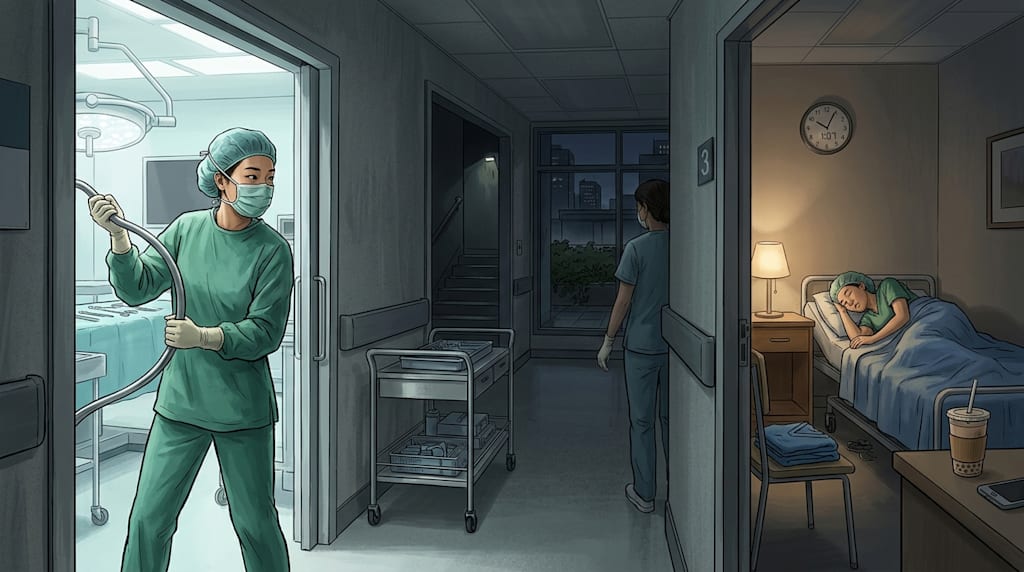
At one in the morning, the operating room had a smell of its own. Not blood. Not disinfectant. A mix of laminar airflow, laundered scrubs, and the old pillow in the call room. The corridor lights were half off. The whole hospital seemed asleep except the light at the end of the hall.
I was a graduate student then. I followed my attending into the OR during the day and slept in the OR call room at night. People later heard the story and said I had unusual stamina. I could operate until seven or eight, then stay with a nursing intern while she washed instruments, prepared supplies, and finished her notes. I could walk her back to her dorm after midnight and still be on the OR schedule the next morning. The rumor in the OR was that I was gifted, that I needed no sleep in twenty-four hours.
The rumor was cleaner than the truth.
They saw me working when they looked. They did not see me sleeping when they did not look. The energy was an attention trick. A schedule did the work.
I lived in the OR for twenty-four hours a day.
After rounds at eight, I volunteered to stay in the OR and take the whole day with my attending. I took the four and five o’clock cases nobody wanted, the cases that would keep a resident past the end of a normal shift. I took them all. The other graduate students could leave on time. In exchange, they managed patients, wrote orders, and finished the notes for me. The trade was simple. They got their evenings. I got the OR.
At eight-something I was already in the room. The first patient was still under anesthesia induction, still being intubated, still having lines placed. That gave me half an hour. I could eat breakfast. I could go back to sleep. To the nurses and residents walking past, I was the first one in the OR every morning.
Between cases there were twenty to forty minutes. I used them. I found a folding chair in the instrument room, set an alarm for twenty minutes, and slept. Most days the alarm did not ring. I woke before it, splashed cold water on my face, and walked back into the room. If I skipped lunch, I could get forty minutes. Charge and drain, charge and drain. The body can look like a machine when the charging is hidden.
At seven or eight in the evening, my cases were done. I went into the OR call room and lay down. I only covered the nursing intern’s night shifts. Day shifts had too many people. The nursing intern’s day shift ended around four. A doctor’s day rarely ended then. So during the day we left each other alone. Her night shift ran until about one in the morning. During that shift she was moving without a break. She had no time to look for me. I slept in the call room until one, then walked out with a cup of milk tea.
She would come out at seven minutes past one, pushing the instrument cart. I would be at the end of the corridor. The cup had water beads running down the side. The sleeve said: less sugar, add pearls. She took it. Her fingers touched my knuckles. Neither of us pulled away.
“What time did you sleep?”
“I didn’t. I was reading.”
The book on the desk had been open to the same page since eight. She drank. She chewed the pearls.
“Too sweet. Another shop tomorrow.”
I said okay. We stood in the corridor. Neither of us mentioned the call room door was open, or that my scrubs were hanging inside.
To her, it looked simple. When she finished work, I answered at once. When she called, I was there. The timing was perfect. The timing was the whole thing.
People think a full day in the OR is exhausting. As a graduate student in his twenties, I pulled retractors and held the scope. I did not carry responsibility. I did not make decisions. The attending said do this, I did it. The attending said move, I moved. The attending cursed, I took it. The cognitive load was low. The physical load was real, but it was not the kind that empties your head.
I also cut out the friction that eats a normal working day.
Commute. Office workers spend an hour a day on buses and trains. My colleagues stood on buses, sat in traffic, walked from the station. I was asleep.
Housing. For a surgical trainee, the OR call room is a place to recover that most people ignore. It is not the ward call room. It is warm in winter and cool in summer. The air is dry enough and clean enough. Someone cleans it. There is laminar airflow, a shower with steady hot water, and in better hospitals, Wi-Fi, a coffee machine, a massage chair, and gym equipment. My student dorm could not compare.
Clothing. I did not think about what to wear. I did not wash clothes every day. If I was tired, I could put a sheet on the floor and lie down without worrying about my clothes. The OR supplied unlimited scrubs. Loose, comfortable, and on the nursing intern, the wide neckline did something the uniform was not designed to do.
Food. The OR work meal was enough.
Patient disputes. I took cases for my colleagues. They managed my patients. I saw patients who were asleep. No one argued with me. The OR had controlled access. No one has heard of a medical dispute charging into an operating room.
Dates. After she finished, we went to the stairwell, the roof, or the small garden downstairs. It cost nothing. It was the loose hour after a busy shift. The stairwell was quiet. The roof was quiet. The scrubs were loose. We had things to say. At that hour, we did not need dinner and a movie. We went to the point.
None of this made me a hero. It made the day cheaper.
Lu Xun once wrote that there are no geniuses; he simply used the time others spent drinking coffee. I used the time you spent drinking coffee to work, and the time you spent working to drink coffee. When you sit with a coffee and watch, you notice I am working. When you are at your desk with your head down, you do not notice whether I am drinking coffee.
The same goes for energy. You see the part that is visible. You do not see the part that is hidden.
Later, people asked about the sleep. They wanted a trick. There is no trick. Do not give yourself a sleep assignment. Do not say: I have to get up early tomorrow, so I must fall asleep by ten. You lie down. You check your phone. It is ten thirty. You think: I am not asleep yet. Tomorrow I will collapse. You put the phone down. Half an hour later you pick it up again. The anxiety loop keeps you awake. Sometimes you fall asleep and dream that you are still awake, still working. You wake up and feel worse than if you had not slept.
Count a second of rest as gained. Do not count it as lost. A baby’s sleep is good. A nap is good. Lying still without sleeping is also good. The catnap is twenty minutes. You do not need deep sleep. Lying down and letting the body loosen can restore alertness for many people. Occasional insomnia, even a night without sleep, does not destroy the body. People read the sudden-death stories and scare themselves. Most of those cases stack genetic risk, chronic disease, poor diet, alcohol, tobacco, overwork, and emotional strain. One bad night is not the whole stack.
That does not mean ignore everything. Long-term insomnia, snoring, daytime sleepiness, and mood problems need a doctor. Sleep management is not a contest in endurance. It is a way to lower the anxiety and raise the recovery.
The story has a second half that the rumor left out.
I was young. The hospital had a call room. The attending allowed it. My colleagues covered my patients. The schedule worked because several conditions lined up. Not everyone gets those conditions. The trade (I take your late cases, you write my notes) also sits near the line of responsibility and compliance. It is not a model for training. It is a story about a particular room in a particular year.
There is also the part about her.
A graduate student and a nursing intern are not peers in an OR. The room has its own hierarchy. The call room is a work resource. A quiet stairwell at one in the morning is not a neutral place. The story can be told as a joke. It should not be packed as a guide. The power difference was there. The privacy was thin. The charm of the time gap does not make those things disappear.
The reputation did part of the work for me. That is the honest part. The rumor of endless energy made me look better than the schedule did. The schedule made me look better than the sleep did.
Later, the head nurse checked the call room. My scrubs were hanging inside. A cup with a sleeve sat on the desk. She did not say anything. She folded the scrubs and put them on the chair.
That night I did not go back. I sat in the stairwell until the light clicked off. No one stomped. In the morning I was on the OR schedule again. The scrubs stayed folded on the chair.
About the Creator
Jin
Writer of reamstories
https://reamstories.com/jin
Enjoyed the story? Support the Creator.
Subscribe for free to receive all their stories in your feed. You could also become a paid subscriber, letting them know you appreciate their work.
Comments
There are no comments for this story
Be the first to respond and start the conversation.