travel
The ultimate test of a compatible relationship is whether you can stand to travel together.
A Stranger Handed Me a Note on the Train — I’ll Never Forget What It Said
It was one of those grey, drizzly afternoons where the sky feels like it’s been smudged with ash. The kind of day when even the streetlights seem too tired to flicker on. I was sitting by the window on the 4:35 train headed uptown, earbuds in, drowning in a playlist meant to convince me everything was fine. It wasn’t. I had just left a job interview that went so badly, it felt like the universe itself was gently nudging me off the path I’d stubbornly insisted on following for years. My savings were nearly gone. Rent was due in a week. I’d barely spoken to my family in months. And somewhere, deep beneath the surface, I was carrying a heaviness I couldn’t name. The train car was mostly empty. A teenager in a denim jacket was sketching something in a notebook. An older woman sat with her eyes closed, mouthing words to a song only she could hear. And directly across from me sat a man in a dark wool coat, probably in his late sixties, with hands that looked like they’d spent a lifetime building things. He wasn’t reading or looking at his phone. Just… watching the world blur past the window. I didn’t pay him much attention at first. The train lurched, slowing as we approached the next station. A few new passengers boarded. One of them, a girl no older than twenty, sat beside the man. She wore a red scarf and had a worn backpack slung over one shoulder. She looked like she hadn’t slept. A few minutes passed. The man reached into his coat pocket and pulled out a small piece of paper — the kind you’d tear from a notepad, edges rough and uneven. He scribbled something down, folded it once, and without a word, handed it to the girl. I couldn’t hear what was said. She glanced at him, surprised, took the note, read it, and suddenly her expression changed. It wasn’t dramatic. No gasps or tears. Just the faintest lift of her brow, the kind of shift you notice only if you’re paying attention. She mouthed “Thank you”, and he gave a small nod. At the next stop, she left. The man remained. I sat there pretending to scroll through my phone but couldn’t shake the scene I’d just witnessed. Who was this man? What had he written? Why did it matter so much to a stranger on a train? The answer came sooner than I expected. Two stops later, as the doors slid open and people shuffled on and off, the man stood up. As he passed my seat, he paused, leaned down, and placed a folded slip of paper on the empty spot beside me. No words. No glance. Just the soft weight of the note on the vinyl seat. I picked it up. It was the same type of torn paper, the edges frayed. In surprisingly neat handwriting, it read: "Whatever it is you’re carrying, you don’t have to hold it alone." I read it twice. Then a third time. My throat tightened in a way I hadn’t expected. It felt like someone had cracked a window in a room I hadn’t realized was suffocating me. By the time I looked up, the man was gone. I don’t know why it hit me so hard. Maybe it was the timing. Maybe it was the tenderness of a stranger reaching across the invisible barriers we build between ourselves every day. Or maybe it was because no one — not my friends, not my family, not even myself — had acknowledged the quiet weight I’d been dragging behind me for months. A simple note. A sentence scribbled by a stranger. And yet it felt like someone had reached into the crowded, aching parts of my chest and untangled something knotted. I kept that note. I tucked it into my wallet, between an expired library card and a photo strip from a night I barely remembered. And every time the world felt too heavy, I’d pull it out like a lifeline. A few weeks later, I started writing again. Nothing fancy — just journaling, bits of poetry, fragments of thoughts I didn’t have the courage to say aloud. I called my sister. Apologized for disappearing. Applied for a part-time job at a bookstore down the street, just to get back on my feet. Little things. But they mattered. And somewhere along the way, I started leaving my own notes. On park benches. Tucked into library books. Slipped beneath windshield wipers in crowded parking lots. Short sentences. Quiet encouragements for whoever might need them. "You are more loved than you realize." "It’s okay not to be okay." "Your story isn’t over yet." I never signed them. Never waited to see who found them. Just left them like breadcrumbs, hoping they might land in the hands of someone whose world felt as heavy as mine once did. I never saw that man again. Sometimes I wonder if he’s still riding trains, handing out small pieces of paper like tiny life rafts to people silently drowning. Or maybe he was only ever meant to cross my path once. Either way, I’ll never forget him. And I’ll never forget what he said.
By Muhammad Ilyasabout a year ago in Humans
Frozen at the Edge of the Sky
What began as a routine paragliding trip for Chinese pilot Peng Yujiang turned into a chilling brush with death — and a record-breaking ascent that stunned even the most seasoned adventurers. On a clear morning, Peng launched from the scenic slopes of Mount Qilian, nestled in the remote reaches of China’s Qinghai Province. An experienced flyer, he expected a smooth ride, a peaceful glide over the ridgelines, and some breathtaking aerial footage. But within minutes, nature had other plans. Caught in a sudden and violent updraft, Peng's paraglider was yanked skyward with terrifying speed. His planned flight altitude of around 3,000 meters was quickly left behind as the air current thrust him higher and higher — past the cruising altitudes of commercial planes, past the elevation of Everest Base Camp. At a staggering 8,598 meters, Peng found himself in a realm few have ever reached without oxygen support. As he soared into the upper reaches of the atmosphere, Peng's onboard camera continued to record. The footage is both awe-inspiring and horrifying: a lone pilot suspended against a vast blue sky, battered by hurricane-force winds and surrounded by nothing but clouds and silence. But the beauty was deceptive. Up there, the temperature plummeted to -40°C, and Peng's body began to shut down. His fingers and face, exposed to the freezing wind, soon went numb. Frostbite set in rapidly. Breathing became difficult. His vision blurred, and his sense of time and direction began to falter. “I couldn’t feel my face or my hands,” Peng later recounted. “My gloves were thin — not meant for that altitude. I thought, ‘This is it. This is where I’ll die.’” Yet, in that frozen silence thousands of meters above the earth, Peng’s training and instincts took over. Despite the pain and panic, he managed to regain control of his wing. Navigating through turbulence and extreme cold, he guided his paraglider on a descent back toward the earth, eventually landing roughly but safely several kilometers from his launch point. The feat shocked the aviation and adventure sports community. Unwittingly, Peng had set a new altitude record for paragliding — something many only attempt with oxygen tanks and backup crews. But while the achievement was awe-inspiring, it didn’t come without consequences. Local authorities, after reviewing the flight data and investigating weather patterns, decided to suspend Peng’s flying license for six months. The reason: failure to properly evaluate and anticipate dangerous weather conditions. It was a painful but necessary warning — even for seasoned professionals, nature’s fury cannot be underestimated. The aftermath for Peng was physically and emotionally devastating. Severe frostbite left parts of his face and hands permanently damaged. Months of recovery followed, including skin grafts and physical therapy. He suffered nightmares, reliving the moment he lost feeling in his limbs, and the horrifying realization that he might never come down alive. “I survived by luck,” he admitted. “But I also learned. The sky can give you the greatest freedom — and the most brutal lesson.” Experts in the field echoed this sentiment. High-altitude paragliding is notoriously unpredictable, especially when thermals and wind currents shift unexpectedly. What happened to Peng was rare — but not impossible. “He broke a record, yes,” said aviation meteorologist Lin Hao, “but it nearly cost him his life. The atmosphere becomes a different world above 8,000 meters. You are not just flying — you are surviving.” Peng’s story has since gone viral on social media, with millions watching the heart-stopping footage he captured from his glider. While many celebrate his bravery and resilience, others caution against glorifying a flight that nearly turned fatal. “There’s a thin line between courage and recklessness,” one commenter wrote. “Peng walked that line, and the wind nearly pushed him off.” Yet for all the controversy, one truth remains: Peng Yujiang’s unintentional journey into the death zone was more than just a record-setting adventure. It became a sobering reminder of how easily the world above can strip us down to our most fragile selves. In the sky, above the mountains and beyond the clouds, there are no guarantees. There is only the wind, the cold, and the silence. And sometimes, a man in a glider — battling both nature and his own mortality — finds himself flying too close to the edge. And if he survives, he returns with a story that changes how we see both the sky and ourselves.
By DigitalAddiabout a year ago in Humans
Trapped in Antarctica 🥶
An Unforgettable Journey Begins In August 1914, Sir Ernest Shackleton and 27 crew members set sail on the Endurance, bound for Antarctica. Their mission: to cross the frozen continent on foot, a feat never before achieved. Enthusiasm ran high as the wooden ship slipped south past icebergs and stormy seas. Little did they know how quickly that dream would turn into a desperate fight for survival. Trapped in Ice By January 1915, Endurance had reached the Weddell Sea, where thick sheets of pack ice surrounded the ship. The crew tried repeatedly to break free, but the ice held firm. Day after day, the pressure increased until, in October, the hull finally gave way. Water poured in and the vessel began to sink. Shackleton ordered everyone into lifeboats with supplies and life jackets. Their ship lay broken beneath the waves, leaving them stranded on shifting ice floes with no hope of quick rescue. Life on the Floe For five months, the men camped on a giant ice block. Nights were bitterly cold—temperatures often plunged below –20 °C—and winds howled without mercy. Supplies were limited to what they had salvaged: tents, rations, seeds, and a few tools. They hunted seals and penguins for fresh meat and melted snow to drink. Every sunrise brought the fear that the ice might crack or drift farther from land. Yet Shackleton enforced strict routines—daily inspections of the ice, seal hunts, gear repairs, and even games to keep spirits alive. Their unity and discipline proved essential in the face of relentless hardship. A Desperate Sea Crossing As spring approached and the ice weakened, Shackleton realized they must reach solid ground. He and his officers chose three lifeboats and prepared for an 800-mile voyage to Elephant Island. In their 22-foot boats, they battled freezing spray, towering waves, and gale-force winds. Rations ran low, and clothing, soaked through, offered little warmth. After sixteen days of constant rowing and bailing, the men landed on the rocky shore of Elephant Island—battered, but alive. Their relief was tinged with alarm: the island was remote, uninhabited, and far from shipping lanes. The Trek Across South Georgia Elephant Island offered scant chance for rescue. Shackleton took five men aboard the James Caird and set out again—this time toward South Georgia Island, nearly 800 miles away. They weathered seventeen days of incessant storms, navigating by a small compass and sextant. Hypothermia and exhaustion stalked them. Yet Shackleton’s steady leadership and expert seamanship kept the boat on course. Finally, they sighted South Georgia’s rugged cliffs—but landed on the uninhabited southern coast. Shackleton, Worsley, and Crean then embarked on a 36-hour trek over the island’s icy mountains and glaciers, following no map, guided only by their will to survive. When they reached the whaling station at Stromness, they immediately organized rescue parties. Return and Rescue Shackleton made four attempts to reach Elephant Island, each time thwarted by sea ice. But on August 30, 1916—497 days after departing England—he succeeded. Every one of the 22 men left behind was alive. Their weak but joyous faces greeted him from the beach. Not a single life had been lost on the entire expedition, an outcome almost unmatched in the history of polar exploration. Why This Story Matters The Endurance expedition stands as a testament to extraordinary leadership, teamwork, and human endurance. In a remote, frozen wasteland, Shackleton’s calm resolve and deep care for his crew forged unbreakable bonds. His refusal to accept defeat, his willingness to risk his own safety for others, and the crew’s unwavering loyalty ensured that no man was left behind. Their experience reminds us that clear goals, shared responsibility, and mutual trust can carry a group through the darkest trials. A Lesson in Courage and Hope More than a century later, Shackleton’s journey continues to inspire. In boardrooms, classrooms, and rescue trainings, his example is cited as the ultimate case study in crisis leadership. The men of the Endurance endured months of hunger, cold, and isolation—yet emerged as symbols of resilience. Today, their story encourages each of us to face life’s challenges with teamwork, determination, and hope, trusting that even when circumstances seem impossible, the spirit can triumph.
By Echoes by Imadabout a year ago in Humans
Best Time to Book Airline Tickets from Atlanta to Dallas
Traveling between Atlanta, Georgia, and Dallas, Texas, is a common direction for each commercial enterprises and leisure travelers, and airline tickets from Atlanta to Dallas are difficult to get. With a flight distance of around 730 miles and flight time usually under three hours, this direction is closely serviced by multiple airways. However, simply as it’s a well-traveled path doesn’t mean booking a price ticket is constantly sincere, or cheap. The price of airfare can vary significantly depending on while you book, how some distance in advance you intend, the time of year, or even the day of the week. Understanding the pleasant time to book airline tickets from Atlanta to Dallas lets you save cash, keep away from needless pressure, and make the most of your journey.
By Lisa Hormykoabout a year ago in Humans
Fueling the Stars
Among the many concepts envisioned for the future of space exploration, antimatter propulsion stands out as both the most theoretically powerful and the most technologically demanding. It is a concept born at the edge of physics and engineering—one that could revolutionize how humanity travels through the cosmos. While still in the realm of experimental physics, antimatter propulsion represents a radical leap beyond conventional rocket technology, promising unprecedented speeds and efficiency. The principles behind this idea draw from the very fabric of the universe: the fundamental relationship between matter, energy, and the structure of particles. --- What Is Antimatter? To understand antimatter propulsion, we must first understand antimatter itself. Antimatter is a form of matter composed of antiparticles, which are mirror images of the particles that make up regular matter. For example: The positron is the antiparticle of the electron. It carries the same mass but has a positive charge instead of a negative one. The antiproton is the opposite of the proton, possessing a negative charge. When a particle and its corresponding antiparticle come into contact, they undergo mutual annihilation, converting their mass entirely into pure energy. This is no ordinary chemical reaction; it's governed by Einstein’s iconic equation, E = mc², which states that even a small amount of mass can release an enormous amount of energy. This reaction is incredibly efficient—far more efficient than nuclear fission or fusion, and orders of magnitude more powerful than chemical combustion used in today’s rockets. --- Unleashing Immense Energy To grasp the staggering potential of antimatter propulsion, consider this: the annihilation of just one gram of antimatter with one gram of matter could release about 90 terajoules of energy. That’s equivalent to approximately 43 megatons of TNT—nearly 3,000 times more powerful than the bomb dropped on Hiroshima. This kind of energy density could dramatically reduce travel times across the solar system and potentially enable interstellar missions. For comparison: A trip to Mars, which currently takes 6 to 9 months using chemical rockets, could be reduced to mere days. A journey to Pluto, which took NASA’s New Horizons probe 9.5 years, could take less than a month with antimatter propulsion. In theory, even Proxima Centauri, the nearest star system to Earth at 4.24 light-years away, could be reached in decades rather than millennia. Such a propulsion system could fundamentally change the scope of what is achievable in human space exploration. --- How Would Antimatter Propulsion Work? There are several proposed designs for how antimatter could be used in a propulsion system, each with varying degrees of feasibility: 1. Direct Annihilation Drives: This concept involves directing the energy released from antimatter annihilation directly out of a spacecraft to create thrust. However, the process releases high-energy gamma rays, which are extremely difficult to control and dangerous to both crew and equipment. 2. Antimatter-Initiated Fusion: In this model, small amounts of antimatter are used to trigger a fusion reaction in a more easily managed fuel like deuterium or helium-3. This approach would combine the efficiency of antimatter with the relative controllability of fusion, potentially offering a more stable and safer means of propulsion. 3. Positron Propulsion: Instead of using heavier particles like antiprotons, some scientists propose using positrons, which are more readily produced. While not as energy-dense as antiproton reactions, positron propulsion might be easier to handle in early applications. Regardless of the method, all designs face the same fundamental challenge: safely storing and managing antimatter. --- The Challenge of Production and Storage Currently, antimatter is one of the most expensive materials on Earth. It is produced in tiny amounts at facilities like CERN (the European Organization for Nuclear Research) using powerful particle accelerators. According to NASA, producing just one milligram of antimatter would cost around $100 billion. At current rates, humanity produces only a few nanograms per year. Even if cost were not a barrier, storing antimatter safely is a major engineering hurdle. Since antimatter will annihilate upon contact with any matter—including the walls of a container—it must be suspended in magnetic or electromagnetic traps, such as Penning traps. These systems use powerful magnetic fields to keep antimatter particles floating in a vacuum, avoiding collisions with physical surfaces. But these storage methods are energy-intensive, fragile, and not yet capable of holding the quantities needed for propulsion. --- Research and Future Prospects Despite these monumental challenges, research into antimatter propulsion continues, driven by organizations like NASA, ESA (European Space Agency), and private think tanks. Several papers in journals such as the Journal of Propulsion and Power have explored potential designs and long-term feasibility. NASA’s Institute for Advanced Concepts (NIAC) has even funded studies on antimatter-based propulsion, including hybrid systems that could initiate micro-fusion explosions or power ion drives. These hybrid approaches are seen as stepping stones toward more advanced systems that could one day support manned missions to outer planets and beyond. Moreover, advances in magnetic confinement, miniaturized accelerators, and radiation shielding may make antimatter technology more practical in the coming decades. --- Implications for Humanity If antimatter propulsion becomes viable, its implications for space exploration are profound. It could allow for: Routine travel to the outer solar system Fast, efficient crewed missions to Mars and beyond Exploration of exoplanets and star systems within a human lifetime A paradigm shift in interstellar communication and colonization efforts However, it also raises ethical and security questions. Antimatter’s immense energy density makes it a potential weapon of mass destruction—far more devastating than any nuclear device. Strict international controls would be required to prevent misuse. ---
By Faizan Khanabout a year ago in Humans
Humanity’s Deepest Journey
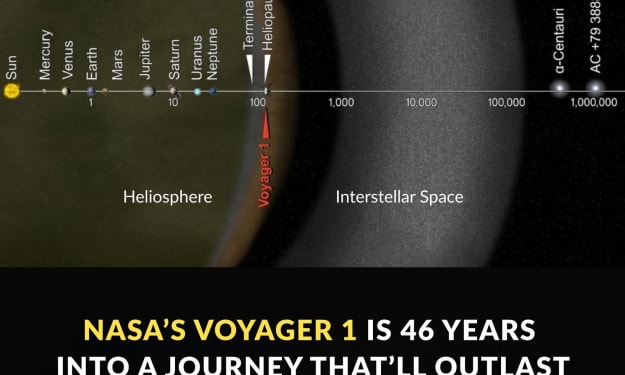
In the vast and mysterious ocean of space, a lone traveler drifts silently beyond the bounds of our solar system. Launched by NASA on September 5, 1977, Voyager 1 has become more than just a spacecraft—it is a symbol of human curiosity, scientific achievement, and our eternal desire to explore the unknown. As of today, Voyager 1 is the farthest human-made object from Earth, traveling at an astonishing speed of over 61,000 kilometers per hour (about 38,000 miles per hour). It has traveled more than 24 billion kilometers (15 billion miles) from Earth, and it continues its journey into interstellar space—the space between stars—where no spacecraft has gone before. Originally designed as part of a twin-mission alongside Voyager 2, Voyager 1 was launched to take advantage of a rare planetary alignment that allowed spacecraft to slingshot from planet to planet using gravitational assists. These gravity boosts enabled it to achieve speeds unattainable by conventional propulsion methods alone. --- A Grand Tour of the Outer Planets Voyager 1’s primary mission was to conduct flybys of Jupiter and Saturn, collecting high-resolution images and data about their atmospheres, moons, and magnetospheres. What it returned exceeded all expectations. At Jupiter, Voyager 1 captured the first detailed images of the planet’s swirling atmosphere and revealed stunning features such as the Great Red Spot, a giant storm system larger than Earth. It also discovered active volcanoes on Io, one of Jupiter’s moons—marking the first time active volcanism had been observed on another body in the solar system. When it reached Saturn, Voyager 1 provided an unprecedented view of the planet’s iconic rings, showing them as complex and dynamic structures with spokes and waves. It also studied Titan, Saturn’s largest moon, revealing a thick atmosphere rich in nitrogen—a tantalizing clue for the study of prebiotic chemistry. After completing its planetary mission, Voyager 1’s trajectory took it out of the plane of the solar system, setting it on course to become our first interstellar probe. --- Crossing into Interstellar Space In August 2012, Voyager 1 made history once again by becoming the first spacecraft to enter interstellar space, crossing the heliopause—the boundary where the solar wind from our Sun gives way to the interstellar medium. This was not a sudden or easily observable event. Determining that Voyager 1 had crossed this threshold required careful analysis of particle data, magnetic field measurements, and plasma wave observations. The spacecraft began detecting high-energy cosmic rays and other signatures indicating it had exited the protective bubble of the Sun’s influence. Despite being in interstellar space, Voyager 1 remains within our galaxy, the Milky Way, and it will continue its lonely journey among the stars for billions of years, long after its instruments go silent. --- The Golden Records: Earth’s Message to the Stars Perhaps the most poetic aspect of the Voyager mission lies in its attempt to communicate with unknown civilizations. Each Voyager spacecraft carries a unique artifact: the Golden Record. Officially titled The Sounds of Earth, this gold-plated copper phonograph disc is a symbolic message from humanity to any extraterrestrial intelligence that might one day intercept the spacecraft. The idea was the brainchild of a team led by the late Carl Sagan, a renowned astronomer and science communicator. The Golden Record contains 116 images, greetings in 55 languages, a variety of natural Earth sounds (like thunder, birdsong, and a baby crying), and 90 minutes of music from different cultures and eras. Included are pieces by Bach, Beethoven, and Mozart, as well as global selections such as a Navajo chant, Senegalese percussion, and even "Johnny B. Goode" by Chuck Berry. In addition to audio and visuals, the record includes a uranium-238 isotope whose half-life serves as a cosmic timestamp, and a diagram showing the location of Earth relative to 14 pulsars, allowing any discoverers to trace our place in the galaxy. The Golden Record is enclosed in an aluminum jacket and includes a cartridge and needle, with visual instructions on how to play it—though whether an alien civilization could or would decipher it is unknown. The record is designed to last over a billion years in space, far longer than human civilization may survive on Earth. --- A Legacy Beyond Time Voyager 1 continues to transmit faint signals back to Earth using its radioisotope thermoelectric generator (RTG), which slowly loses power each year. By around 2025 to 2030, it is expected that the spacecraft will no longer have enough energy to power its instruments or communicate. But even when its voice goes silent, Voyager 1 will continue traveling through space indefinitely. In about 40,000 years, it will pass within 1.6 light-years of another star system. In a billion years, it may still be sailing among the stars, long after Earth and its inhabitants have changed or vanished. The Voyager missions embody a legacy not just of science and engineering, but of philosophy and wonder. They ask profound questions: What does it mean to be human? Are we alone in the universe? How will we be remembered? Even if no intelligent life ever finds Voyager 1 or its Golden Record, the very act of sending it out is meaningful. It is a message to the universe that we were here, that we tried to understand our place, and that we reached for the stars not only with machines but with the hopes of an entire species. ---
By Faizan Khanabout a year ago in Humans