Stream of Consciousness
The Line We Were Never Meant to Cross — Part 2
I shouldn’t have gone back. I knew better. Every nerve screamed, run. But there was something about Aarav that made logic dissolve like sugar in rain. A week passed since that night. A week of sleepless hours, of replaying the feel of his hands, his mouth, the suffocating heat of him pressed against me. I told myself I was done, that I could survive without him. But survival wasn’t enough—I wanted him, and that made me dangerous to myself.
By Rosalina Jane8 months ago in Humans
The Line We Were Never Meant to Cross — Part 1
I knew better than to trust silence. Silence had a way of tempting people into saying things they couldn’t take back. The night I went to Aarav’s house, the city was under a power cut. No streetlights. No neighbors awake. Just rain scratching against windows like it wanted to be let in. I told myself I was there for closure. That was a lie. The door opened before I knocked twice. Aarav stood there barefoot, sleeves rolled up, eyes dark in the candlelight behind him. He looked… undone. Like someone who hadn’t slept, or forgiven himself, or stopped thinking about me. “You shouldn’t be here,” he said. “I know.” Neither of us moved. The storm thundered. Somewhere inside the house, a clock ticked loudly—counting down to something neither of us was ready for. “Come in,” he said finally, stepping aside. The door shut behind me with a sound that felt too final. The house smelled like coffee and rain and something unmistakably him. The living room was lit only by two candles on the table. Shadows clung to the walls, turning familiar furniture into something dangerous. “You said you were done with me,” I said, crossing my arms. “I said I was trying,” he corrected. “There’s a difference.” We had history. Ugly history. Stolen looks that lasted too long. Conversations that went too deep at the wrong hours. A kiss we pretended never happened. And the night he walked away without explanation. “I didn’t come to argue,” I said. “I just wanted to understand why you left.” Aarav laughed softly. Not amused. Bitter. “Because wanting you made me someone I didn’t recognize.” That should’ve scared me. Instead, it pulled me closer. “I waited,” I said quietly. “You disappeared, and I waited like an idiot.” He took a step toward me. One. Slow. Careful. Like approaching a wild thing. “If I touch you,” he said, voice low, “I won’t stop.” My heart slammed against my ribs. “Then don’t touch me,” I whispered. He stopped inches away. Close enough that I could feel his breath. Close enough to smell the rain on his skin. “You’re shaking,” he said. “So are you.” His hand rose—hesitated—then gripped the edge of the table instead of me. Wood cracked softly under his fingers. “This is why I left,” he said tightly. “Because you make me lose control.” I should’ve walked out. Instead, I reached for him. The moment my fingers brushed his wrist, something in him snapped. He pulled me against the wall—hard enough to steal my breath, careful enough not to hurt me. His body caged mine, his forehead resting against my shoulder as if he was fighting himself. “Say the word,” he breathed. “And I’ll let you go.” I didn’t. I tilted my head, exposing my neck without meaning to. That was all it took. His mouth found my skin—slow, claiming, dangerous. Not rushed. Like he wanted to memorize every reaction, every gasp. My hands fisted in his shirt, pulling him closer even as my mind screamed warnings. This wasn’t soft love. This was hunger. He kissed me like he was afraid I’d disappear again. Like the world might end if he didn’t take this moment. When his lips met mine, it wasn’t gentle—it was controlled, deliberate, full of restraint barely holding together. “I hate how much I want you,” he murmured against my mouth. “I hate that I came back,” I replied, breathless. We kissed anyway. Time blurred. The storm raged louder. Candlelight flickered wildly, shadows dancing around us like witnesses. His hand rested on my waist, thumb pressing into my skin like a promise and a threat. Then he stopped suddenly. Forehead against mine. Breathing uneven. “If we keep going,” he said, “this won’t end clean.” I looked at him. Really looked. At the man who ran because he cared too much. At the darkness he carried. At the way he still held me like I mattered. “Nothing about us ever was,” I said. The power came back on with a sharp click. Light flooded the room. Reality rushed in. We stepped apart instantly. I smoothed my clothes. He ran a hand through his hair. The moment shattered, but the damage was already done. I walked to the door. “Don’t disappear again,” I said without turning around. “I won’t,” he replied. I believed him. That was the most dangerous part.
By Rosalina Jane8 months ago in Humans
I’m Feeling the Generation Gap
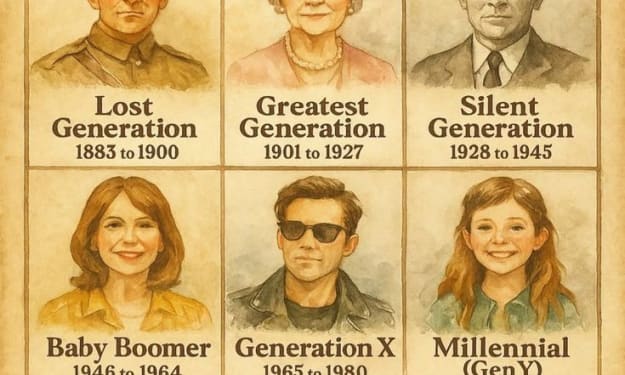
Funny thing, as you get older, everything changes. We start to regress. I call it the cycle of life. We start out as infants who are dependent on our parents. As we get older, we regress and become dependent on our children. Now, I don’t have children, so I am going to be in real strife in the not-too-distant future.
By Calvin London8 months ago in Humans
We Don’t Eat for Nutrition. We Eat for Relief.
There is a certain hour at night when kitchens light up again. The day is technically over. The work is done or abandoned. The phone is finally quiet. And yet refrigerators open, cupboards slide out, and hands reach for food without much thought about taste or nutrition. It happens almost automatically, as if the body is finishing a sentence the day never completed.
By Aarsh Malik8 months ago in Humans
The Unseen Power of Words
Words are among the few things humans create that outlive their creators while still carrying their breath. Long after a voice goes silent, its words continue working quietly, shaping beliefs, framing memories, and steering decisions. We often treat language as a simple tool for communication, a neutral bridge between minds. But words are not neutral. They never were. They are forces.
By noor ul amin8 months ago in Humans
Is true love still out there?
It’d be unfair to say I was unloved. In some capacity, it’s always been there. Parents and grandparents that kind of wanted me (shout out to all my firstborn oops babies out there). The aunts, who found me novel being the first baby since well, them. A little brother and cousins that to some extent care that I’m not dead. It was the familial affection that one would expect. At least, when it was convenient.
By Emily Valentine 8 months ago in Humans
Today, Tomorrow
I had a moment recently where I contemplated what is even genuine anymore in the digital space. Humans were bound to be predictable in our unethical use of AI, I cannot think of any popular user generated platform online that has not been exploited or oversaturated in one way or another. Money, power and dominance are the pillars of society, so it is no surprise the rapid development of AI coincides with the human condition.
By Malachai Hough8 months ago in Humans
The CEO of Everything. Top Story - January 2026.
They say "jack of all trades, master of none," but they forgot to mention the part where the jack of all trades is also the camera woman, the makeup artist, and the person currently yelling at a tangled Wii microphone cable in a her own bathroom while recording herself singing and trying to make it look realistic and professional. (As professional as you can make it with nothing but a cell phone camera and a mic that doesn't work)
By Sara Wilson8 months ago in Humans
How One Neurology Book Changed the Way I Understand the Human Mind
Reading “The Man Who Mistook His Wife for a Hat” Made Me Question What It Means to Be a Person I picked up The Man Who Mistook His Wife for a Hat thinking it would just be one of those clever science books. You know, the kind that explains how the brain works and throws in a few strange cases. I wasn’t really prepared for how weirdly emotional it would feel. Not in a dramatic way. More like the kind of feeling that sits with you quietly while you’re reading. The title made me pause. A man mistaking his wife for a hat sounds silly. Almost like a joke. But when you get into the story, it really isn’t. It’s about someone who just doesn’t see the world the way the rest of us do. Faces don’t look like faces to him. Objects don’t behave like objects. Even his own wife’s face doesn’t show up in his mind the way it should. And that’s… hard to think about. What I liked about Oliver Sacks is that he doesn’t talk about these people like they’re broken. He talks about them like people who are dealing with something strange and difficult, but who are still very much themselves. Some of them forget things. Some of them see the world in pieces. But they still laugh. They still care. They still get annoyed and happy and confused, just like anyone else. The man from the title really stayed in my head. He can speak normally. He can think. But when he looks at the world, it doesn’t line up the way it does for us. So when he reaches for his wife’s head, thinking it’s his hat, it isn’t because he doesn’t love her. His brain just gives him the wrong information. That tiny detail made me feel kind of uncomfortable, because it shows how easily reality can slip if one part of the brain goes off. While I was reading, I kept thinking about how much we trust our minds. We assume what we see is real. What we remember is real. But these stories show that it’s not always that simple. Some people in the book wake up thinking it’s another year. Some don’t recognize their own bodies. Imagine trying to live like that. I don’t think most of us ever really think about how lucky we are that our minds usually stay in sync with the world. The memory parts hit me too. A few of the people can’t remember what happened a few minutes ago. They’re stuck in the present, all the time. They still have personalities. They still feel things. But they can’t build a story of their life anymore. And when you think about it, that story is a big part of who we are. There were moments in the book that felt sad, yes. But there were also moments that felt strangely warm. Some people could still enjoy music. Some could still talk deeply about things they cared about. It made me realize that the brain isn’t just one big switch. You can lose some things and still keep others. I don’t know if this book made me smarter, but it definitely made me more patient. When people act in a way that doesn’t make sense, there might be something going on in their head that we’ll never see. Not everything strange is done on purpose. This isn’t a light, cozy read. But it’s not cold either. It feels very human, even when it’s talking about damaged brains. By the time I finished it, I wasn’t really thinking about science anymore. I was thinking about how fragile being a person actually is. And honestly, that thought stayed with me longer than I expected.
By Rosalina Jane8 months ago in Humans