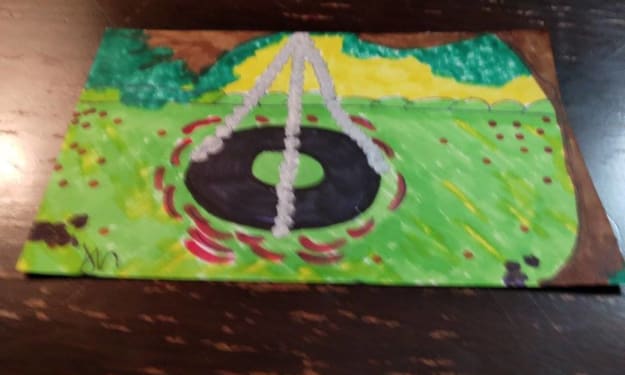
Stream of Consciousness
Personality versus Outward Appearances
Some of you may be wondering why I chose to use an artistic depiction of a tire swing to coincide with an article that is on the topic of human superficiality. I think I'll explain it like a parable. The tire swing is not your typical swing found at most parks. There have been many man-made swings, but the standard swing is not meant to spin and is designed in most cases for one person to sit on. The tire swing is unique because not only is it an upcycle (saving the planet from tires dumped at the bottom of the ocean or rivers) it also can carry two children, swing back and forth, and spin for delirious enjoyment. I think of the tire swing the way I think of how people can sometimes get bent out of shape regarding how people look. Some care nothing about it, while others care too much about it. Most lack a good balance. When someone isn't by standard definition of "attractive" or "beautiful" they are often described as having a great personality, to soften the judgements of those who have not met the person before and introduce them as desirable regardless. Let's say a standard swing is the normal definition of "attractive" or "beautiful", and the tire swing has a great personality. Now you understand the connection.
By Shanon Angermeyer Norman2 years ago in Humans
The Truth About the Russell’s Viper: Understanding the Chandraborha
The Russell's snake, generally known as "Chandraborha" in the Indian subcontinent, has been a piece of this district's environment for centuries. The name "Russell's snake" frequently starts dread, driving numerous to erroneously accept it is an outlandish species. Truly, it is local to our properties, prevalently found in the Barind Lot district.
By MD.KAMRUL HOSEN2 years ago in Humans
Embracing Absence: A Reflection on Self-Worth and Letting Go
It is many times said that failing to remember somebody can be pretty much as simple as a temporary second. However, I view myself longing for the capacity as forgotten simply by somebody whose lack of concern punctures further than any words could. I wish for this individual to eradicate me from their memory, similarly as they have easily segregated themselves from our discussions and my reality.
By MD.KAMRUL HOSEN2 years ago in Humans
The Chameleon Conman: Frédéric Bourdin's Unbelievable Impersonation of Nicholas Barclay
The Chameleon Conman: Frédéric Bourdin's Unbelievable Impersonation of Nicholas Barclay In 1997, Frédéric Bourdin, a 23-year-old French conman, carried out one of the most audacious impersonation schemes in history. He assumed the identity of Nicholas Barclay, a 16-year-old boy from Texas who had been missing for three years. Bourdin’s deception was so convincing that he lived with Nicholas’s family for nearly five months before his true identity was discovered. This blog post delves into the details of this extraordinary case, exploring the psychology behind Bourdin's actions, the impact on the Barclay family, and the eventual unraveling of the deception. The Disappearance of Nicholas Barclay Nicholas Barclay disappeared on June 13, 1994, from his hometown of San Antonio, Texas. He was last seen playing basketball with friends, and his sudden disappearance left his family devastated and desperate for answers. Despite extensive searches and media coverage, Nicholas remained missing, leaving a void that his family struggled to fill. Frédéric Bourdin: The Chameleon Frédéric Bourdin was already a seasoned impostor by the time he assumed Nicholas Barclay’s identity. Born in 1974 in Nanterre, France, Bourdin had a troubled childhood marked by instability and neglect. He began running away from home at a young age and soon developed a talent for assuming new identities. Bourdin adopted numerous aliases over the years, often posing as a lost or orphaned teenager to gain sympathy and assistance from authorities and foster families. Bourdin’s ability to convincingly portray different personas earned him the nickname "The Chameleon." His motivations ranged from a desire for a sense of belonging to a compulsion for deception and attention. However, his impersonation of Nicholas Barclay would become his most infamous and elaborate con. The Impersonation Begins In 1997, Bourdin found himself in Spain, where he decided to take on the identity of a missing American teenager. After a series of phone calls to U.S. authorities, he claimed to be Nicholas Barclay, stating that he had escaped from a child sex trafficking ring. Bourdin provided a harrowing account of his supposed abduction, claiming that he had been subjected to abuse and torture for three years. The story quickly garnered attention, and the U.S. consulate in Spain arranged for Bourdin to be flown to the United States. To support his claim, Bourdin went to great lengths to alter his appearance, dyeing his hair blond and using a razor to create scars on his body that matched descriptions of Nicholas. Despite having brown eyes and a French accent, Bourdin convinced authorities and Nicholas’s family that he was indeed the missing teenager. Reunited with the Barclay Family Upon his arrival in San Antonio, Bourdin was greeted by Nicholas’s family, who were overwhelmed with joy and relief. Beverly Dollarhide, Nicholas’s mother, and Carey Gibson, his older sister, welcomed Bourdin into their home. The family’s eagerness to believe that Nicholas had been found made them overlook inconsistencies in Bourdin’s story and appearance. During his time with the Barclays, Bourdin attended high school and attempted to reintegrate into normal life. However, his behavior and mannerisms often seemed strange to those around him. Bourdin’s limited knowledge of English and his odd responses to questions about his past raised suspicions among Nicholas’s friends and acquaintances. The Unraveling The first major cracks in Bourdin’s façade appeared when a private investigator, Charlie Parker, became involved in the case. Hired by a television producer to investigate the miraculous "reappearance" of Nicholas Barclay, Parker quickly noticed discrepancies in Bourdin’s story and appearance. Parker’s skepticism grew when he compared photographs of Nicholas and Bourdin, noting significant differences in facial features and eye color. Parker’s suspicions led him to contact the FBI, who began their own investigation. In February 1998, Bourdin’s fingerprints and DNA were tested, conclusively proving that he was not Nicholas Barclay. The authorities discovered his true identity, and Bourdin was arrested and charged with perjury and passport fraud. The Aftermath Bourdin's deception had a profound impact on the Barclay family. The revelation that they had been living with an impostor was devastating, compounding the grief and trauma they had already experienced from Nicholas’s disappearance. The family’s desperation to believe that Nicholas had been found blinded them to the glaring inconsistencies in Bourdin’s story. For Bourdin, the exposure of his con marked another chapter in his long history of deception. He was sentenced to six years in a U.S. federal prison, a much harsher sentence than his previous run-ins with the law. After serving his sentence, Bourdin was deported to France, where he continued his life of impersonation and deceit. The Psychology Behind the Deception The case of Frédéric Bourdin raises intriguing questions about the psychology of impostors and the lengths to which they will go to deceive others. Bourdin’s actions were driven by a complex mix of emotional needs, including a desire for acceptance and a compulsion for attention. His ability to convincingly assume new identities highlights the human capacity for deception and the vulnerabilities in our social and institutional systems. For the Barclay family, their willingness to accept Bourdin as Nicholas underscores the profound impact of loss and the lengths to which people will go to find closure. Their desperate hope that Nicholas had returned blinded them to the inconsistencies in Bourdin’s story, a testament to the power of denial and the human need for resolution. Conclusion The story of Frédéric Bourdin's impersonation of Nicholas Barclay is a chilling and fascinating tale of deception and psychological manipulation. Bourdin’s ability to convincingly assume the identity of a missing teenager and live with the boy’s family for nearly five months is a testament to his cunning and audacity. The case highlights the vulnerabilities in our social and institutional systems and raises important questions about the psychology of impostors and the impact of unresolved loss on families. While Bourdin’s deception ultimately failed, it remains one of the most remarkable and unsettling cases of impersonation in modern history. It serves as a reminder of the complexities of human behavior and the lengths to which individuals will go to fulfill their emotional needs and desires.
By Deji Akomolafe2 years ago in Humans
Limerence, Limoncello, and Other Tasty Things. Content Warning.
Limerence. If you do not have the slightest hint of what this word means, then let me speak it. It's a drug, one not to be taken more than once or else you'll end up as miserable as a crone. Addictive substance that it is, no one can truly define how it starts and how it ends, at least to me. It slams you on the face, making you savor the air like the prized heirloom recipe passed down to you, eventually leaving you as quick as it met you.
By Xyrza Marquez2 years ago in Humans
Does a Quote ever hit you the wrong way?
The Quote read: You are keeping yourself from the life you want by feeding the life you don't want. While it seems simple or obvious, this quote disturbed me as I applied it to myself, my life, and my truest desires.
By Shanon Angermeyer Norman2 years ago in Humans
Random Thoughts
As I took a few minutes to breath after an emotional day, I stared up at the clouds blowing across the horizon. Earlier I had been so blissfully happy. I had joked with Mom and laughed so hard that I was almost embarrassed by my childlike joy out in public. Halfway through that trip to the store, I distanced myself from Mom and calmed myself down. Remembering how if I acted like that, no one would take me seriously and that no guy will touch me if I am overly joyous combined with how young I look. Or at least that was what /he/ said again and again...
By Adora Hooper2 years ago in Humans
Is Mindfulness Just a Buzzword?
Mindfulness has become a buzzword in our postmodern, hyper-connected world. Even I repeatedly use the word ‘mindful’ in my writings in different contexts. From meditation apps to wellness retreats, the practice promises a path to inner peace amidst the chaos. But what lies beneath the surface of this practice? Are there any scientific principles that make mindfulness more than just a fleeting trend?
By Waleed Mahmud Tariq2 years ago in Humans
Navigating the Journey, from Fear, to Liberation; Overcoming Social Anxiety and Welcoming a Fresh Start
Social anxiety, also referred to as phobia is a mental health issue characterized by a strong fear of social situations. Individuals dealing with anxiety often feel extremely self conscious and fearful of being judged or rejected in settings. This can result in avoiding interactions, which can greatly affect ones well being. Social anxiety may manifest through symptoms, like sweating, trembling, fast heartbeat and difficulty speaking in scenarios. It may also lead to self perceptions and beliefs that contribute to the cycle of anxiety.
By Aboudraman kanoute2 years ago in Humans