science
The Science Behind Relationships; Humans Media explores the basis of our attraction, contempt, why we do what we do and to whom we do it.
Fueling the Stars
Among the many concepts envisioned for the future of space exploration, antimatter propulsion stands out as both the most theoretically powerful and the most technologically demanding. It is a concept born at the edge of physics and engineering—one that could revolutionize how humanity travels through the cosmos. While still in the realm of experimental physics, antimatter propulsion represents a radical leap beyond conventional rocket technology, promising unprecedented speeds and efficiency. The principles behind this idea draw from the very fabric of the universe: the fundamental relationship between matter, energy, and the structure of particles. --- What Is Antimatter? To understand antimatter propulsion, we must first understand antimatter itself. Antimatter is a form of matter composed of antiparticles, which are mirror images of the particles that make up regular matter. For example: The positron is the antiparticle of the electron. It carries the same mass but has a positive charge instead of a negative one. The antiproton is the opposite of the proton, possessing a negative charge. When a particle and its corresponding antiparticle come into contact, they undergo mutual annihilation, converting their mass entirely into pure energy. This is no ordinary chemical reaction; it's governed by Einstein’s iconic equation, E = mc², which states that even a small amount of mass can release an enormous amount of energy. This reaction is incredibly efficient—far more efficient than nuclear fission or fusion, and orders of magnitude more powerful than chemical combustion used in today’s rockets. --- Unleashing Immense Energy To grasp the staggering potential of antimatter propulsion, consider this: the annihilation of just one gram of antimatter with one gram of matter could release about 90 terajoules of energy. That’s equivalent to approximately 43 megatons of TNT—nearly 3,000 times more powerful than the bomb dropped on Hiroshima. This kind of energy density could dramatically reduce travel times across the solar system and potentially enable interstellar missions. For comparison: A trip to Mars, which currently takes 6 to 9 months using chemical rockets, could be reduced to mere days. A journey to Pluto, which took NASA’s New Horizons probe 9.5 years, could take less than a month with antimatter propulsion. In theory, even Proxima Centauri, the nearest star system to Earth at 4.24 light-years away, could be reached in decades rather than millennia. Such a propulsion system could fundamentally change the scope of what is achievable in human space exploration. --- How Would Antimatter Propulsion Work? There are several proposed designs for how antimatter could be used in a propulsion system, each with varying degrees of feasibility: 1. Direct Annihilation Drives: This concept involves directing the energy released from antimatter annihilation directly out of a spacecraft to create thrust. However, the process releases high-energy gamma rays, which are extremely difficult to control and dangerous to both crew and equipment. 2. Antimatter-Initiated Fusion: In this model, small amounts of antimatter are used to trigger a fusion reaction in a more easily managed fuel like deuterium or helium-3. This approach would combine the efficiency of antimatter with the relative controllability of fusion, potentially offering a more stable and safer means of propulsion. 3. Positron Propulsion: Instead of using heavier particles like antiprotons, some scientists propose using positrons, which are more readily produced. While not as energy-dense as antiproton reactions, positron propulsion might be easier to handle in early applications. Regardless of the method, all designs face the same fundamental challenge: safely storing and managing antimatter. --- The Challenge of Production and Storage Currently, antimatter is one of the most expensive materials on Earth. It is produced in tiny amounts at facilities like CERN (the European Organization for Nuclear Research) using powerful particle accelerators. According to NASA, producing just one milligram of antimatter would cost around $100 billion. At current rates, humanity produces only a few nanograms per year. Even if cost were not a barrier, storing antimatter safely is a major engineering hurdle. Since antimatter will annihilate upon contact with any matter—including the walls of a container—it must be suspended in magnetic or electromagnetic traps, such as Penning traps. These systems use powerful magnetic fields to keep antimatter particles floating in a vacuum, avoiding collisions with physical surfaces. But these storage methods are energy-intensive, fragile, and not yet capable of holding the quantities needed for propulsion. --- Research and Future Prospects Despite these monumental challenges, research into antimatter propulsion continues, driven by organizations like NASA, ESA (European Space Agency), and private think tanks. Several papers in journals such as the Journal of Propulsion and Power have explored potential designs and long-term feasibility. NASA’s Institute for Advanced Concepts (NIAC) has even funded studies on antimatter-based propulsion, including hybrid systems that could initiate micro-fusion explosions or power ion drives. These hybrid approaches are seen as stepping stones toward more advanced systems that could one day support manned missions to outer planets and beyond. Moreover, advances in magnetic confinement, miniaturized accelerators, and radiation shielding may make antimatter technology more practical in the coming decades. --- Implications for Humanity If antimatter propulsion becomes viable, its implications for space exploration are profound. It could allow for: Routine travel to the outer solar system Fast, efficient crewed missions to Mars and beyond Exploration of exoplanets and star systems within a human lifetime A paradigm shift in interstellar communication and colonization efforts However, it also raises ethical and security questions. Antimatter’s immense energy density makes it a potential weapon of mass destruction—far more devastating than any nuclear device. Strict international controls would be required to prevent misuse. ---
By Faizan Khanabout a year ago in Humans
Humanity’s Deepest Journey
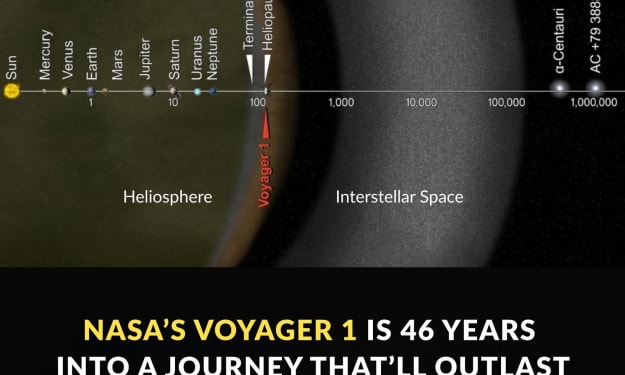
In the vast and mysterious ocean of space, a lone traveler drifts silently beyond the bounds of our solar system. Launched by NASA on September 5, 1977, Voyager 1 has become more than just a spacecraft—it is a symbol of human curiosity, scientific achievement, and our eternal desire to explore the unknown. As of today, Voyager 1 is the farthest human-made object from Earth, traveling at an astonishing speed of over 61,000 kilometers per hour (about 38,000 miles per hour). It has traveled more than 24 billion kilometers (15 billion miles) from Earth, and it continues its journey into interstellar space—the space between stars—where no spacecraft has gone before. Originally designed as part of a twin-mission alongside Voyager 2, Voyager 1 was launched to take advantage of a rare planetary alignment that allowed spacecraft to slingshot from planet to planet using gravitational assists. These gravity boosts enabled it to achieve speeds unattainable by conventional propulsion methods alone. --- A Grand Tour of the Outer Planets Voyager 1’s primary mission was to conduct flybys of Jupiter and Saturn, collecting high-resolution images and data about their atmospheres, moons, and magnetospheres. What it returned exceeded all expectations. At Jupiter, Voyager 1 captured the first detailed images of the planet’s swirling atmosphere and revealed stunning features such as the Great Red Spot, a giant storm system larger than Earth. It also discovered active volcanoes on Io, one of Jupiter’s moons—marking the first time active volcanism had been observed on another body in the solar system. When it reached Saturn, Voyager 1 provided an unprecedented view of the planet’s iconic rings, showing them as complex and dynamic structures with spokes and waves. It also studied Titan, Saturn’s largest moon, revealing a thick atmosphere rich in nitrogen—a tantalizing clue for the study of prebiotic chemistry. After completing its planetary mission, Voyager 1’s trajectory took it out of the plane of the solar system, setting it on course to become our first interstellar probe. --- Crossing into Interstellar Space In August 2012, Voyager 1 made history once again by becoming the first spacecraft to enter interstellar space, crossing the heliopause—the boundary where the solar wind from our Sun gives way to the interstellar medium. This was not a sudden or easily observable event. Determining that Voyager 1 had crossed this threshold required careful analysis of particle data, magnetic field measurements, and plasma wave observations. The spacecraft began detecting high-energy cosmic rays and other signatures indicating it had exited the protective bubble of the Sun’s influence. Despite being in interstellar space, Voyager 1 remains within our galaxy, the Milky Way, and it will continue its lonely journey among the stars for billions of years, long after its instruments go silent. --- The Golden Records: Earth’s Message to the Stars Perhaps the most poetic aspect of the Voyager mission lies in its attempt to communicate with unknown civilizations. Each Voyager spacecraft carries a unique artifact: the Golden Record. Officially titled The Sounds of Earth, this gold-plated copper phonograph disc is a symbolic message from humanity to any extraterrestrial intelligence that might one day intercept the spacecraft. The idea was the brainchild of a team led by the late Carl Sagan, a renowned astronomer and science communicator. The Golden Record contains 116 images, greetings in 55 languages, a variety of natural Earth sounds (like thunder, birdsong, and a baby crying), and 90 minutes of music from different cultures and eras. Included are pieces by Bach, Beethoven, and Mozart, as well as global selections such as a Navajo chant, Senegalese percussion, and even "Johnny B. Goode" by Chuck Berry. In addition to audio and visuals, the record includes a uranium-238 isotope whose half-life serves as a cosmic timestamp, and a diagram showing the location of Earth relative to 14 pulsars, allowing any discoverers to trace our place in the galaxy. The Golden Record is enclosed in an aluminum jacket and includes a cartridge and needle, with visual instructions on how to play it—though whether an alien civilization could or would decipher it is unknown. The record is designed to last over a billion years in space, far longer than human civilization may survive on Earth. --- A Legacy Beyond Time Voyager 1 continues to transmit faint signals back to Earth using its radioisotope thermoelectric generator (RTG), which slowly loses power each year. By around 2025 to 2030, it is expected that the spacecraft will no longer have enough energy to power its instruments or communicate. But even when its voice goes silent, Voyager 1 will continue traveling through space indefinitely. In about 40,000 years, it will pass within 1.6 light-years of another star system. In a billion years, it may still be sailing among the stars, long after Earth and its inhabitants have changed or vanished. The Voyager missions embody a legacy not just of science and engineering, but of philosophy and wonder. They ask profound questions: What does it mean to be human? Are we alone in the universe? How will we be remembered? Even if no intelligent life ever finds Voyager 1 or its Golden Record, the very act of sending it out is meaningful. It is a message to the universe that we were here, that we tried to understand our place, and that we reached for the stars not only with machines but with the hopes of an entire species. ---
By Faizan Khanabout a year ago in Humans
Nourish Your Mind: Gentle Practices for Mental Clarity and Focus. AI-Generated.
In today's fast-paced world, many of us experience moments of forgetfulness, difficulty focusing, or mental fatigue. But the good news is: your brain is not fixed. With the right habits, it’s possible to improve your memory, sharpen your focus, and enhance mental clarity, naturally and effectively.
By DR. Allama iqbalabout a year ago in Humans
Smiling on the Outside, Struggling Inside. AI-Generated.
Monday Morning and the Disappearing Spark Mira was always the dependable one. She woke up early, dressed smart, hit deadlines, and never missed a meeting. Her Instagram showed matcha lattes, yoga poses, and weekend brunches with friends.
By DR. Allama iqbalabout a year ago in Humans
Survivability over Depression
Drowning for your own thoughts? Have you been in your life where you can't think properly? Where your mind is bombarded with unweary thoughts and occupied with so many things that you can't figure out? Is there anything needs to avoid and do about it ? Life is tough nowadays since we're facing this pandemic situation that gave us so many life changing experiences. People lost their livelihood, lost their love one's and lost the life that we used to be. Everyone of us struggling how to survive this unbearable situation, some of us battling with their own thoughts that lead them to depression. They created scenarios in their mind that caused them to isolate themselves from the crowd, hallucinating or the worst thing curtailing their own lives. Depression is a mood disorder that will lower the physical and mental vitality of a person to function actively. A person who lost their interest to the things that they love to do before, changed their mood quickly, having self pity and can't figure out properly are the signs of a person struggling depression. Having this kind of battle is one of the toughest thing because there are people overcome from it and some did not make it. Some of the factors that may triggered of a person experiencing this are the environment that they're moving everyday, the people they mingle and around them most of the time and the emotional situation of a person. In order to survive in this pandemic, we can't deny the fact that we are going to cope the people and the nature of our job even it's not inline of our attainment since we have to provide the needs of our self as well as for our families. Having a healthy environment will help to lessen the burden of a person most specially receiving a support from the people you've rooting the most has a big impact of a person's mindset. It is very important that we must choose properly the circle of friends that we're going to be with most of the time. We must exercise ourselves having a strong mind in overcoming unexpected situations and some shortcomings that will come on our way. We should be vigilant because we are responsible of our own mental health and we must bare in mind that no one will help us aside from our own self. It is necessary to give time in communicating our family because they are our biggest flex when we think other people trying to bring us down. Even though there are instances that there's misunderstanding will occur within our family that will affect us the most we should be open of how we feel so that there's adjustment and solution to figure out the problem. It is important that we must not drown ourselves in forcing the things that we can't make it by our own. We should avoid engaging ourselves from toxic circle that will kill our peace of mind and lower our self worth. Stop pressuring yourself for the success of others and do not listen to the people around who do not do anything to help but to brag you down. We must explore activities that will help us see the importance on how to deal life beyond immeasurable trials. Let's adventure the hidden beauty what truly life can offer us. Strengthening our faith to the Omniscient is a must to make our life more convenient. Let's stop depressing and continue surviving because life is what we make it. "Do something today that your future
By Neel Smithabout a year ago in Humans
AI Girlfriends, Virtual Relationships, and the Future of Love
In 2025, love is no longer confined to candlelit dinners, handwritten notes, or even swipes on dating apps. Instead, it's taking a leap into the digital unknown—where relationships aren’t just mediated by technology, but fully created by it.
By Kamran Zebabout a year ago in Humans
Ed Miliband rejects £24bn plan to bring power from Morocco to UK
**Ed Miliband Rejects £24 Billion UK-Morocco Energy Link in Major Policy Shift** Energy Secretary Ed Miliband has rejected a £24 billion proposal to import renewable electricity from Morocco to the United Kingdom via a record-breaking subsea cable. The ambitious Morocco-UK Power Project, led by British energy firm Xlinks, had aimed to provide up to 8% of Britain’s electricity needs by transporting solar and wind power from the Sahara Desert to the Devon coast.
By GLOBAL NEWSabout a year ago in Humans
The Importance of a Balanced Diet for Long-Term Health
Introduction Eating healthy isn't just about losing weight—it's about feeling good, staying strong, and living a long, happy life. A balanced diet gives your body all the nutrients it needs to work properly. Without the right foods, you might feel tired, get sick often, or develop health problems like diabetes, heart disease, or weak bones.
By MUHAMMAD Abbasabout a year ago in Humans
The photograph that saved her life
The train roared past, its steel wheels screeching against the tracks, drowning out the sounds of the bustling platform. Amidst the crowd stood a girl—thin, pale, almost invisible. Her name was Alina, a 19-year-old who looked more like a shadow than a person. She clutched a tattered schoolbag to her chest and stared blankly at the yellow line just inches from the edge. She had come to the station not to travel but to disappear. Life had become unbearable. Her father had died two years ago in a factory accident, and her mother, overwhelmed by grief, turned cold. Poverty clung to their lives like mold, and Alina, once a bright student with dreams of becoming a journalist, had dropped out of school to work at a sewing shop. Each day drained her more. Each night she cried silently in a corner of their one-room home. Her only escape was through writing in a diary she kept hidden in her bag. But even words had stopped comforting her. On that particular morning, after another argument at home, she walked toward the station with no ticket, no destination—just a decision. She sat on a bench and waited, counting each train, each minute, waiting for the platform to clear enough for her to do it without a scene. As she rose and stepped forward, a voice behind her called out, “Excuse me! Can I take your photo?” She froze. A man, perhaps in his mid-30s, held a professional-looking camera. He wore a denim jacket and had a kind but tired face. “I’m a street photographer,” he explained. “I capture real emotions. You have... something in your eyes. May I?” Alina hesitated. No one had spoken to her kindly in months. She nodded without a word. He clicked the camera once. Twice. Then smiled. “Thank you,” he said gently. “You have a powerful presence.” She didn’t reply but turned away, tears suddenly burning her eyes. She hadn’t heard anything good about herself in a long time. “What’s your name?” he asked. “Alina,” she whispered. “I’m Imran,” he said. “You’re meant for more than sadness, Alina. I don’t know what you’re going through, but... I hope this photo reminds you that you exist. And that you matter.” She didn’t know what to say. He handed her a small card with his Instagram handle. “I’ll post it later. Look for yourself through someone else’s eyes.” Then he walked away, blending into the morning crowd. --- That night, Alina lay awake, the small card still clutched in her hand. She opened her mother’s old mobile and found the photographer’s page. And there it was. The caption read: > “I saw a girl today at the train station. There was sorrow in her eyes, but strength too. This is a face that has a story—a story worth telling. Alina, if you’re reading this: the world is waiting for your voice.” Over a hundred strangers had liked and commented on the post: “She’s beautiful.” “There’s something poetic in her gaze.” “Tell her she’s not alone.” Alina read every word. Again and again. For the first time in months, her tears were not from pain but from a strange sense of hope. She felt seen. --- In the weeks that followed, something shifted. Alina reached out to Imran. They met again. He listened to her story—not with pity, but with respect. He offered to publish her writings as captions on his photographs. Slowly, she began to write again. Short poems. Stories of survival. Dreams long buried. Her words started resonating with others. Imran's page grew. So did her confidence. By the end of the year, she had her own social media account under the name AlinaWrites, where she shared raw, heartfelt pieces about poverty, grief, healing, and hope. A local magazine noticed her and offered her a part-time job writing articles. Her mother, seeing the light return to her daughter’s eyes, began changing too. They healed together—slowly, imperfectly, but truly. --- Years later, Alina stood on the same platform—not as a girl wanting to vanish, but as a woman launching her first self-published book titled “The Photograph That Saved My Life.” A crowd had gathered. Imran stood beside her, proud. She held the book in one hand and the same photograph in the other. It was framed now, preserved like a sacred memory. In the picture, her eyes were tired, but fierce. Lost, yet quietly searching. As she looked out at the crowd, she said, “Sometimes, we think we’re invisible. That no one sees us, hears us, or cares. But all it takes is one person, one moment, one photograph—to remind you that your story matters. That you matter.” The applause was thunderous. But all she could hear was the quiet whisper inside her that had once wanted to give up… now turned into a roar that said, “Keep going.”
By Shehzad khanabout a year ago in Humans
Looks, Brains & Boundary Lines: Unpacking Modern Attraction and Dating Trends for 2025
Not long ago, my best friend called, upset after a disastrous first date. She ranted about mismatched text vibes, awkward jokes, and an overall sense that, despite his good looks, something vital was missing. It’s a story I’ve heard too often lately: in 2025, finding the right match feels much more complicated than judging someone’s face or confidence from across the room—yet we can’t pretend looks don’t matter at all. As dating apps, scientific research, and cultural winds all play tug-of-war with our hearts, what actually attracts us these days? And are we finally ready to admit it’s not just about a symmetrical jawline? Let’s pull back the curtain on modern attraction and dating trends—quirks, contradictions, and all.
By Abdus Salam Khanabout a year ago in Humans
Burnout Made Me Rebuild My Entire Life—And I’m Glad It Did
Burnout Made Me Rebuild My Entire Life—And I’m Glad It Did Let me take you back to a morning that broke me. It was a Tuesday. Nothing special. The alarm went off at 6:30 a.m., like it always did. I had an inbox full of emails, a calendar stacked with Zoom calls, and three deadlines breathing down my neck.
By hammad khanabout a year ago in Humans