science
The Science Behind Relationships; Humans Media explores the basis of our attraction, contempt, why we do what we do and to whom we do it.
Scariest Invention By Nikola Tesla, Hidden from us!
Today, the world knows Nikola Tesla as the man behind the invention of electricity generation systems. But there’s a darker and lesser-known side to his legacy—his terrifying inventions that many still find hard to believe were real.
By Chronicle of Powerabout a year ago in Humans
The Man Who Forgot He Was Alive
The Man Who Forgot He Was Alive He couldn’t remember where he’d put his keys. That was how it started. A small thing. He stood at the doorway, hand frozen over the knob, a blank space in his mind where knowledge used to be. He checked the table, his coat pocket, the kitchen counter—nothing. Eventually, he found them in the fridge, resting beside a carton of milk he didn’t remember buying.
By Huzaifa Dzineabout a year ago in Humans
Why Do We Keep Asking: What Is Love?
What is love? It's a question older than language itself, woven into ancient myths, whispered in sacred temples, etched into poetry, and searched a billion times on the internet today. Love shapes our deepest decisions, our highest joys, and our most painful losses. It is both universal and deeply personal, mystifying and familiar. But in an age where technology mediates connection and commitment is often feared more than desired, the question feels more urgent than ever: What is love today?
By F. M. Rayaanabout a year ago in Humans
5 Deep Questions Everyone Asks Themselves- And What Modern Life, Psychology,and Faith Say About them. AI-Generated.
Across continents, cultures, and generations, there are certain questions that visit the mind of every person. They appear during quiet nights, after heartbreak, in the middle of success, or when life feels uncertain. These are not silly doubts—they're the core questions of being human.
By Nowshad Ahmadabout a year ago in Humans
Putting End to Stereotyping, But Bringing Awareness About Mental Health
People with mental health issues aren't crazy at all. Negative perceptions and incorrect assumptions about mental illness may be as harmful as the disorder itself. Countless barriers are created by the stigma associated with major mental illness. Mental illnesses, also known as mental disorders, are indeed a complex topic of conditions that affect ambiance, thinking, and attitudes. For a long time, it has been defined as the absence of mental illnesses such as anxiety and depression. However, mental illness is generally used for all diagnosable mental disorders -health conditions characterized by changes in mood, thinking, and even our behavior that is associated with distress and impaired functioning. Many people suffering from mental illnesses are now fighting to raise awareness of disorders such as depression and anxiety. The 10th of October is designated as World Mental Health Day to raise awareness about mental health issues around the world and to also make every effort to support mental health. Being mentally healthy is also being physically healthy. Since mental and physical health is inextricably linked. They are both equally important to a person. Considering that it is not only made up the health of a human being but also a person cannot make a progress decently if they are not mentally healthy - and vice versa. People suffering from mental health issues exhibit a variety of symptoms such as having little or no energy, pushing people away and withdrawing from regular activities, losing sleep or the desire to eat, smoking, drinking, or doing drugs, feeling helpless, yelling, and fighting, losing temper quickly, harming themselves, and many others. Amidst the pandemic we are facing right now, we are also facing a mental health crisis worldwide. Especially here in our country, the Philippines. The rate of depressed people and suicide has been increasing pretty quickly. All of a sudden, this has been rather alarmingly to everyone. As reported by ABSCBN News according to the Department of Health on May 19, 2021, there are at least 3.6 million Filipinos that are battling mental health issues as the Philippines continues to grapple with the COVID-19 Pandemic. This has been becoming ubiquitous in the twenty-first century. Not everyone receives the assistance they require. Although mental illness is common these days and affects anyone, it still leaves scars -stigma. Given the fact about stigma, people are still hesitant to accept mental illness. They are ashamed to admit it and seek medical treatment. For an instance in our lives, when it comes to renting a home, applying for jobs, and accessing mental health services, people who are mentally ill face discrimination and prejudice, the reason being behind this is the stereotypes about mental health. Now that we are in the twenty-first century, social media has been popular right now. Particularly a lot of teenagers and kids have benefited from it, since we are in a new normal-where almost everything is done virtually considering the pandemic. In social media, not only we can make ourselves comfortable and enjoy
By Neel Smithabout a year ago in Humans
Notes to My Future Self
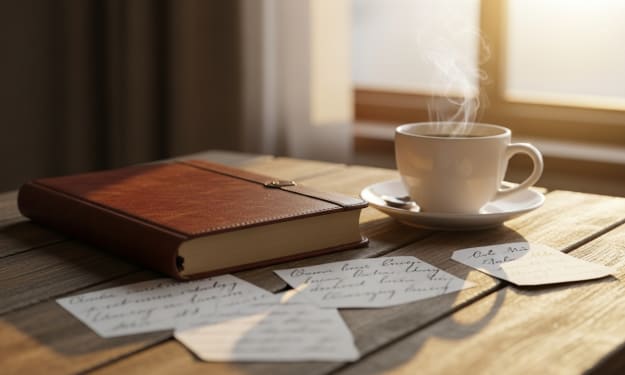
The first note was dated five years ago. It wasn’t written with elegant handwriting or on scented paper. Just a crumpled sticky note tucked between the pages of an old journal I hadn’t opened in years. The ink had bled slightly, probably from tears I didn’t remember crying. "You’re not broken. You’re still building." I stared at it for a long time, heart pounding. I hadn’t remembered writing it, but it was my handwriting. The kind I had in college—hurried, slightly crooked, always in blue ink. I flipped the journal open, and more notes fluttered out like autumn leaves caught in a draft. Some were dated, others not. Some were just single lines: "Call Mom. Even when you’re mad." "Success isn’t peace. Choose peace." "Don’t marry the person who makes you feel small." I read each one like they were sacred texts, letters from the version of me that had felt everything harder, hoped more recklessly, and somehow had the foresight to leave breadcrumbs back to myself. I was thirty-five now. A marketing director in a tech firm. I had a two-bedroom apartment that looked like a Pinterest board come to life. People said I was successful. Confident. Sharp. But I hadn’t felt whole in a long time. It was like I’d built my life on a tightrope—always one wrong step away from falling, but somehow still smiling at the crowd watching from below. Until the day the tightrope snapped. It was a Tuesday. Of course it was. Nothing ever breaks on a dramatic Friday. Just a regular morning—email, coffee, an impromptu meeting—and suddenly, I was standing in the office kitchen, gripping the edge of the counter, unable to breathe. Anxiety attack, the doctor called it. Said it was probably long overdue. Burnout. Stress. Unprocessed grief. Grief? I didn’t know what I was grieving until I opened that journal again later that night. "Future Me, I hope you still dance barefoot in the kitchen. I hope you forgive people, but not so much that you forget what you deserve. I hope you didn’t give up writing." I hadn’t written in years. Once, writing was everything. My sanctuary, my rebellion, my way of making sense of a world that didn’t always make room for sensitivity. But over time, deadlines replaced dreams. KPIs replaced poems. I traded my journals for spreadsheets. And now, here I was—reading a note from a girl who still believed in magic. Who trusted herself enough to leave behind words for a woman she hoped she’d become. I wasn’t sure I’d lived up to her expectations. Over the following weeks, I read every note. I cried through some. Laughed out loud at others. There was one that simply said: "Just because it’s familiar doesn’t mean it’s love." That one hit harder than I expected. It reminded me of Adam. Adam, with his charming smile and emotionally unavailable heart. We were together for two years. I called it love. But looking back, it was more like habit wrapped in fear of loneliness. I’d stayed long after the warmth had faded, convincing myself that comfort was enough. My younger self had seen it coming. Had written a warning. I just hadn’t read it in time. Inspired, I began writing back. “Dear Past Me,” I scrawled late one night, wine glass half-empty beside me. “You were right. About more than I ever gave you credit for.” I wrote about the days I’d felt like quitting. The friendships I let fade because I was too “busy.” The moments I had stood in front of the mirror and hated my reflection—not for how I looked, but for how far I’d strayed from who I wanted to be. But I also wrote about healing. About finally understanding that success isn’t climbing a ladder—it’s learning when to step off. I told her that I had started dancing again in the kitchen, barefoot and unbothered. That I had called Mom. That I had started writing again. --- One evening, I invited a few close friends over. We poured wine and passed around blank notecards. “Write a note to your future self,” I told them. “Something you’ll want to remember five years from now.” They looked skeptical at first, but eventually, the room grew quiet as pens moved across paper. We sealed the notes in envelopes, wrote the date on the outside, and agreed to meet again in five years to open them. A small ritual of hope. Now, the journal is thicker than ever. Filled with letters to and from my past selves. A map of mistakes, lessons, and little victories. And every now and then, when I feel lost again, I turn the pages. I don’t always find answers. But I find myself. If you’re reading this, maybe write a note today. Not for who you are now—but for who you hope to be. She’ll thank you for it. I know I did.
By Shah Nawazabout a year ago in Humans
The Art of Slowing Down
We live in a world that rewards speed. Faster results. Quicker replies. Instant updates. We rush through our mornings, skim through meals, multitask our way through work, and collapse into bed with one eye on tomorrow’s to-do list. Success is often measured in how much we can get done, how quickly we can reply, and how far ahead we can stay. But in all this momentum, we’ve lost something essential. We’ve forgotten how to slow down. Slowness Is Not Laziness Let’s get one thing straight: slowing down doesn’t mean giving up. It’s not laziness, or apathy, or failure. It’s intention. It’s choosing presence over productivity. It’s recognizing that our value isn’t determined by our output. In fact, the art of slowing down is a form of rebellion—a conscious choice to push back against a culture that glorifies burnout and busyness. The Moment That Made Me Pause My own journey toward slowness began the hard way. I was juggling two jobs, trying to finish a side project, replying to texts at red lights, and sleeping with my phone under my pillow “just in case.” I thought I was being efficient, maximizing every moment. Until one day, I missed something. I was sitting at a coffee shop, laptop open, multitasking like a pro. I barely noticed the elderly man beside me until the barista brought over his drink with a warm smile and said, “See you tomorrow, Mr. Patel.” He smiled back and said, “Same time, same place.” And then he just… sat. No phone. No laptop. Just sipping his coffee and looking out the window. He wasn’t wasting time—he was using it well. That moment stuck with me. I started asking myself, What am I racing toward—and what am I missing along the way? The Hidden Cost of Constant Speed When we move too fast, we trade depth for efficiency. We skim books instead of reading them. We eat while scrolling instead of tasting. We talk but don’t always listen. We even forget how to breathe properly. (Seriously—how often do you take a full, slow breath?) Chronic rushing leads to chronic stress. Our bodies stay in fight-or-flight mode, our minds bounce from thought to thought, and our creativity flattens under pressure. Relationships suffer. Sleep suffers. Life begins to feel like a blur. Slowing down isn’t just a nice idea—it’s necessary for mental, physical, and emotional health. The Beauty Found in Slowness When you slow down, you start to notice things again. You feel the warmth of sunlight through the window. You hear the wind in the trees. You taste the first sip of coffee. Conversations become richer. Walks become meditative. Even boredom—once the enemy—becomes a doorway to creativity. Slowness teaches you to live rather than perform. You’re no longer rushing through your life as if it’s a task list. You’re experiencing it fully. Practical Ways to Slow Down Slowing down is not about dropping everything and moving to a mountain cabin (though that does sound nice). It’s about small shifts in awareness and habit. Here are some practical ways to begin: 1. Wake Up Without Rushing Start your day 15 minutes earlier. Use that time to stretch, sip tea, or sit in silence. Resist the urge to check your phone immediately. Let your mind ease into the day. 2. Practice Mindful Transitions Pause between tasks. Take a few deep breaths before switching from work to dinner, or from a meeting to your commute. These tiny pauses anchor you. 3. Single-Tasking Over Multitasking Multitasking splits your focus and increases stress. Try doing one thing at a time. If you’re walking, walk. If you’re eating, eat. Your brain (and body) will thank you. 4. Create Technology-Free Time Designate moments in your day that are screen-free. No social media. No notifications. Just you, the present, and whatever you choose to do with it. 5. Schedule Nothing Yes—schedule unstructured time. A morning with no plans. An hour to wander. Let yourself get bored. That's where ideas and peace can bloom. --- Conclusion: Slow Is a Superpower We often say life is short. But maybe, life just feels short because we speed through it. Slowing down doesn’t mean doing less—it means living more deliberately. It means noticing the world around you, the people beside you, and the person you are becoming. You don’t need to escape to live more slowly. You just need to pause, breathe, and remember that time is not a race to win—it’s a rhythm to feel. So take a deep breath. Unclench your jaw. Look up from your phone. And take the scenic route—because sometimes, the detour is the destination.
By Junaid Ali (Official)about a year ago in Humans