science
The Science Behind Relationships; Humans Media explores the basis of our attraction, contempt, why we do what we do and to whom we do it.
What Are Probiotics, and Do They Actually Work?
You might’ve seen the word “probiotic” plastered across many products when skimming the grocery store, most often on yogurts and health drinks. They also often have “improves gut health” labeled on these products, but what does that even mean? Do they even really work?
By Seliyan Selvakumar7 months ago in Humans
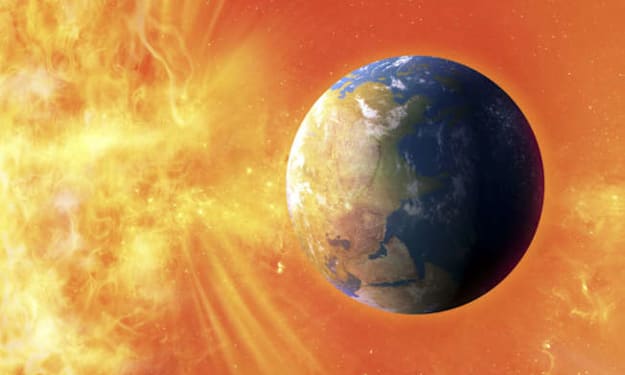
The Earth has already passed a point of no return
Earth's atmosphere is running out of time. Not tomorrow, not in a century, but in approximately one billion years, the air we breathe — the oxygen that every living creature on this planet depends upon — will become unbreathable. According to a landmark new study, there is nothing anyone can do to stop it.
By Shirley Oyiadom7 months ago in Humans
History’s Most Famous Biologist
Charles Robert Darwin transformed the way we understand the natural world with ideas that, in his day, were nothing short of revolutionary. Celebrated as one of the greatest British scientists who ever lived, but in his time, his radical theories brought him into conflict with members of the Church of England. All animals were created by God, except in Darwin’s eyes, they were not.
By Calvin London7 months ago in Humans
🌕 Humanity Returns to the Moon After 50 Years
A New Era of Space Exploration For the first time in more than 50 years, humanity is preparing to return to the Moon. The last time astronauts walked on the lunar surface was during Apollo 17 in 1972. Since then, the Moon remained quiet, visited only by robotic spacecraft and satellites. But today, a new space race has begun — and this time, the goal is not just to visit the Moon, but to stay.
By Wings of Time 7 months ago in Humans
The Woman
The Rare Genetic Condition That Sounds Like a Superpower But Is Actually a Death Sentence THE GIRL WHO NEVER CRIED 😶 Jo Cameron lived the first seventy-one years of her life without understanding why she was different from everyone around her, why she could hold her hand over a candle flame without flinching while others yanked their hands away in agony, why she had walked around with a broken arm for days as a child without mentioning discomfort because she genuinely felt none, why childbirth which other women described as the most painful experience of their lives felt to her like mild pressure rather than agony, and why she could eat scotch bonnet peppers rated at over one hundred thousand on the Scoville scale without any burning sensation while her dinner companions gasped and reached for water, and she assumed that she simply had a high pain tolerance and that other people were being dramatic about their discomfort until 2013 when she had hand surgery and the surgeon noticed that she required no pain medication during recovery and referred her for genetic testing that would reveal something extraordinary 🧬
By The Curious Writer7 months ago in Humans
AI as a Reflective Surface
Much of the confusion surrounding artificial intelligence comes from treating it as an agent rather than a surface. When people speak about AI “doing the thinking,” “creating the ideas,” or “speaking for someone,” they are often projecting agency onto a system that does not possess intention, belief, or understanding. This projection obscures what is actually happening in many real-world uses. In those cases, AI is not acting as a source of meaning, but as a surface that reflects, redirects, and reshapes what is already present.
By Peter Thwing - Host of the FST Podcast7 months ago in Humans
Why Saying Less Makes Words Feel More Valuable
There is a widely held belief that words gain value through scarcity. When someone speaks rarely, their statements are treated as weightier, more deliberate, and more worth attending to. When someone speaks often, their words are assumed to be interchangeable, disposable, or less carefully considered. This intuition is not entirely wrong, but it is frequently misapplied. Scarcity does affect perception, but perception is not the same as truth, and rarity is not the same as meaning.
By Peter Thwing - Host of the FST Podcast7 months ago in Humans
The Science of Spirituality
Spirituality is not a destination to reach but is a frequency that is constantly being broadcast. Much like a radio station, it exists in space regardless of whether we have the ears or equipment to listen to it. It is entirely invisible to the eye and silent to the casual observer, yet its lack of physical presence does not diminish its reality or its power. Whether you are actively listening or lost in the static of daily life, the signal remains – unwavering and omnipresent simply waiting for to tune in. To unmask spirituality is to realize that the music has been here the whole time.
By Susan Eileen 7 months ago in Humans