photography
Photography that showcases the best, worst and everyday moments of modern relationships.
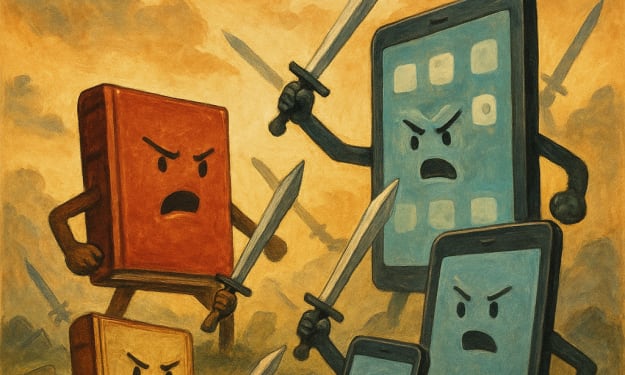
The Battle of Pages and Screens
ChatGPT said: The Battle of Pages and Screens (A story of words, wisdom, and war) Once upon a time, in a world divided by ink and electricity, there stood two kingdoms — the Realm of Pages and the Empire of Screens. For centuries, they lived in uneasy peace. The Pages were ruled by Queen Bibliara, a wise monarch made of parchment and poetry. Her people — novels, storybooks, encyclopedias, and journals — lived in grand libraries and whispered stories to anyone who turned their pages.
By abdul qadir12 months ago in Humans
The Stranger Who Knew Too Much About Me
It began on a Tuesday night — the kind of quiet evening when scrolling through social media feels like background noise. I was half-asleep, thumbing through Instagram stories when a new follow request popped up: @lifebylena.
By Malaika Piolet12 months ago in Humans
Retro Tech 100
Retro Tech 100 The Sound Era: 10 Devices That Changed How We Heard the World. Before streaming became invisible, music was something you touched. It had texture, temperature, and ritual. You flipped switches, pressed clunky buttons, wound tape with a pencil, and carried sound like a secret. Every beat took effort; every song, a bit of patience.
By Sayed Zewayed12 months ago in Humans
Fabric of Dreams
Auther Name Asmatullah Fashion has never been just about what we wear. It is an ever-evolving narrative that connects culture, identity, comfort, and creativity into one seamless fabric. Every piece of clothing is more than a stitched garment; it is a reflection of who we are, what we believe in, and how we choose to be remembered. The concept of a fabric of dreams does not merely imply fine threads and exquisite textures; it conveys a deeper reality where fashion becomes a companion to human aspirations, a space where comfort and class are perfectly balanced.
By Asmatullahabout a year ago in Humans
The Deluge of 2025: Pakistan’s Battle Against a Relentless Flood
A Nation Under Water August 2025 will be remembered in Pakistan’s history as a month of heartbreak. What began as heavy monsoon rains quickly turned into a national disaster. Torrential downpours, cloudbursts in the north, and collapsing glacial lakes unleashed torrents of water across provinces, leaving behind devastation on a scale that once again tested the resilience of millions. Entire villages vanished under mudslides in Khyber Pakhtunkhwa, crops were swallowed by overflowing rivers in Punjab, and mountain roads were swept away in Gilgit-Baltistan. This was not just another flood season—it was a catastrophe that revealed how deeply vulnerable Pakistan remains in the age of climate change. --- The Human Cost In the north, flash floods and landslides hit hardest. Swat, Bajaur, and Buner districts witnessed scenes of horror: houses crumbling, bridges collapsing, families running for higher ground. More than 300 lives were lost in a matter of days, with Buner district alone burying over 150 people after a rare cloudburst. Rescue helicopters were dispatched, but even they were not spared—one crashed during operations, adding five more names to the list of martyrs. Meanwhile, Punjab faced its own nightmare. The mighty Ravi, Sutlej, and Chenab rivers swelled beyond their banks after days of relentless rain, worsened by water releases from India. By late August, more than 1.2 million people were directly affected, with nearly a quarter of a million displaced from their homes. Families camped out on roadsides, clutching what little they could carry as they watched floodwaters consume their fields and homes. And then came Gilgit-Baltistan, where melting glaciers unleashed a deadly glacial lake outburst flood in Ghizer district. At least 10 people were killed, hundreds of families displaced, and more than 300 homes destroyed. It was a chilling reminder that Pakistan’s mountains, once symbols of serenity, are now ticking climate time bombs. --- Why This Keeps Happening It’s easy to call these floods a “natural disaster.” But the truth is more complex—and more uncomfortable. Pakistan contributes less than 1% of global greenhouse gas emissions, yet it ranks among the countries most battered by climate change. Rising global temperatures are melting the Hindu Kush–Himalaya glaciers at record speed, feeding rivers and destabilizing valleys. Deforestation has stripped the land of its natural defenses—forests that once slowed water flow and prevented soil erosion are gone. Then there’s the failure of the global community. After Pakistan’s catastrophic floods of 2022, billions were pledged in aid for reconstruction. But by 2025, less than 20% of that money had been delivered. Entire communities still live in makeshift shelters from three years ago. The new floods didn’t just destroy homes—they swept away fragile hopes of recovery. This isn’t just a story of rainfall. It’s a story of climate injustice. --- Acts of Courage Amidst Chaos Yet, amidst the wreckage, stories of courage continue to shine. The Red Cross and local rescue teams waded through waist-deep waters to save stranded families. Alkhidmat Foundation carried out over 140 rescue missions, saving more than 650 people while distributing food, water, and tents. In Punjab, authorities relocated more than 24,000 residents to safer ground, often in a race against time. Global aid also trickled in—the Gates Foundation pledged $1 million through the WHO to help nearly half a million victims. It’s a start, but far from what’s needed for a disaster of this magnitude. --- What the Future Demands By the end of August, Pakistan’s official death toll had crossed 800. Unofficial estimates put the number even higher. Entire families have been erased, crops destroyed, and livestock drowned. For a country where millions already live hand-to-mouth, such devastation pushes the line between survival and collapse. But this is not just about Pakistan. This is about the world we’re building. The 2025 floods tell us that climate change is not a distant threat—it’s already here, rewriting lives and landscapes. Pakistan’s story should ring as a warning: without global responsibility, stronger infrastructure, and local preparedness, tragedies like this will not remain rare. They will become the new normal. --- Final Reflection The floods of 2025 were not just a clash of water and land. They were a clash between a vulnerable nation and a warming planet, between promises made and promises broken. And while Pakistan mourns its dead and struggles to rebuild, the question echoes louder than ever: How many more times must the people of this country drown for the world to finally listen?
By Muhammad Bilalabout a year ago in Humans
A Complete Guide to Living a Balanced and Healthy Life
What Is Health? Health is more than just the absence of illness; it is a state of complete physical, mental, and social well-being. The World Health Organization (WHO) emphasizes that good health allows individuals to live productive, fulfilling lives. It impacts every aspect of our daily existence—from energy levels and mood to productivity and longevity. In today’s fast-paced world, taking care of your health has become more important than ever.
By salamguideabout a year ago in Humans
Meet Slavic Women: How To Find Single Slavic Girls Online
Single Slavic women attract men from all over the world since they incorporate everything guys want to see in their ideal partners: outer beauty, unparalleled features, and real family values. If you want to meet Slavic women for dating and marriage, check this review, and you’ll find your true soulmate easily.
By Paul Sandersabout a year ago in Humans