love
All you need is Love, and Love is all you need.
When You Both Choose Growth Over Blame
In every relationship, there are instances of tension, disappointment and miscommunication. However, a real turning point occurs when the two partners are ready to quit accusing one another and instead concentrate on developing as a couple. This transition alters the emotional mood. Rather than considering a problem as an evidence of failure, you start to perceive it as a chance to learn to know each other better.
By Steve Waugh9 months ago in Humans
Why True Love Requires Daily Understanding
Real love is not maintained by big gestures and every now and then but on everyday knowledge. Once two individuals are trying to refer to one another in the way of constant attempts to comprehend their sentiments, demands, and experiences, the connection is made more powerful and meaningful. Being aware is the blood that flows in love. It helps to avoid the emotional distance and establishes the basis of trust and intimacy.
By Steve Waugh9 months ago in Humans
How to Nurture a Love That Feels Secure
A safe relationship is home-based, predictable, cozy and soul-binding. It is cultivated as a deliberate action and not chance. As soon as love is safe, each of the partners will feel respected, encouraged and comprehended. This permanence turns the relationship into a place of safety where susceptibility can be embraced instead of dreaded. This kind of love forms the basis on which long term connection is established.
By Steve Waugh9 months ago in Humans
I Married the Love of My Life, and I Have Never Felt More Alone
If you looked at our Instagram profile, you would probably hate us. We look perfect. We go on date nights every Friday at the trendiest restaurants. We smile broadly in photos at weddings, our arms wrapped around each other. We hold hands when we walk into parties, projecting the image of a solid, unbreakable unit. Our friends constantly tell me, “You guys are so lucky. You are relationship goals.” I smile, say thank you, and squeeze his hand. Then I go home, lock the bathroom door, turn on the shower so he can’t hear me, and sit on the floor in silence because it is the only place I can breathe. I love my partner. That is not the issue. He is a good man. He works hard to provide for us. He doesn't raise his voice. He is kind to my parents. He remembers anniversaries and buys me flowers on Valentine's Day. On paper, he is everything a woman should want. But somewhere along the way, we stopped being "soulmates" and started being "roommates." The loneliness didn't happen overnight. It wasn't a sudden explosion. It was a slow, quiet erosion, like water wearing down a rock. It started when we stopped asking, “How are you really feeling?” and started asking, “Did you pay the electric bill?” It started when we stopped talking about our dreams, our fears, and our wild ideas, and started talking only about logistics. Schedules. Groceries. Chores. The maintenance of life took over the living of it. Now, our evenings are a perfectly choreographed routine. We sit on the same sofa, watching the same TV show, but we are miles apart. He is scrolling on his phone, laughing at videos I can't hear; I am reading a book I don't talk to him about. There is a physical body next to me—warm, breathing, familiar—but the emotional connection feels like a ghost that haunts the house. There is a specific, sharp kind of pain in this. When you are single, you expect to be alone. You make peace with the silence. You fill it with friends, hobbies, music, and noise. You own your solitude. But when you are married, the loneliness feels like a betrayal. You think, “I signed a contract against this feeling. I promised to share my life. Why do I feel so isolated?” I remember our last anniversary dinner. We were at a beautiful Italian restaurant, surrounded by candlelight. We ordered our food. We commented on the wine. And then… silence. I looked at him, desperate for connection. I wanted to talk about how I was feeling anxious about my job, or how I missed painting. But he was looking around the room, distracted. “The service is slow tonight,” he muttered. That was it. That was our conversation. I realized then that he sees me, but he doesn't see me. He sees the wife who manages the house, not the woman who is screaming inside. I try to talk to him sometimes. I say, “I feel like we’re drifting. I feel lonely.” He looks confused, genuinely baffled. “What do you mean? We’re fine. We just had dinner together. I’m right here.” He thinks "presence" is the same thing as "connection." He doesn't understand that you can hold someone’s hand and still can’t feel their heart. He thinks that because we aren't fighting, we are happy. He doesn't realize that the opposite of love isn't hate; it's indifference. I realized recently that I am grieving. I am grieving the loss of the person who used to look at me across a crowded room and know exactly what I was thinking. Now, I have to explain my sadness to him like I am explaining a complicated math problem, and he still doesn't get the answer. I am writing this because I know I am not the only one. I know there are thousands of people reading this right now, sitting next to their spouses on a comfortable couch, feeling completely invisible. It is a terrifying realization: Being single is lonely. But being with someone who makes you feel alone is shattering. I don't know if we will fix this. I don't know if couples counseling can bridge a gap this wide. I don't know if we will survive another year. But I know that I cannot keep pretending. Tonight, I will turn off the TV. I will put down my phone. I will turn to him and ask a real question. Not about the bills. Not about dinner. But about us. If he answers, maybe we have a chance. If he turns away, then at least I will know the truth. We are taught to fear divorce, to see it as a failure. But perhaps we should fear a loveless, silent marriage even more. Because wasting your life waiting to be seen is the ultimate tragedy.
By Noman Afridi9 months ago in Humans
Why I Stopped Being a "Good Person": The Day I Quit People-Pleasing
For as long as I can remember, my identity was wrapped up in one simple word: "Yes." “Can you help me move apartments this weekend?” Yes. (Even though I had a fever.) “Can you cover my shift at work?” Yes. (Even though it was my only day off.) “Can I borrow money?” Yes. (Even though I was struggling to pay my own rent.) I wore my exhaustion like a badge of honor. I convinced myself that this was what it meant to be a "good person." I thought that if I sacrificed enough, if I gave enough, if I suffered enough for others, then I would be worthy of love. I treated relationships like vending machines: I inserted kindness, expecting respect to fall out. But the machine was broken. The turning point didn't come during a dramatic argument. It happened on a quiet Sunday afternoon. I was sitting in my car, parked outside a friend’s house. I had just spent four hours helping them organize their garage. I was tired, hungry, and my back was aching. I checked my phone. It was my birthday. Not a single person I had spent the last year "saving" had sent me a message. Not one. I sat there in the silence, staring at the steering wheel, and for the first time, I didn't feel angry at them. I felt angry at myself. I realized that I wasn't being kind. I was being transactional. I was doing things for people not because I wanted to, but because I was terrified that if I stopped being useful, they would stop liking me. I was buying their companionship with my labor. I had turned myself into a doormat and then complained that people were wiping their feet on me. That day, I made a decision. I decided to try a dangerous experiment. I decided to start saying "No." The first time was terrifying. A coworker asked me to do a report that was his responsibility. My heart hammered in my chest. My palms sweated. The old instinct to please screamed at me to just agree. But I took a deep breath and typed: “I can’t do that. I have my own workload to finish.” I waited for the world to end. I waited for him to scream at me, to fire me, to hate me. Instead, he simply replied: “Okay, no problem.” The world didn’t end. But my world shifted. Over the next few months, I went on a "No" spree. I stopped attending events I didn't want to go to. I stopped listening to drama that drained my energy. I stopped apologizing for taking up space. The reaction was revealing. Some people—the ones who truly cared about me—respected my boundaries. They were happy to see me taking care of myself. But the others? The ones who only liked me for what I could do for them? They became angry. They called me selfish. They called me "changed." They fell away from my life like dead leaves. And honestly? It was the greatest relief of my life. I realized that losing a "friend" who only calls you when they need something is not a loss. It is a gain. It is gaining back your time, your energy, and your self-respect. I am no longer a "nice" person. "Nice" is polite. "Nice" is quiet. "Nice" is doing what you are told. Instead, I am striving to be a kind person. There is a difference. Kindness is honest. Kindness comes from a place of strength, not fear. A kind person helps you up when you fall, but they won't lay down so you can walk over them. Today, my circle is smaller. My phone is quieter. But when I say "Yes" now, I mean it. I am not giving from an empty cup anymore. If protecting my peace makes me the villain in your story, then so be it. I would rather be a happy villain than a miserable hero.
By Noman Afridi9 months ago in Humans
How To Handle Conflicts And Grow Together Stronger
Tension is an inherent aspect of any relationship, and the purpose of conflict may be understood to change the manner of couples developing. Conflict helps point out where there is need to pay attention and communicate more rather than to indicate incompatibility. When tackled positively, conflicts lead to the need to get to know about each other in terms of values and emotional triggers. The understanding of conflict as a positive way of growth instead of a danger promotes patience and maturity. This thinking will eliminate fear and enable the two partners to discuss issues freely. When conflict is perceived in this manner, couples allow ample grounds upon which better understanding and endurance can be built.
By Steve Waugh10 months ago in Humans
Steps To Overcome Doubts And Feel Secure Again
Relationship doubts usually have a basis on the past experiences, unfulfilled expectations or emotional detachments. Healing begins by understanding their origins. As long as the partners recognize what led to the uncertainty, it is possible to deal with the root as opposed to the surface. Uncertainty is never a weakness, it is an indication that something is amiss. Through investigating such sentiments with their candid eyes, they become aware of their fears and emotional requirements. This heightened understanding is the source of regaining trust and recovering security.
By Steve Waugh10 months ago in Humans
The Psychology of Having Two Lives Inside One Body
We all live two lives — one that the world sees, and one that we keep hidden. This long-form deep-dive explores the psychology of dual identities, why they develop, and how modern life pushes us to split ourselves into multiple versions just to survive emotionally, socially, and mentally.
By F. M. Rayaan10 months ago in Humans
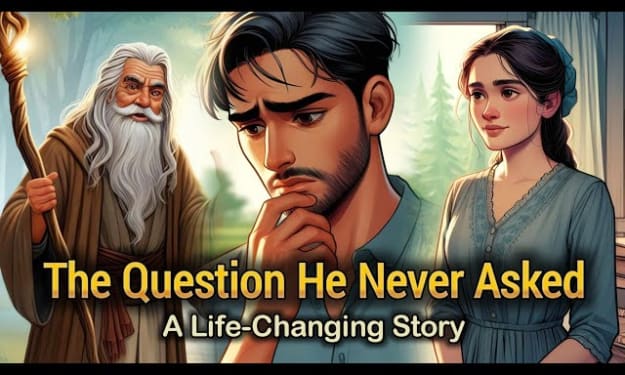
The Question He Never Asked
Once upon a time, in a small village, lived a poor man. He was tired of his poverty and always wondered, "When will my life change? When will I escape this misery?" One day, he heard that a wise monk had arrived in a nearby village. It was said that the monk had answers to any question one might ask. The man wanted to find a solution to his problems, so he decided to go and meet the monk. To reach the other village, he had to cross a dense forest. As he walked through the forest, night began to fall, and darkness descended. Then he saw a large and beautiful house in the middle of the forest. He approached it and politely asked the owner if he could stay the night. The owner agreed and welcomed him. Curious, the owner asked, "Where are you going so late at night?" The poor man replied, "I am going to meet the monk in the neighboring village. I want to ask him a question about my life." The owner nodded and said, "Please, ask me a question too. My daughter is twenty years old and has never spoken a word in her life. She is mute." The monk asked, "When will she begin to speak?" The poor man agreed and left early the next morning. As he continued on his way, he came across an old magician with a magic wand. The magician looked at him and asked, "Where are you going, young man?" The man replied, "To meet a monk. I want to ask him a question." The magician said, "Then ask him a question for me too. I have lived a long time and I long to enter Heaven. Ask him when I will be able to enter it." The man agreed and continued on his journey. After a while, he saw a giant tortoise resting under a tree. The tortoise looked at him and asked, "Where are you going?" The man replied, "To see the monk." The tortoise said, "Please, ask the monk another question. I have always dreamed of becoming a dragon. Ask him when I will finally become a dragon." The man nodded again and finally reached the monk. The monk was sitting under a tree, deep in thought. The man greeted him respectfully and asked, "May I ask you a few questions?" The monk opened his eyes gently and said, "Yes, but you may only ask three." The man was taken aback. Only three, but I have four questions—one from me and three from the others. He stood there thinking that my question was about poverty, but it seemed trivial compared to what these people were going through. I would ask their questions first. He took a deep breath and asked his first question: "When will the tortoise become a dragon?" The monk answered, "When it takes off its shell and abandons its protection, it will become a dragon." Then he asked his second question: "When will the sorcerer ascend to heaven?" The monk replied, "When he walks on his staff for someone else, his time will come, and he will... ascend to heaven." Finally, he asked the last question: "When will the girl find her voice?" The monk said, "When she meets someone who truly understands her heart, her voice will awaken." The poor man bowed in gratitude. Although his question remained unanswered, he began his journey back, walking the same path. On his way, he first met the tortoise. The man told him what the monk had said: "You will become a dragon when you take off your shell." The tortoise hesitated but trusted the monk's wisdom. She began to slide slowly from her shell, and right before the man's eyes, she transformed into a great dragon. When the ancient shell opened, dozens of glittering pearls rolled to the ground. The dragon smiled and gave all the pearls to the man in gratitude, then flew away into the sky. The man was amazed. He picked up the pearls and went on. Then he met the old magician and told him. The monk said, "You will go to heaven when you give your staff to someone else." The magician thought for a moment, then He handed the staff to the poor man. At that moment, his body was filled with light, and his soul ascended peacefully to heaven, free, happy, and at peace. The poor man now carried a magic staff and a bag full of pearls. Finally, he returned to the great house in the forest and met the kind man who had allowed him to stay. The man asked eagerly, "Did you ask the monk my question?" The traveler smiled and replied, "Yes." He said, "Your daughter will speak when she finds someone who truly understands her." The man paused in surprise, then slowly turned to his daughter. She looked at the traveler, and their eyes met. For the first time, she opened her mouth and said softly, "Thank you." Her father was astonished. Overjoyed, he embraced her and said, "It is you I mean." "You truly understand her heart." "Will my daughter marry?" The poor man nodded humbly. The two were married in front of the villagers. The man who had nothing—no money, no voice, no answers—now had a loving wife, a bag of pearls, a magic wand, and a wise heart. The moral of the story: Sometimes we gain more in life when we put others first.
By Abdur Rahman10 months ago in Humans
The Invisible Thread: Why Some Connections Feel Like Coming Home
We've all felt it—that peculiar moment when someone new somehow feels ancient. When conversation flows like water finding its level, when silence sits comfortably between you like an old friend. But what creates these magnetic bonds that pull certain people into our orbit while others drift past like ships in the night?
By Waqar Khan10 months ago in Humans
Want a Marriage That Lasts? Learn These Secrets for a Successful Marriage
A successful marriage isn’t built overnight—it grows through daily choices, intentional actions, and a shared commitment to understanding one another. At Bloom Boldly, we think that lasting love is not luck. It is a set of habits, ideals, and emotional abilities that deepen the link between two people. In a world where relationships often feel rushed and overwhelming, we must return to the foundations that make a partnership resilient and meaningful.
By Bloom Boldly10 months ago in Humans