literature
Whether written centuries ago or just last year, literary couples show that love is timeless.
The Rhythmic Power of Brisk Walking
The Rhythmic Power of Brisk Walking The human heart, a tireless engine of life, beats with a rhythm that sustains our very existence. When this rhythm falters, giving rise to disorders like atrial fibrillation, tachycardia, or bradycardia, the consequences can be significant. Yet, within the simple act of walking, particularly at a brisk pace, lies a profound potential to safeguard this vital cadence. Recent research illuminates this connection with remarkable clarity, painting a vibrant picture of how our daily strides can harmonize the heart's electrical symphony. Imagine a gentle breeze turning into a steady current – that's akin to the transformation that occurs within the body when a leisurely stroll evolves into a purposeful, brisk walk. This increased intensity is not just about covering ground; it is also about starting a chain of good changes in the body. The risk of developing troublesome heart rhythm abnormalities may be significantly reduced by this increased pace, according to recent studies.
By MD.JAKARIAabout a year ago in Humans
the prince returns to set up a dream match
back story: The last time we saw jake was when he came out of the work meeting and bam he got hit by a car which took him out for quite some time due to not being medical cleared for the obvious reason. there is a number one contender battle royal at the upcoming ppv and to close the final show before the ppv trey clears everyone from the ring and he says he'll win the the battle royal however as soon as he says that the lights go out and then on the titration screen all that shows is the words i promised.
By josh napperabout a year ago in Humans
Roblox Faces Criticism Over Child Safety
Roblox, the massively popular online gaming platform with over 70 million daily users—many of whom are children—is facing renewed scrutiny over its child safety practices. A recent investigative report highlighted the platform's persistent risks of sexual exploitation, inappropriate content, and predatory behavior and accused the company of a "systematic failure to keep children safe."
By Tanmoy Hossainabout a year ago in Humans
The Broken Vase
The vase had been in Emma’s family for generations. Hand-painted with delicate blue flowers, it was the one thing she had left of her grandmother. Every time she looked at it, she could almost hear the old woman’s laughter, smell the lavender-scented handkerchiefs she always carried.
By yousaf shahabout a year ago in Humans
Embracing Human Illnesses and Breaking Free from Perfectionism Part 2
Embracing Human Illnesses and Breaking Free from Perfectionism Introduction Many of us are instructed to strive for perfection from an early age. We’re praised for getting the highest grades, winning awards, or looking flawless. In a world that celebrates idealism and perfection, anything less can feel like failure. However, the cost of striving for perfection is frequently anxiety, self-doubt, exhaustion, and a separation from our true selves. Reclaiming your humanity is at the heart of this article, not just about the dangers of perfectionism. It’s about freeing yourself from the heavy burden of always needing to be perfect and stepping into the beautiful, messy, and real experience of being human. What perfectionism actually is, how it affects your life, and, most importantly, how to break free and accept your imperfection are all covered in this article. We'll walk through a comprehensive journey—from defining perfectionism and exploring its roots, to applying practical strategies and learning how to heal.
By Afia Sikderabout a year ago in Humans
Breaking Free from Perfectionism: Embracing the Imperfections of Being Human
Breaking Free from Perfectionism: Embracing the Imperfections of Being Human Introduction From the earliest days of childhood, many of us are taught to strive for perfection. We get high marks, awards, and praise for our flawless appearance. In a world that celebrates idealism and perfection, anything less can feel like failure. But this pursuit of flawlessness often comes at a cost: anxiety, self-doubt, exhaustion, and a disconnect from our authentic selves.
By Afia Sikderabout a year ago in Humans
I'm Not a Strong Black Woman; I'm Weak
The first time I voiced it, my therapist’s pen halted in mid-air. “I’m not a resilient Black woman.” Those words had a bitter taste, like medicine I had been avoiding. She leaned in, her expression serious. “What makes you say that?”
By Mubarak Hossain Akashabout a year ago in Humans
The Love Languages You’ve Never Heard Of: Beyond the Famous Five
Introduction For decades, Gary Chapman’s famous model of the five love languages—words of affirmation, acts of service, receiving gifts, quality time, and physical touch—has provided a framework for understanding how we give and receive love. While this model has served millions well, the complexities of modern relationships reveal that love is communicated through an even richer array of languages. Beyond the familiar five, there are subtle, unexpected, and deeply personal ways that individuals express and perceive love. These unique expressions not only deepen our connections with others but also allow us to better understand the many layers of our own hearts. This article explores these lesser-known love languages, offering new perspectives on how love can be felt, shared, and celebrated in today’s diverse world.
By Mysteries with Professor Jahaniabout a year ago in Humans
The Human Brain . Content Warning. AI-Generated.
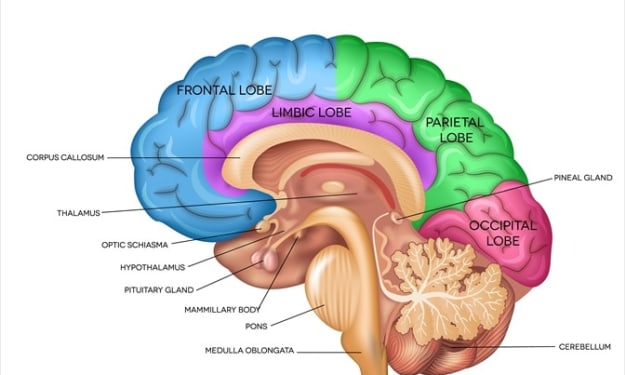
The human brain is one of the most complex and fascinating organs in the human body, serving as the control center for all bodily functions, thoughts, emotions, and behaviors. Weighing about three pounds and containing approximately 86 billion neurons, the brain is a marvel of biological engineering that scientists are still striving to fully understand. Each of these neurons can form thousands of connections with other neurons, creating trillions of synapses that enable the communication networks essential for every aspect of our lives, from breathing and digestion to memory, language, and abstract thinking. The brain is divided into several major parts, each with distinct functions. The cerebrum, the largest part of the brain, is responsible for higher cognitive functions such as thinking, decision-making, perception, and voluntary movement. It is divided into two hemispheres—left and right—which control opposite sides of the body and are further subdivided into four lobes: frontal, parietal, temporal, and occipital. The frontal lobe governs reasoning, planning, problem-solving, and emotions; the parietal lobe manages sensory input and spatial orientation; the temporal lobe processes auditory information and is essential for memory and language; and the occipital lobe is primarily responsible for vision. Below the cerebrum lies the cerebellum, which plays a key role in motor control, coordination, balance, and fine-tuning movements. The brainstem, which connects the brain to the spinal cord, is responsible for basic life-sustaining functions such as heart rate, breathing, and sleeping. The brain communicates with the rest of the body through the nervous system, which includes the central nervous system (brain and spinal cord) and the peripheral nervous system (nerves extending throughout the body). Electrical impulses travel between neurons across synapses via neurotransmitters, enabling the brain to process sensory information and issue motor commands almost instantaneously. Additionally, the brain regulates hormone production through the hypothalamus and pituitary gland, influencing growth, metabolism, and reproductive functions. One of the brain’s most extraordinary features is its plasticity—the ability to change and adapt throughout life in response to learning, experience, and injury. This neuroplasticity allows individuals to acquire new skills, recover from brain damage, and form new memories. Memory itself is a complex process involving encoding, storing, and retrieving information. Different types of memory—such as short-term, long-term, episodic, and procedural—are stored and processed in various regions of the brain, including the hippocampus and the prefrontal cortex. Language is another remarkable function of the brain, primarily managed by areas such as Broca’s area and Wernicke’s area, which are critical for speech production and comprehension. Emotions are processed in the limbic system, especially in the amygdala and the hypothalamus, which influence how we react to situations and form emotional memories. Despite its capabilities, the brain is also susceptible to disorders such as Alzheimer’s disease, Parkinson’s disease, depression, anxiety, and traumatic brain injuries, all of which can significantly affect cognition, behavior, and quality of life. Ongoing research in neuroscience and related fields seeks to unravel the brain’s many mysteries, leading to new treatments for mental and neurological conditions. Advances in technology, such as brain imaging (MRI, fMRI, PET scans), have allowed scientists to observe the brain in action and identify how different regions are activated during specific tasks. Understanding the brain also has implications beyond medicine, influencing fields like artificial intelligence, education, and psychology. The human brain is not only a biological organ but also the seat of consciousness, self-awareness, creativity, and the very essence of what it means to be human. It enables us to imagine, create art, solve problems, build societies, and experience the world in deeply personal and meaningful ways. As research continues to unlock its secrets, the brain remains a source of wonder and inspiration, a testament to the complexity of life and the potential of the human mind.
By Shohan Hossenabout a year ago in Humans
Beyond the Headlines: Everyday Life in Modern Afghanistan Through My Eyes
When people hear the word “Afghanistan,” their minds often go straight to war zones, political crises, or humanitarian headlines. For most of the world, my country exists only in breaking news segments and grim statistics. But for me, Afghanistan is something much more intimate—it's my home, full of quiet mornings, shared laughter, and everyday beauty that rarely makes it to international screens.
By Mysteries with Professor Jahaniabout a year ago in Humans
The Power of Silence: How Embracing Quiet Moments Transformed My Life
In a world buzzing with notifications, chatter, and endless digital noise, silence often feels like a forgotten language. For years, I ran from it, filling every pause with sound—music during commutes, podcasts while walking, videos playing in the background while I cooked, cleaned, or even showered. Silence, to me, felt empty. But it wasn’t until life forced me into a space where noise wasn’t an option that I discovered silence was never empty. It was full—of truths I’d long avoided, of emotions I hadn’t processed, and of healing I didn’t know I needed.
By Mysteries with Professor Jahaniabout a year ago in Humans