friendship
C.S Lewis got it right: friendship is born when one person says to another: "What! You too? I thought I was the only one!"
The Map of My Voice On Vocal.Media
The Map of My Voice On Vocal.Media I never expected to find my voice in the places I did. Not on stages, not in crowded rooms, not through conversations where people talk over each other. My voice grew in quieter corners, in the places where I didn’t need to perform, only to feel. If I were to draw a map of how I found it, it wouldn’t look like rivers or roads. It would look like moments that tested me, broke me, and somehow rebuilt me.
By ♿ V+ Marie381Uk 12 months ago in Humans
The Promise Under the Banyan Tree
The Promise Under the Banyan Tree Days passed gently after Zoya’s return to the village. The river, the fields, and even the dusty paths seemed to look different when she walked beside Amir. They still didn’t call it love out loud, but everyone who saw them knew what was slowly forming.
By Wings of Time 12 months ago in Humans
Trump calls on House Republicans to vote to release Epstein files
In a dramatic turn that reignited one of America’s darkest and most controversial chapters, former President Donald Trump publicly called on House Republicans to vote in favor of releasing the long-sealed Jeffrey Epstein files. The demand—made through a late-night social media post and later repeated at a rally—sent shockwaves across Washington, stirring a storm of political debate, renewed public curiosity, and quiet anxiety among those whose names may appear in the documents. The Epstein case, which has haunted the American public for years, has always carried an air of mystery. A wealthy financier with connections to presidents, celebrities, and global elites, Epstein was arrested in 2019 on federal sex-trafficking charges. His death in a Manhattan jail cell, ruled a suicide, only deepened suspicion and fueled conspiracy theories. For many, the truth still feels buried, trapped behind redactions, sealed testimonies, and pages of classified case material. Trump’s latest call added an explosive new chapter to that ongoing saga. A Push That Caught Washington Off Guard According to political insiders, Trump’s statement did not come after negotiations or coordinated planning. Instead, it arrived abruptly—catching some House Republicans off guard and energizing others who have long demanded more transparency surrounding Epstein’s network. “We should release the Epstein files,” Trump said, in a post that quickly went viral. “Let the American people see the full truth. Vote on it. Make it public.” Almost instantly, lawmakers were thrust into the spotlight. Some privately admitted they had been waiting for someone with Trump’s influence to force the issue into national conversation. Others feared the political and social fallout that could follow. The documents reportedly contain names—some already rumored, some never revealed—of individuals who flew on Epstein’s plane, visited his private island, or maintained contact with him. Releasing those files could expose powerful figures across industries, not limited to a single political party. And that, analysts say, is exactly what makes Trump’s demand both potent and risky. A Public Hungry for Answers For millions of Americans, the Epstein story symbolizes unanswered questions, institutional failures, and a justice system too often seen as protecting the powerful. Each whisper or leaked detail only increases the public appetite for clarity. Outside federal courthouses and online forums alike, citizens expressed frustration that the truth has taken this long to come to light. “I don’t care who’s on the list,” one woman at Trump’s rally said. “Democrat, Republican, actor, billionaire—anyone involved should be held accountable.” Her voice echoed a broader national sentiment: transparency over secrecy, justice over protection. The Epstein case is no longer just a legal matter; it has become a cultural wound. Every new revelation, every unredacted name, every legal motion reminds the nation of the fragility of institutional trust. Behind Closed Doors in Congress As Trump amplified the issue, House Republicans met privately to discuss their options. Sources familiar with the conversations said the mood was tense. Some members urged caution, warning that releasing names without full context could lead to misinformation, misidentification, or legal complications. Others insisted that withholding the files would erode public confidence even further. The tension revealed a deeper divide: should Congress protect reputations until guilt is proven, or should it open the archives and let the public decide what the truth means? One senior GOP aide described the atmosphere starkly: “If they vote to release the files, the fallout will be massive. If they vote not to, the backlash will be massive. There’s no safe path.” Still, many recognized the political reality—once Trump had made the demand publicly, ignoring it would come at a cost. Why Trump Spoke Now Political strategists have been speculating about Trump’s motivation. Some say it’s part of his broader transparency push, especially during heated political seasons. Others argue it could put pressure on opponents whose names might appear in the files. Regardless of the motive, the timing has undeniably reshaped the national conversation. By calling for the release, Trump placed both parties in an uncomfortable position. Democrats fear the documents could implicate influential donors or public figures. Republicans worry the fallout could affect their own ranks. Every camp faces potential damage; no one is fully insulated. That bipartisan discomfort may be exactly why the public has renewed hope for disclosure. When everyone has something to lose, transparency suddenly becomes more possible. What Happens Next If the House votes to release the files, the Justice Department and courts would need to coordinate how to handle redactions, privacy concerns, and ongoing investigations. The process could take weeks—or months. If the House rejects the release, pressure from the public is almost guaranteed to escalate. For now, the nation watches and waits. Parents who worry about safety. Survivors who demand justice. Citizens who have lost faith in the institutions sworn to protect them. Millions of people, bound by a single hope—that this time, finally, the truth will not be buried. A Story Still Being Written The Epstein case has always felt like a story with missing pages. Names whispered but never confirmed. Crimes hinted at but never fully exposed. A web of power and influence that seemed to stretch far beyond one man. Trump’s call to release the files may become the moment that forces the final curtain to rise.
By DigitalAddi12 months ago in Humans
The Decline of the Marriage Covenant
Marriage was once the sacred foundation of civilization. It was the covenant upon which families, communities, and moral order were built. It bound man and woman together in purpose, duty, and devotion under the authority of God. Today, that covenant has been reduced to a fragile contract of convenience. What was once holy has become negotiable. What was once permanent has become temporary. The decline of the marriage covenant is not only a personal tragedy. It is a national one.
By Peter Thwing - Host of the FST Podcast12 months ago in Humans
The Moral Economics of Love
Every human system, whether spiritual, political, or relational, is governed by incentives. People repeat what is rewarded and avoid what is punished. Love is no exception. It may sound sacred and emotional, but it still follows the law of cause and effect. When love is rewarded with gratitude, it grows. When it is met with entitlement, it dies. Modern society has rewritten the incentives of love, turning what was once an act of sacrifice into a transaction of convenience. The result is a generation that no longer knows how to give without gain.
By Peter Thwing - Host of the FST Podcast12 months ago in Humans
“The Heart That Connects Us All”
In a world filled with constant movement—cars rushing, screens glowing, people hurrying from one place to another—it becomes easy to forget the most powerful force we carry within us: our ability to connect. This truth revealed itself to Adeel on an ordinary morning that began like any other. Adeel lived in a quiet neighborhood where people greeted each other with simple nods but rarely stopped to talk. He worked long hours in an office, walked home tired, and often felt that life had become a cycle of routines. Yet somewhere inside him, he wished his days felt more meaningful. One cold morning, as he walked to work, he noticed an elderly man sitting alone on a bench. His hands trembled slightly, and he looked lost. People walked past him without slowing down. Adeel hesitated, unsure if he should approach. After a moment of thinking, he took a small step forward. “Assalamualaikum, sir. Are you okay?” he asked gently. The man looked up with surprised eyes. “Wa Alaikum Assalam. I think I lost my way. I came to visit a friend nearby, but I took a wrong turn. My phone battery is dead.” Adeel smiled reassuringly. “No problem. Tell me the address; I’ll help you get there.” As he guided the man, whose name was Ahmed, he listened to stories of his youth—stories about building friendships, raising a family, and the importance of helping others. Adeel felt something warm in his chest, a feeling he hadn’t experienced in a long time. When they finally reached the correct house, Ahmed thanked him with a sincere smile that stayed in Adeel’s mind the entire day. That small act changed something inside him. Over the next weeks, Adeel made a quiet promise to himself: wherever life allowed, he would choose connection over silence. He would choose kindness over hurry. He began greeting neighbors properly, stopping for a minute to exchange small conversations. He held doors open, helped students carry their books, and smiled at children playing in the street. None of these actions were big, yet each one created a spark—something gentle but powerful. Then one day, something unexpected happened. Adeel had finished work late and was walking home in the dark. He felt tired and drained. Halfway down the road, his bag strap tore, and everything fell onto the ground. Papers, lunchbox, keys—scattered everywhere. He sighed in frustration. Suddenly, he heard footsteps approaching. A young boy from the neighborhood, about twelve years old, knelt down beside him and began gathering the scattered papers. “Here, uncle, let me help,” the boy said. Adeel looked at him, surprised. “Thank you, beta. That’s very kind of you.” The boy smiled. “You always help people. Today I help you.” For a moment, Adeel couldn’t speak. He realized that kindness had come full circle. The small gestures he had been offering the world were quietly being returned. The feeling warmed his heart more deeply than he expected. That night, sitting in his room, Adeel understood something important: human connection doesn’t require grand actions. It requires attention. It requires choosing to notice one another, even when the world feels busy and crowded. He thought of Ahmed, the elderly man he helped weeks ago. He thought of the neighbors who now smiled more often. He thought of the young boy who had helped him. All these moments, all these simple interactions, were threads—threads forming a larger tapestry of humanity. From that day on, Adeel carried a new belief: every person carries a light, and every act of kindness helps that light shine brighter. Life becomes more beautiful when we share that light with others. In a world that sometimes feels divided, Adeel discovered a simple truth that everyone can live by: we are all connected—not by language or culture or background, but by the kindness we choose to give. And sometimes, it only takes one small gesture to remind someone that they matter.
By Muhammad Saad 12 months ago in Humans
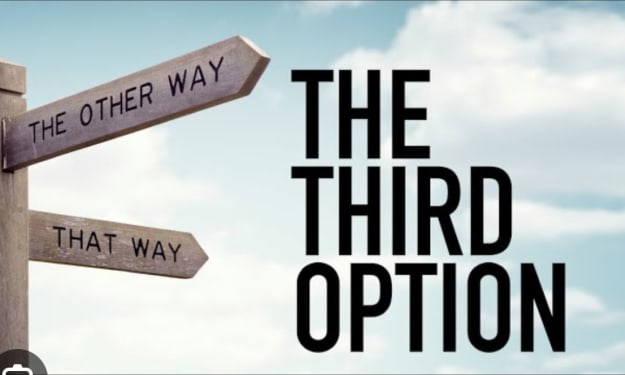
The Third Option
For a long time, I believed my marriage ended because we failed. That if we had talked more, loved better, tried harder, or stayed longer in therapy, maybe we could have saved it. Marriage teaches you to internalize the blame — that if it cracks, it’s because you weren’t strong enough.
By Dhatbrowngirl 12 months ago in Humans
“The Light We Carry Within: Stories That Make Us Human”
In a world where technology moves faster than thoughts and expectations rise higher with every passing day, it’s easy to forget the quiet truth that binds us all: being human is not about perfection—it is about connection. This truth became clearer to Rayan the day a small moment changed the direction of his thinking forever. Rayan was an ordinary man with ordinary routines. He walked the same path to work each morning, listening to the same music and noticing the same city sounds. Life was predictable, and predictability often made him feel invisible. Like many people, he wondered if his actions mattered in a world full of noise, pressure, and endless stories of achievement. But one morning, as he walked past a local park, he noticed an elderly man struggling to lift a box from a bench. Rayan hesitated. He had a meeting. He was already running late. Yet something inside him whispered that stopping—just for a moment—could mean more than arriving on time. He approached the man gently. “Hello, may I help you with this?” Rayan asked with a calm smile. The old man nodded gratefully. Together, they placed the box on a small trolley. It took less than a minute, but the man held Rayan’s hand afterward and said, “Thank you, my son. People forget that kindness doesn’t need to be big to be beautiful.” That sentence stayed with Rayan long after he left the park. All day, it repeated in his mind like a soft echo. Kindness doesn’t need to be big to be beautiful. Maybe humanity isn’t measured by extraordinary achievements but by simple choices made in ordinary moments. As days passed, Rayan started noticing things he had never paid attention to: a bus driver who waited an extra second for a rushing passenger, a child sharing her snack with a friend, a shopkeeper placing a free bottle of water beside a homeless man’s bag. None of these moments were loud, dramatic, or heroic. Yet each one added a small drop of goodness into the world. He realized something profound—being human means being aware. Aware of the feelings around us. Aware of the burdens others carry silently. Aware of how a single smile can lighten someone’s day. Inspired, Rayan began small changes in his own routine. He made eye contact with the security guard at work and greeted him warmly. He wrote anonymous encouragement notes and left them near bus stops. He spent extra minutes talking to his younger brother about school, actually listening instead of replying quickly. These were not grand gestures, but they created ripples. Over time, the ripples grew. The security guard said those greetings made him feel respected. The bus stop notes became something people looked forward to. His brother felt more confident, more supported. Rayan didn’t fix the world—but he changed feelings, and feelings change lives. One evening, as he walked home, a young boy recognized him and said, “You’re the person who leaves the notes, right? I found one on a day when I felt very bad. It helped me.” Rayan felt warmth spread through him. He didn’t know that a small piece of paper could hold so much power. But it did. And at that moment, he understood the heart of humanity: every person carries a light, and when we share it, the world becomes brighter—not instantly, but steadily. Humans are not remembered for the perfection of their lives but for the moments in which they offered kindness, understanding, support, and hope. Our true stories are written not by what we achieve, but by who we touch along the way. And sometimes, all it takes is one minute, one word, one gentle act. Because in the end, it is the light we carry within—and how we share it—that makes us human.
By Muhammad Saad 12 months ago in Humans
“When Hearts Remember: The Quiet Power of Everyday Humanity”
Some stories don’t begin with heroes, dramatic events, or unforgettable victories. Some begin with the quiet hum of ordinary life—where humanity reveals itself in the smallest, most unexpected ways. That is exactly where Adeel’s story begins. Adeel lived in a busy neighborhood where everyone rushed through their routines as if life itself was racing them. People moved fast, spoke fast, and rarely paused long enough to notice each other. Adeel was much the same. With work, errands, and responsibilities filling every hour, he rarely gave a second thought to the people around him. One evening, after a long day, Adeel stopped at a small roadside shop to buy tea. As he waited, he noticed a young delivery boy struggling with a heavy crate of water bottles. The boy’s hands trembled from the weight, and his face showed exhaustion. He looked no older than sixteen. Adeel saw him. Really saw him. Before he could think too much, Adeel stepped forward. “Here, I’ll help you,” he said. The boy’s surprise turned into quiet relief. Together, they carried the crate inside the shop. It took less than a minute, but when they finished, the boy’s eyes shone with gratitude. “Thank you, bhai,” he whispered. “People see me, but they don’t actually look at me.” Adeel froze. Those words struck him deeply. People see me, but they don’t look at me. How many people around us feel invisible behind their work, struggles, or responsibilities? That night, Adeel lay awake thinking about it. Humanity wasn’t fading; it was simply waiting for people to notice one another again. The next day, he made a small decision. Wherever he went, he would try to genuinely see people. Not just look at them, but notice them—acknowledge them. That decision changed everything. He started greeting the old bookstore owner, who always sat quietly behind the counter. He offered his seat to a tired father on the bus. He stopped to ask the gardener in his building how he was doing and listened—really listened—to his answer. These weren’t big acts. They didn’t require money or strength. They required something far more meaningful: presence. Surprisingly, Adeel began noticing changes in those around him. The bookstore owner began smiling more, even sharing stories from his youth. The gardener told him about his dream of educating his daughter. The father on the bus nodded with such gratitude that Adeel remembered it all day. It was as if humanity had never left—it just needed space to breathe. One afternoon, a stranger approached Adeel near the marketplace. “You probably don’t remember me,” the man said. “But last week you helped my son pick up his school books that fell on the road. He came home smiling. Thank you.” Adeel didn’t even remember the moment. But the boy did. And that was what mattered. He realized then that humans create impact even without realizing it. Every action—small or large—adds to someone’s memory. Sometimes to someone’s hope. Weeks passed, and Adeel’s small acts grew naturally—not forced, not planned, just part of who he was becoming. People in his neighborhood started showing more kindness too. Someone left water out for stray animals. Someone else helped an elderly woman cross the street. A shopkeeper began handing out free fruit to children from poor families. It was contagious—humanity spreading quietly, beautifully. One evening, Adeel met the same delivery boy again. This time, the boy stood taller, smiling confidently. “You helped me once,” he said. “So I helped someone today too. I think that’s how the world becomes better, bit by bit.” Adeel felt a warmth in his heart that words couldn’t describe. He realized that humanity doesn’t need grand gestures or loud announcements. It grows in silence, in sincerity, in the gentle choices we make without expecting anything in return. We all have the power to create change—one small moment at a time. Because in the end, what makes us human is not just how we live, but how we help others live a little better.
By Muhammad Saad 12 months ago in Humans
Scorpio Pig. . Top Story - November 2025.
When coming up with a title for this, I came to the brilliant realisation that I am a Scorpio Pig. A classic and undisputable Scorpio (though the horoscope vs reality debate lives on) and a 1995 year of the pig baby. I’ve always liked being a Scorpio, but the pig thing took a minute. A couple years ago my friend took me micro-pig walking for my birthday, did you know pigs have a hierarchy system? Seriously. They take rankings very seriously, and as my pig Mr Darcy was pushed out the way by his superior, I found out just how serious it was.
By Kirstyn Brook12 months ago in Humans