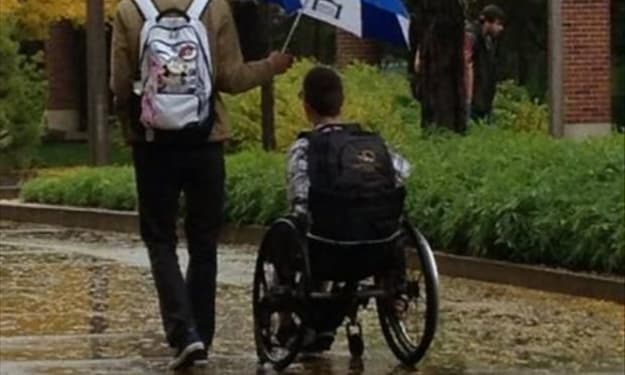
friendship
C.S Lewis got it right: friendship is born when one person says to another: "What! You too? I thought I was the only one!"
🌙 Story The Light of the Lantern
🌙 The Light of the Lantern A tale of love, patience, and prayer It was a dark winter night. The sky was covered with thick, restless clouds, hiding the moon and the stars. Snowflakes kept falling, carried by the cold wind that pierced through the silence of the village. On the edge of the village stood a small, humble house. Outside its door, an old lantern glowed faintly, its light trembling but never going out.
By New stAr writer about a year ago in Humans
Cancer Woman and Capricorn Man Compatibility Score. AI-Generated.
When a Cancer woman and a Capricorn man come together, it often feels like the stars have intentionally placed two complementary souls side by side. She is nurturing, emotional, and values security above all. He is ambitious, grounded, and values stability and achievement. Together, they create a bond built on trust, loyalty, and the shared desire to build a meaningful life. This is not a whirlwind romance based on fleeting passions, but a partnership that matures beautifully over time.
By Inspire and Funabout a year ago in Humans
The Beautiful Imperfection of Being Human
M Mehran If you strip away the noise of modern life—the glowing screens, the endless deadlines, the rush of traffic—you’re left with something raw and unpolished: us. Humans. Imperfect, unpredictable, vulnerable, and yet extraordinary. I didn’t always see it that way. For years, I thought being human meant constantly chasing perfection, hiding flaws, and living like life was some test I had to ace. But a series of moments—small, ordinary moments—taught me that being human is less about achieving and more about experiencing. The Stranger on the Train It started on a crowded train ride home. I was exhausted, scrolling through my phone, when I noticed an older man across from me. His coat was frayed at the edges, his hands trembling slightly as he held a paperback book. Every few pages, he would glance up, make eye contact with strangers, and smile. Not the forced, polite kind of smile, but one filled with warmth. People around him responded almost instinctively: a tired mother softened, a businessman lowered his phone, a teenager stopped frowning at the world. In that cramped metal box, surrounded by strangers, I realized something simple but powerful: humans crave connection. Even in silence, even in exhaustion, we reach for one another. The Beauty of Flaws Later that year, a close friend confessed something that changed the way I thought about humanity. She said, “I spent so much of my life pretending to be okay, until I realized that pretending was lonelier than the pain itself.” That struck me. How often do we, as humans, put on masks to look strong? We iron out our voices, tidy up our emotions, polish our stories. But the truth is, our flaws are the bridges that connect us. When someone admits fear, we say, me too. When someone shares grief, we hold their hand. When someone shows us their scars, we recognize our own. Being human isn’t about hiding the cracks. It’s about showing them and discovering we’re not broken—we’re just real. The Kindness of Strangers One rainy afternoon, my car broke down on a quiet street. Frustrated and cold, I stood there trying to flag down help. Cars passed by until finally, a woman in a small blue hatchback pulled over. She didn’t ask for anything, didn’t hesitate. She simply grabbed an umbrella from her backseat and stood with me until help arrived. She never even told me her name. That moment reminded me that being human isn’t always about grand gestures. It’s often about small acts of kindness that ripple far beyond what we can see. A smile, a held door, an umbrella shared on a rainy day—these are the threads that quietly weave humanity together. The Storm and the Sunrise But of course, being human also means facing storms. I remember the night my grandfather passed away. Grief came like a tidal wave, pulling me under. For days, everything felt gray and meaningless. And yet, slowly, life whispered back. A friend dropped off food without asking. My dog rested her head on my lap. The sun rose, stubbornly, each morning. That’s when I realized: humans are resilient not because we avoid pain, but because we learn to carry it. We break, but we also mend. And sometimes, we emerge softer, kinder, and more aware of how precious every sunrise is. Our Search for Meaning There’s another thread that defines us: our endless search for meaning. Humans build cities, paint murals, write poems, and explore galaxies not just to survive, but to understand. We want to know why we’re here, what love means, whether our stories matter. Maybe that’s why we tell each other stories at all. Every book, every song, every whispered confession is an attempt to say, I was here. I felt this. Do you feel it too? And when someone nods, when someone says yes, suddenly the vast mystery of life feels a little less lonely. Imperfect, Yet Enough One evening, sitting by the window with a cup of tea, I thought about all these moments—the man on the train, my friend’s confession, the stranger with the umbrella, the ache of loss, the joy of stories. I realized that humanity is not a polished sculpture. It’s more like a quilt: messy, stitched together from scraps of laughter, pain, mistakes, and kindness. And that’s the beauty of it. We are not perfect beings. We are enough, simply by existing, by loving, by trying. Why Humans Matter In a world that often values speed, efficiency, and flawlessness, it’s easy to forget the essence of being human. It’s not about how much we earn, how flawless we look, or how many goals we check off a list. It’s about how deeply we love, how bravely we endure, and how openly we share this journey with one another. So when I think about what it means to be human, I think of this: We smile at strangers. We cry when we lose someone. We laugh until our stomachs hurt. We stumble, fail, and then get up again. We carry memories, regrets, and dreams in equal measure. And through it all, we keep reaching out for connection. That’s the story of humanity: flawed, fragile, and yet endlessly full of hope. A Final Thought Someday, when I’m old and gray, I don’t think I’ll remember the deadlines or the polished masks. I’ll remember the people. The train rides, the confessions, the kindness, the grief, the laughter. Because being human isn’t about living perfectly. It’s about living fully. And that, I think, is the most extraordinary thing about us.
By Muhammad Mehranabout a year ago in Humans
🔮 Aquarius: The Visionary Water-Bearer of the Zodiac
Born between January 20 and February 18, Aquarius is the eleventh sign of the zodiac, symbolized by the Water-Bearer—a figure who pours life, wisdom, and inspiration upon the world. Despite the name, Aquarius belongs to the Air element, and is ruled traditionally by Saturn and in modern astrology, by Uranus, the planet of innovation, technology, and surprising breakthroughs.
By Mehran Amanabout a year ago in Humans
How Long-Term Love Improves Mental and Physical Health
Long-term love gives you a profound emotional reassurance that fuels mental health. The presence of a partner that is always there, all the time is stability in a world that is often not. Couples who enjoy long lasting love report to be less stressed, because they feel bolstered by their partner’s help. It is this emotional security that is a buffer against anxiety and depression. Love eventually becomes steadying and a soothing mooring, that makes you feel less alone. Long-lasting love gives people emotional equanimity that allows them to think more clearly and negotiate everything life throws their way with an underlying sense of comfort, connectedness and trust.
By Grace Smithabout a year ago in Humans
"Walls of Hope, Wings of Freedom”( Season 01 ).
The walls had always stood, towering and unshakable, guardians of humanity’s fragile hope. To those born inside them, they were both prison and sanctuary — a reminder of weakness and a shield against extinction. For Eren Yeager, a boy of burning spirit and restless heart, they were chains he could not bear. While others accepted the walls as protection, Eren saw them as cages. His eyes, sharp with fire, longed for the world beyond, the vast unknown swallowed by Titans. But on that fateful day, the world shattered. The Colossal Titan appeared in a thunder of steam and lightning, its massive face rising over Wall Maria like a nightmare reborn. In a single kick, the unthinkable happened: the wall, once thought eternal, crumbled. The ground shook, the air filled with ash, and the lives of thousands were swallowed in chaos. Among them was Eren’s world — his home, his mother. Pinned beneath the rubble, his mother’s final smile seared into his soul, Eren screamed as she was devoured by a Titan. It was not merely grief that filled him; it was rage, raw and consuming. In that moment, the boy’s heart forged an oath that would shape his destiny: to slaughter every Titan until none remained. That vow burned brighter than his tears. The fall of Shiganshina forced survivors into the inner walls, carrying hunger, despair, and bitter resentment. Yet for Eren, Mikasa, and Armin, it lit a path — the path of soldiers. They enlisted in the Cadet Corps, swearing blades and blood to humanity’s fight. Training was brutal, but Eren’s determination was unbreakable. While others wavered, he endured falls, bruises, and failures, his eyes fixed on one truth: strength was the only path to freedom. Mikasa stood as his unshakable shadow — protector, sister, and silent guardian. Armin, though frail in body, shone with a mind sharper than any blade. Together, they became more than cadets; they became the remnants of Shiganshina’s dream, a trio bound by loss and fire. But no training could prepare them for what lay beyond the gates. When humanity launched its desperate mission to reclaim Trost, Eren stepped onto the battlefield for the first time. The reality was merciless — comrades crushed, devoured, erased in an instant. Titans were not simply monsters; they were fear incarnate. Yet Eren did not falter. His heart surged with vengeance, and his blade found flesh. Until fate struck. In a single moment of sacrifice, Eren threw himself to save Armin, only to be swallowed whole by a Titan’s jaws. To his friends, he was gone — another name carved into tragedy. To humanity, he was a symbol of how fragile hope remained. But within darkness, something stirred. From the Titan’s belly, a power long dormant awakened. Flesh tore, bones snapped, and the world trembled as Eren was reborn — not as prey, but as predator. He emerged not as a boy, but as a Titan himself, his rage manifest in colossal muscle and fire. No one could understand it. Fear and suspicion spread faster than courage. Was he human? Was he monster? Even his closest allies struggled to see past the terror of what he had become. Yet when the walls of Trost stood on the brink of collapse, it was Eren — half-man, half-Titan — who bore the burden of salvation. With his newfound power, he moved a massive boulder to seal the breach, halting the Titans’ invasion. In that moment, humanity glimpsed something they had long forgotten: hope. But hope came with a cost. Eren was placed under watch, treated as both savior and threat. The military quarreled over his fate — execution or weapon. It was in this crucible of suspicion that Commander Erwin Smith and Captain Levi emerged, men who saw beyond fear into possibility. With their guidance, Eren was given a chance: to join the Survey Corps, humanity’s only line of offense beyond the walls. And so, the journey continued. Beyond the walls, Eren faced not just Titans, but truths hidden in shadow. The Female Titan appeared — swift, ruthless, and cunning, unlike any enemy before. It slaughtered without mercy, tearing through soldiers with terrifying intelligence. Yet Eren, driven by his vow, confronted it head-on. The battles were not just against Titans, but against despair itself. Comrades fell, blood stained the forests, and hope once more wavered. Still, the Survey Corps pressed on, uncovering fragments of the greater mystery — that Titans were not merely beasts, but once human. And with each revelation, Eren’s vow deepened. By the end of that season of blood, humanity stood shaken but unbroken. Shiganshina was lost, but Trost stood. The Survey Corps had survived, though scarred by betrayal and death. And Eren, once a powerless boy staring beyond the walls, had become the keystone of humanity’s survival — the wielder of a Titan’s power, the bearer of impossible responsibility. But in his heart, the vow remained unchanged. The walls were not salvation. They were cages. The Titans were not undefeatable. They were enemies. And Eren Yeager, with fire in his veins and fury in his soul, would not stop until every Titan lay in ruins. For beyond fear, beyond despair, there waited only one truth: Humanity must fight — or be devoured.
By EREN YEAGERabout a year ago in Humans
How Language of Love Evolves Over the Years Together
The lovetalk is how partners show love, appreciation, and emotional support. As relationships mature, those words and actions evolve very naturally — as they should — simply because couples learn more about each other’s needs, preferences and ways of communicating. Vocabulary, expressions and action evolves in lock-step with common experiences, individual maturity, and shared understanding. The ability to know when love is being transmitted helps couples stay connected and intimate with one another. Language like this is a sign of relational health, because love is dynamic and responsive, and is calibrated through a series of shared experiences together.
By Grace Smithabout a year ago in Humans
The Role of Vulnerability in Deepening Long-Term Love
It’s the openness to reveal your innermost thoughts, desires, wishes, concerns to another person. In couples couples that have been together years, it’s a bridge to emotional intimacy where the two of you can connect on a deeper level. Vulnerability encourages empathy and understanding and leads to trust and an attunement in the relationship. Overcompensating in an attempt to avoid vulnerability could make a relational wall, or result in stagnation. Through choosing openness, couples can face challenges together, establish a safe emotional environment, and develop a love that is real, durable, and capable of standing the test of decades.
By Grace Smithabout a year ago in Humans
How Long-Term Couples Master the Art of Difficult Conversations
Awkward conversations are a part of any lasting relationship. Couples that handle these moments well find a better trust, understanding, and emotional closeness built up between them. Open communication also helps couples work through conflict, define expectations, and establish unmet needs before grudges form. Couples who meet difficult subjects with tenderness also reinforce the foundation of the partnership and show each other respect. Over time, facing hard conversations becomes a muscle and a skill that increases communication, deepens connection, and, I have come to believe, protects love, even when it falls upon difficult times, disagreements, or circumstances that are challenging.
By Grace Smithabout a year ago in Humans
Why Emotional Safety Is the Real Secret to Long-Term Love
Emotional safety is key to lasting love, where couples can share their emotions without fear of their partner’s judgment, disapproval or rejection. It isthat kind of environment where the vulnerability is encouraged and intimacy can just grow naturally. Couples who make emotional safety a priority build trust, empathy and mutual respect, so that both people in the relationship are seen and heard. This trust creates open lines of communication, strengthens bonding, and promotes relationship resiliency. Without emotional safety, even strong love can break down in times of stress or conflict, underscoring how its now-clear importance is key to long-lasting, satisfying relationships.
By Emeri Adamesabout a year ago in Humans
Why Long-Term Couples Swear by Daily Rituals of Love
The greatest secret to success in long-term relationships is not a string of grand moments, not big things, not huge wins, but the little things, baby, low and steady. Daily acts of affection such as this provide a sense of order and expectation and peace to a relationship by letting a partner know that they matter every time a new dawn arrives. These rituals can be as basic as having coffee together in the morning, a goodnight text message, or a walk together. In the long run, those acts create a structure of trust and emotional closeness. They're anchors in busy lives, a connection to a place where attention is not just paid, but given, relationships are not just maintained, but nurtured and made to flourish.
By Emeri Adamesabout a year ago in Humans