family
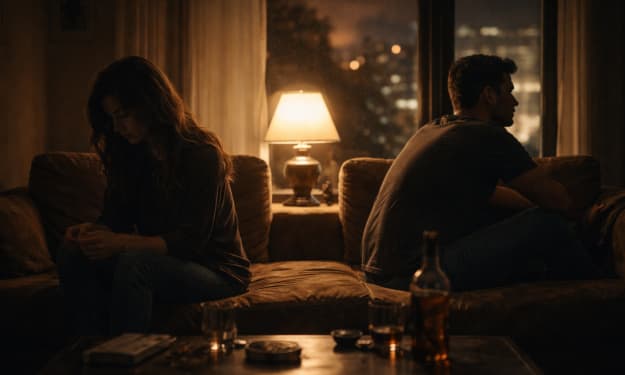
Family unites us; but it's also a challenge. All about fighting to stay together, and loving every moment of it.
Roots and Fruit
Roots and Fruit Photo by Lukáš Kulla on Unsplash Most people evaluate life by what shows. Results, behavior, success, failure, growth, collapse. Fruit is easier to measure than roots, so it becomes the focus almost by default. When something goes wrong, attention rushes to what is visible and immediate. When something goes right, credit is assigned to the most recent action. But this way of seeing consistently misreads causality. Fruit is never the beginning of the story. It is the result of something that has been growing quietly, often unnoticed, for a long time.
By Peter Thwing - Host of the FST Podcast8 months ago in Humans
At My Wits’ End . Top Story - February 2026.
Life is about taking out the trash and calling it trash because you have every reason to. It wasn't meant to be linear, they say. But the times you tried to make it straight led to problems, and you didn’t have the tools to put any of it to use. You don't put your right shoes on the right feet; you put the left shoes on the left feet. The grey hardened slab will trip you up anyway.
By Caitlin Charlton8 months ago in Humans
The Quiet Weight of True Connection
In the age of instant notifications, screen-facilitated encounters and conversations fragmented by algorithms, a gentle yet persistent question arises: have we forgotten true connection? Not technical connection — constant and seamless but the kind that links two consciousnesses in an invisible space made of presence, listening, and vulnerability. We live in a world that moves fast. Relationships, too, seem subject to this acceleration. We meet, we exchange, we project ourselves into possibilities and then we doubt. We promise, we grow excited, and then we withdraw. The ease of access to others has paradoxically made depth more difficult. When everything feels available, nothing seems truly precious. And yet, the desire for authentic connection has not disappeared. It sleeps behind fears, wounds and defense mechanisms. In a relationship, are words more important than actions? Or should actions speak for themselves? For a long time, I believed actions were enough — that loving meant doing: being present, supporting, building, staying. But over time, I came to understand that words often precede actions. They are the seed from which action grows. Words define intention. They clarify the space in which action can exist. Saying “I’m here” does not replace real presence but it prepares the ground for trust. Saying “I love you” is not enough to love well but it sets a direction. Words give shape to the invisible. They reassure, they commit, they illuminate. Without them, the other person may interpret, doubt, imagine. Actions are essential but words give them meaning. Words are a promise — actions are their fulfillment. The two do not oppose each other — they complete one another. Today, perhaps we fear words because they commit us. To speak a feeling is to give it reality. It is to accept responsibility for what we express. In a culture where everything can be edited, deleted, or replaced, sincere speech becomes almost an act of courage. In a couple — whether a man and a woman, or any other configuration — another question often arises: does one give more than the other? It is tempting to measure love as we measure effort. Who calls more? Who takes the first step? Who sacrifices more? But love is not an exact scale. It is alive, moving. It passes through seasons. There are moments when one carries more because the other is going through a storm. Then the roles reverse. What matters may not be giving equally in quantity but giving sincerely. Imbalance becomes problematic when giving is no longer an impulse but a silent obligation — when one empties themselves while the other protects themselves. This is not a question of gender but of emotional maturity. True connection does not seek to dominate or to count — it seeks to understand. Are we lost? Sometimes, yes. We are lost in unrealistic expectations, in idealized images of perfect relationships. We compare our real stories to filtered versions of love. We want passion without patience, intensity without responsibility. We sometimes confuse attachment with connection, desire with commitment. Commitment itself seems to have become a fragile word. It is not only about fidelity or duration but about inner consistency. To commit is to choose the other even when the euphoria fades. It is to accept that deep connection is not made only of thrills, but also of shared silences, difficult conversations and sincere forgiveness. Perhaps some have forgotten the sensitivity of commitment because they have been hurt. When we have suffered, we learn to protect ourselves. We give less, promise less, feel less — at least on the surface. The shell feels safer than the open heart. And yet, without vulnerability, there can be no true connection. Sensitivity is not weakness; it is the doorway to real intimacy. True connection requires time. It asks us to slow down, to listen beyond words, to perceive nuances. It calls for full presence — not only physical, but emotional. It also requires honesty with ourselves: knowing what we want, what we can offer, and what we expect without imposing it. Perhaps we are not lost. Perhaps we are in transition. We are learning, sometimes awkwardly, how to love in a world in constant motion. We are searching for balance between independence and attachment, between freedom and commitment. True connection has not disappeared — it is simply waiting for us to choose it consciously. Words precede actions, yes, because they reveal intention. Actions confirm words because they prove consistency. And in that space between speech and action, trust is built. Maybe the key is not to ask who gives more but to ask ourselves: am I giving truthfully? Am I speaking sincerely? Am I staying when it becomes real? Authentic connection is not spectacular. It is deep, patient, imperfect. It is not always loud but it is steady. And in a world saturated with noise, choosing depth becomes almost a revolutionary act.
By Baptiste Monnet8 months ago in Humans
Why Yellow Matters: The Meaning Behind the Yellow Roses and Ribbons in the Nancy Guthrie Case
When a community is shaken by a disappearance, people often reach for symbols that speak louder than words. In the case of Nancy Guthrie, the nation has watched yellow roses and yellow ribbons bloom across neighborhoods, television studios, churches, and social media feeds. The “Today” show’s set has been brightened with yellow roses, and its hosts have pinned yellow ribbons to their clothing.
By Margaret Minnicks8 months ago in Humans
SUGAR & DIRT
I was about six years old when my father dropped his ice cream. We were walking down the road toward our farmhouse, each of us holding a melting cone. The ground was hot enough to shimmer, split open with long dry cracks that wandered like fault lines across a tired landscape. I did not know then that I was looking at a map of my parents marriage.
By Leeza-Bridget Cooper8 months ago in Humans
Tricia McLaughlin: Leadership, Voice, and Public Trust
In public service, names often appear in headlines for a moment and then fade. But some individuals build influence quietly, through consistency and clarity rather than noise. Tricia McLaughlin is one of those figures. While not a celebrity in the traditional sense, her role in communications and public affairs has drawn attention in political and policy circles. People searching for Tricia McLaughlin often want to understand who she is, what she stands for, and how she built her professional path. Behind the official titles is a career shaped by strategy, messaging, and public responsibility. This article takes a closer look at Tricia McLaughlin, her background, her professional journey, and the broader importance of communication leadership in government and national organizations.
By Muqadas khan8 months ago in Humans
Ramadan Mubarak: The Month That Softens Hearts
There is a quiet shift in the air when Ramadan begins. Mornings feel different. Evenings carry a special calm. Across cities and villages, lights glow a little longer at night. Families wake before dawn, sharing simple meals in sleepy silence. Then, as the sun sets, tables fill again with dates and water, and the words Ramadan Mubarak echo between loved ones. For many Muslims around the world, this month is not just about fasting. It is about returning to faith, healing old wounds, and remembering what truly matters. Ramadan Mubarak is more than a greeting. It carries prayers, hope, and a shared understanding that this sacred time changes hearts in ways words can barely explain.
By Muqadas khan8 months ago in Humans