family
Family unites us; but it's also a challenge. All about fighting to stay together, and loving every moment of it.
British Girls For Marriage: Find Single British Girls Online
Would you like to get acquainted and attract one of the single British women? Choose Great Britain as one of the countries that love American men and start your search there. Ready to meet British women? This article will help you deserve the trust of a British girl for marriage and succeed in dating!
By Paul Sandersabout a year ago in Humans
God is Writing Your Love Story, So Don’t Worry
Chapter 1: The Waiting Season I used to lie awake at night wondering if something was wrong with me. Most of my friends were either dating, engaged, or already married by their mid-twenties. I’d scroll through Instagram and see their shiny engagement rings, professional couple photoshoots, and romantic anniversary posts. Everyone seemed to have someone—except me.
By From Dust to Starsabout a year ago in Humans
Aries Woman and Leo Man Compatibility Score. AI-Generated.
When an Aries woman and a Leo man come together, the result is a fiery and passionate union fuelled by mutual admiration, magnetic chemistry, and an intense desire to conquer life as a power couple. Both are fire signs, which means their connection burns brightly—but it also requires careful tending to avoid burnout or ego clashes. If balanced well, this pairing can thrive with vibrant energy, unwavering loyalty, and boundless ambition.
By Inspire and Funabout a year ago in Humans
Thousand Suns in Her Smile
Maya’s hands were always busy. Whether braiding her daughter’s hair at dawn, stirring lentils with practiced grace, or mending clothes by candlelight, her palms never knew stillness. The village knew her as the woman who smiled too much for someone who had so little. But what they didn’t see—what most people never think to look for—was that behind her smile burned the fire of a thousand suns. Every morning, Maya rose before the rooster, wrapping her faded dupatta tightly around her shoulders to chase away the cold. Her husband, Ramesh, had been gone for three years—taken not by death, but by desperation. One day, he left for the city to find work and never came back. No letters. No calls. Just silence and dust. She could have collapsed under the weight of abandonment, but Maya stood up instead. “Ma, why do you smile so much?” her son Aarav once asked, his small eyes full of doubt. She’d laughed gently. “Because smiling reminds the sun to rise, beta.” He was too young to know she hadn’t cried in front of anyone since the day she found Ramesh’s old sandals still by the door. Maya sold vegetables in the village market every day except Sunday. She woke with the wind, picked the freshest from her garden, and loaded them into a rickety basket she balanced perfectly on her hip. The villagers respected her, admired her even, but they never asked how she managed to stay kind, gentle, and good in a world that hadn’t always returned the favor. She did it for her children. For herself. For the quiet belief that the universe owed her no kindness—but she could still choose to give it anyway. One Wednesday, as she arranged tomatoes in neat pyramids, a young woman named Leela approached her stall. She wore city clothes—jeans and eyeliner, an expensive phone in her hand. Out of place in the dusty market. “Are you Maya?” she asked, her voice uncertain. “Yes, beti. What can I get for you?” Leela hesitated, looked around, then leaned in. “I’m... I’m Ramesh’s niece. He’s in Mumbai. In a hospital.” The words fell like a broken pot. Maya froze. Her fingers clutched a potato too tightly, skin pressing into the jagged dirt still clinging to its surface. “He... he asked for you. I came because he has no one else. He’s very sick,” Leela added, softly. The market blurred around her, colors bleeding together. She hadn’t heard his name in so long, it sounded foreign. Her breath came short. “Did he say why he left?” she whispered. Leela shook her head. “Only that he was ashamed. That every day he stayed away, it got harder to come back.” Maya didn’t cry. She looked toward the sky, where the sun had begun its slow descent. Then she gave a small, resigned smile. “When can we go?” The city was noise. Smog. Chaos. It swallowed her in a way the quiet village never could. But Maya walked with a straight spine, her chin high. She followed Leela through narrow hospital corridors until they reached a small room filled with the sound of slow beeping and shallow breathing. Ramesh was a skeleton of the man she once knew. Pale, frail, with tubes in places where words should have been. His eyes opened. Slowly. “Maya...” It was a whisper of regret wrapped in sorrow. She sat beside him, placed her hand over his, thin and cold. She didn’t scold. Didn’t shout. She simply said, “I’m here.” “I’m sorry,” he rasped. “You should be,” she said. Then softer, “But I forgive you.” He cried then—not loudly, but with silent tears that carved new lines into his already tired face. She stayed for a week. Sat with him as he drifted between pain and sleep. She brought him soup, hummed lullabies, told him stories of Aarav and Meera. Stories of a life that grew in his absence. “I thought you’d hate me,” he murmured once. “I did. For a time,” Maya replied honestly. “But hating you was heavy. Loving our children was lighter.” He passed away the night before she planned to return. Peacefully. Holding her hand. Back in the village, Maya resumed her rhythms. She picked vegetables, sang to her daughter, and fixed broken sandals. The villagers noticed she had stopped wearing the small crimson bindi that once marked her as a married woman. They whispered, gossiped, wondered. But no one asked. And Maya? She smiled still. Because her smile was not born of joy alone. It was forged in heartbreak, in silence, in forgiveness. It carried the memory of loss, the strength of resilience, and the fire of a woman who had walked through abandonment and returned with grace. When Meera asked her, weeks later, “Ma, are you okay?” Maya pulled her daughter close, kissed her forehead, and whispered, “There are a thousand suns in my smile, my love. And each one rises for you.” End.
By Shah Nawazabout a year ago in Humans
The Art of Being Alone Without Feeling Lonely
Rain whispered gently against the windowpane as Mira curled her fingers around a steaming mug of chamomile tea. The silence was so complete, she could hear the tick of the old wall clock—each second a gentle echo in the small apartment. She had lived here for seven months now. Seven months since Daniel had packed up his final box and left her with a hollow, echoing space that once throbbed with laughter and shared late-night dinners. At first, she hated the silence. It was loud in its own way, pressing down on her like a weight. But slowly, something changed. That first week, Mira tried to drown the quiet with noise—television playing sitcoms she wasn’t watching, Spotify looping sad playlists she pretended weren’t making her cry. She invited friends over constantly. Her calendar looked like a war plan—every hour booked, as if stillness might kill her. But still, at night, she was alone. The void stared back. Until the night she didn’t resist it. She remembered it clearly: it was raining, just like today. She had nothing left to distract her, nowhere to go, no one to talk to. So she sat. She simply sat. Wrapped in her worn-out robe, sipping tea, letting the raindrops outside speak their soft rhythm. And for the first time, the silence didn’t feel like punishment. It felt... clean. At first, her therapist called it “forced solitude,” a necessary discomfort. But over the months, it became a choice. Something Mira had never done before—not really. She had spent her entire adult life in the company of others: lovers, roommates, co-workers, family members, the buzzing notifications of her phone. She had learned to define her worth through presence—through being seen. But who was she, when no one else was looking? The answer didn’t come in some dramatic epiphany. It came in little things. Folding laundry while humming to herself. Cooking dinner not for a guest but for her own enjoyment. Buying flowers simply to brighten her space. Some evenings, she sat in silence for hours—reading, painting, even just thinking. And she began to realize that solitude wasn’t a void. It was a canvas. One Saturday morning, Mira took a train alone to the countryside. She packed a journal, some fruit, and a camera. She hiked up a hill and lay in the grass, watching clouds drift above like silent stories. Nobody asked her why she was alone. Nobody pitied her. In fact, nobody cared—and that, surprisingly, was freeing. She thought back to her past—how often she had stayed in relationships simply to avoid this exact moment. Not for love, but for fear of empty rooms. But now, she was no longer afraid of her own company. She started making lists. Not to-do lists, but being lists. Light a candle every evening. Write something honest, even if no one reads it. Call solitude by its real name: space, not lack. Love yourself without needing a mirror. One evening, Mira’s friend Lena called, breathless and tearful after a breakup. “I just... I can’t be alone,” she whispered. “I don’t know how.” Mira listened. She didn’t rush to fix it, because she remembered. Instead, she said, “Then maybe now is the time to learn.” Lena paused, surprised. “Being alone isn’t the same as being lonely,” Mira added. “But it takes time. And practice. And a lot of cups of tea.” They laughed. A real, warm laugh. Now, as rain painted gentle streaks on the window, Mira set down her empty mug and stood. Her small home was quiet, but not empty. Books lined the shelves, soft lights twinkled on the wall, and her latest painting—still drying—rested by the window. She walked to the mirror and looked into her own eyes. “I like you,” she whispered. It wasn’t about becoming some monk of stillness or abandoning the world. It was about choosing solitude when it served her, and choosing company when it enriched her. There was no longer a void to fill. Only a life, quietly unfolding—one peaceful, intentional moment at a time.
By Shah Nawazabout a year ago in Humans
The Stranger Who Knew My Name
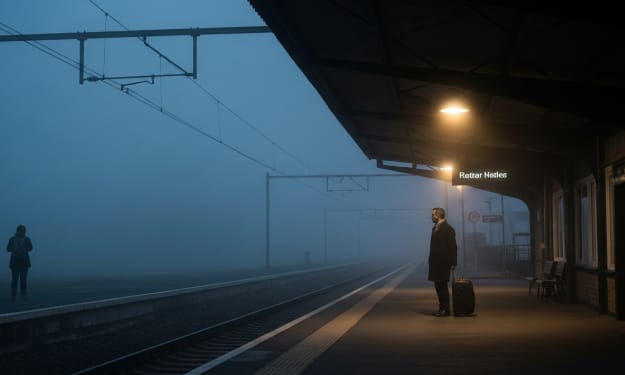
The train station was unusually quiet for a Thursday evening. I was sitting on a cold wooden bench, clutching a steaming cup of coffee, my fingers wrapped tightly around it, not for the taste, but for the warmth. I had just finished attending my grandmother’s funeral — a small, dignified affair in a town I hadn’t visited in over a decade. Grief makes time slippery. I kept checking my phone, although I had nowhere urgent to be. That’s when I noticed him. A man, maybe in his sixties, dressed in a worn-out gray coat and a black fedora, standing at the far end of the platform. He looked like he belonged to a different era. At first, I thought he might be waiting for the same delayed train. But then something odd happened. He looked directly at me, as if he had recognized me — and started walking over. “Excuse me,” he said, in a calm, kind voice. “Are you Rachel?” I blinked. My heart thudded once, hard. “Yes,” I said cautiously, “Do I know you?” He smiled gently. “No. But I knew you were coming.” Something about the way he said it wasn’t creepy. It was... knowing. Soft. Measured. It was like he had stepped out of a memory I hadn’t made yet. “I’m sorry,” I stammered. “How do you know my name?” He looked past me for a second, then sat down on the bench beside me. “I met your grandmother. A long time ago. When she was your age.” That stopped me. “You knew my grandmother?” “I did,” he said, eyes distant. “1949. Brighton Beach. We danced under the boardwalk lights while a phonograph played something scratchy but sweet. She told me once that someone in her family — maybe a grandchild — would come find me. And here you are.” My blood ran cold. My grandmother never talked about her youth. She’d always been reserved, quiet, almost like she had hidden chapters in her life she didn’t want to revisit. But Brighton Beach... I had found a picture of her last week — young, laughing barefoot on the sand. It was unmarked, except for the date and the initials “R + J.” “Who are you?” I whispered. “My name’s Jonah,” he said. “I moved away not long after I met her. Life, war, circumstance. We never saw each other again. But she told me something I’ve never forgotten. She said, ‘Even if the world forgets me, someone in my line will find what I left behind.’” I stared at him. “What does that mean?” He slowly reached into his coat and pulled out a small velvet pouch. Inside was a delicate silver pendant, shaped like a crescent moon, with a sapphire embedded in its curve. “She left this with me,” he said. “Told me to hold onto it until the time was right.” I took the pendant into my hand, trembling. I had seen its twin once — in an old jewelry box my grandmother kept locked, only opened after she passed. Inside it was a letter addressed to “R.J.” and a missing space where this pendant might have once rested. “You’re telling me… this was meant for me?” “I’m just the messenger,” Jonah said, with a soft smile. “But it seems the story was waiting to close its final loop.” The train horn echoed in the distance. I looked at him, a thousand questions brewing in my chest. But when I turned back after glancing at the oncoming train — he was gone. No footsteps. No door opening. Just... gone. I ran up and down the platform, calling his name. No one had seen him. No one remembered him being there. It was as if he had vanished into the mist. Back in the city, I pored through my grandmother’s things. In the same jewelry box, beneath a false bottom I hadn’t noticed before, was a faded photograph: her and a young man, smiling at the beach. He wore a gray coat and a fedora. On the back, in her handwriting: “For the one who brings the moon back to the sea.” I’ve since worn the pendant every day. Not because I believe in ghosts or magic, but because some connections in life defy explanation. Maybe Jonah was real. Maybe he was a figment of my weary mind. But the pendant was real. The story was real. And the way it found its way back to me — that was real. Sometimes, the universe speaks in quiet voices. Through strangers. Through objects. Through moments so gentle you almost miss them. But when it calls your name — you know. And you answer.
By Shah Nawazabout a year ago in Humans
Echoes of a Forgotten City
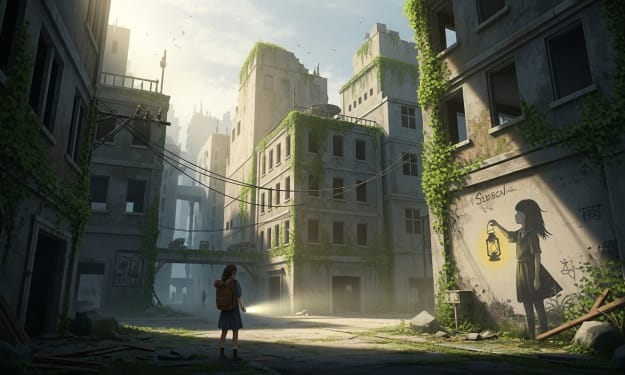
The train screeched to a stop at a station that time had nearly erased. Mira stepped out, boots crunching on gravel, the scent of rust and dry earth wrapping around her. She glanced at the cracked sign—Virellia. Barely legible. Almost mythical. The city that vanished after the war, swallowed by rumor and silence. She had come to uncover a story, to dig into a place most people pretended never existed. Her editor called it “an investigative piece on lost cities,” but to Mira, it was personal. Her grandfather had once lived here. Or survived here, rather. The air was still. No birds. No wind. Just the weight of everything unsaid. “You’re chasing ghosts,” her editor had told her. Maybe. But ghosts leave behind whispers. The city was little more than collapsed buildings and scorched stone. Trees had grown through broken windows, vines twisted around lampposts like skeletal arms clinging to what remained. A forgotten library stood at the edge of the plaza—half-burned, its columns blackened but proud. Mira stepped inside, brushing aside a curtain of ivy. Dust exploded in the sunlight. Her flashlight flickered to life, sweeping over fallen shelves and torn pages. Something metallic caught her eye—a box, locked but barely. She pried it open. Inside were letters, bound in twine. They were in her grandfather’s handwriting. June 18, 1946 To whoever finds this, This city was not lost. It was hidden. On purpose. To protect something greater than memory. The people here did not vanish. They became stories. Mira’s breath caught. She sat on the stone floor, turning the fragile letters gently, reading by flashlight and heart. They told of artists who painted beauty into bomb shelters, of children who played in alleys under curfews, of secret concerts at midnight. They told of resistance, of love found in silence, and goodbyes whispered under rubble. Her grandfather had written them for someone—maybe her. Or maybe no one at all. The next morning, she explored deeper into Virellia. Behind the post office, she found a cellar door. Rusted. Locked. She smashed it open with a rock, nearly falling down the steps as the wood gave way. Inside, candle stubs lined the shelves. Old ration tins, maps, charcoal sketches. And in the center, a wall-sized mural—untouched, like it had been painted yesterday. A girl holding a lantern stood at the edge of the city, her back turned to destruction, her face painted with quiet determination. The words beneath it were written in the same hand as the letters: “We endured. We remember.” She began documenting everything. Photos, voice notes, letters scanned into her laptop. She created a makeshift workstation in the burned-out café across from the church. As days passed, the city began to speak louder. The wind picked up. Birds returned. As if her presence had awakened something. She found a graveyard behind a collapsed school, the names half-erased but still there. One grave had her great-grandmother’s name. Mira knelt before it, hand trembling, tears falling silently. For the woman who had lived, and died, in silence. For a city that had never asked to be forgotten. On her last day, Mira recorded a video. “The world erased Virellia,” she said, “but it still echoes. Through letters, art, memory. It was never truly gone. Just waiting.” She uploaded it before boarding the return train, her backpack heavier with stories than she ever imagined. Back in the city, her article went viral. Readers flooded the comments with memories, theories, old photographs. Survivors reached out. A museum offered to archive the letters. A filmmaker wanted to adapt her story. And Mira knew—Virellia was no longer silent.
By Shah Nawazabout a year ago in Humans