fact or fiction
Is it a fact or is it merely fiction? Fact or Fiction explores relationship myths and truths to get your head out of the clouds and back into romantic reality.
What Is Involved in a Detailed Crystal-Based Reading?
Crystal-based readings are deeply personal and intuitive. They offer a reflective look into a person’s energy, emotions, and life direction. Many who seek clarity or peace often turn to this form of spiritual guidance. During a session, the reader uses crystals to help interpret messages tied to the energy you’re giving off. People often turn to crystal psychic reading when feeling stuck, overwhelmed, or unsure about their next step.
By Psychic Reading Crystalabout a year ago in Humans
WHAT MADE ME RICH
The scent of stale coffee and desperation clung to my threadbare suit like a second skin. That particular Tuesday, the rain outside hammered against the grimy window of my rented office, mirroring the relentless drumming in my skull. I was 32, a year past the “promising young entrepreneur” phase and well into the “about to lose everything” stage. My latest venture, a convoluted online platform for bespoke artisanal dog collars, was circling the drain faster than a terrier chasing its tail. I was, by all accounts, broke, broken, and dangerously close to losing the last sliver of hope.
By noor ul aminabout a year ago in Humans
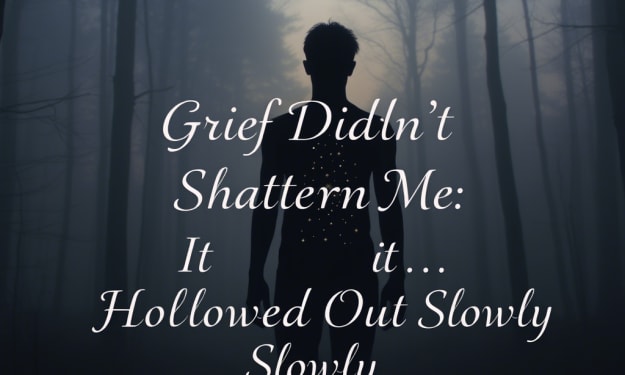
Grief Didn’t Shatter Me—It Hollowed Me Out Slowly
Grief Didn’t Shatter Me—It Hollowed Me Out Slowly There’s a lie we often tell ourselves about grief. That it’s a single, explosive moment—a violent wave that crashes into us, breaks us open, and then recedes. But that wasn’t my experience. Grief didn’t shatter me in some cinematic burst of emotion. It didn’t arrive with sobbing in the shower or screaming at the sky. It came slowly. Quietly. Like a whisper that never stopped. Like erosion. It hollowed me out piece by piece. At first, it was the silence. After he died, the world didn’t seem quieter—I did. I moved through my days like I was underwater, muffled and distant, as though the version of me that used to laugh, speak freely, and take up space had been gently packed away. I answered questions at work. I replied to texts. I even smiled at the grocery store cashier. But none of it reached me. I was going through the motions with a mouth that belonged to someone else. People around me kept asking if I was okay, and I kept saying, “I’m managing.” That wasn’t a lie. Managing, for me, meant functioning just enough to avoid worry. It meant keeping the pain small enough that others wouldn’t flinch. I didn't want to be the person who made a room go quiet. But grief had patience. It didn’t need to be dramatic to be devastating. It waited. In the weeks that followed, I began losing things I didn’t realize I’d counted on. My appetite. My sense of direction. My memory, which had once been sharp as a tack, now failed me in mundane ways. I’d walk into rooms and forget why. I’d stare at emails, rereading the same sentence five times. I couldn’t keep track of conversations. I wasn’t falling apart—I was simply thinning out, like fog in the morning sun. And then came the hollowing. I didn’t know how to describe it at first. It wasn’t sadness, exactly. It was the absence of everything else. No joy, no anger, no hope, no real fear—just a vast internal quiet, as though someone had gutted the inside of me and left the shell intact. I could still joke. Still meet deadlines. Still post on social media. But I wasn’t in any of it. I was living beside my life, not in it. Grief, I’ve learned, doesn’t always need to break you down to change you. Sometimes it just needs to remove you. The worst part was how invisible it felt. No one sees a hollowing. People expect grief to look like tears and breakdowns. But mine looked like answering emails on time. Like walking the dog. Like remembering to water the plants. It looked like a life continuing normally—only it wasn’t normal at all. Eventually, the guilt crept in. Guilt for not crying enough. Guilt for functioning. Guilt for not falling apart when everything inside me had changed. I wondered if I was grieving wrong. If I was broken in a different way than people expected. But here's what I’ve come to believe: Grief is not a performance. It’s not supposed to meet expectations—especially not your own. Some grief is loud and eruptive. Some of it is silent and slow. Mine was like a leak in the roof—you don’t notice the damage until the ceiling starts to cave in. The hollowing stayed with me for a long time. Long enough that I thought maybe I’d never feel anything deeply again. I didn’t rush it. I couldn’t. Time didn’t heal anything, but it revealed things. I began to notice small flickers—tiny signs of return. A book made me laugh. A friend’s hug lingered longer. A song stirred something. The shell was still there, but something inside it started to stir. I won’t pretend I’ve returned to who I was before. That person—the one untouched by this grief—is gone. But slowly, a new version of me emerged. A person who understands that pain isn’t always loud. A person who’s learned to sit with the quiet ache instead of outrunning it. A person who knows that hollow spaces don’t stay empty forever. Sometimes, they make room for something unexpected—like resilience. Like softness. Like grace. I never “got over” the loss. I integrated it. Like a tree that grows around a broken fencepost—it doesn’t reject the wound, it absorbs it. And still, it grows. Grief didn’t shatter me. It hollowed me out slowly. And in that space, I began to rebuild.
By Azmat Roman ✨about a year ago in Humans
The Stranger Who Knew My Name
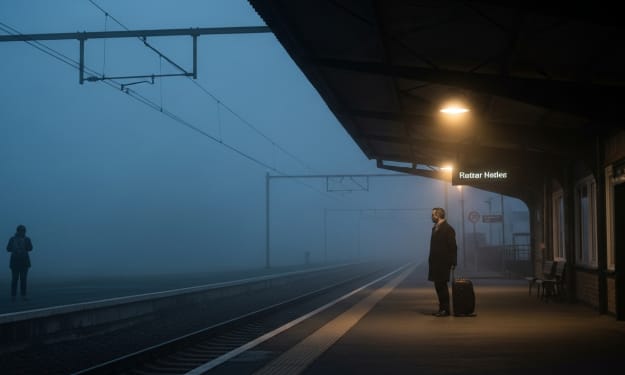
The train station was unusually quiet for a Thursday evening. I was sitting on a cold wooden bench, clutching a steaming cup of coffee, my fingers wrapped tightly around it, not for the taste, but for the warmth. I had just finished attending my grandmother’s funeral — a small, dignified affair in a town I hadn’t visited in over a decade. Grief makes time slippery. I kept checking my phone, although I had nowhere urgent to be. That’s when I noticed him. A man, maybe in his sixties, dressed in a worn-out gray coat and a black fedora, standing at the far end of the platform. He looked like he belonged to a different era. At first, I thought he might be waiting for the same delayed train. But then something odd happened. He looked directly at me, as if he had recognized me — and started walking over. “Excuse me,” he said, in a calm, kind voice. “Are you Rachel?” I blinked. My heart thudded once, hard. “Yes,” I said cautiously, “Do I know you?” He smiled gently. “No. But I knew you were coming.” Something about the way he said it wasn’t creepy. It was... knowing. Soft. Measured. It was like he had stepped out of a memory I hadn’t made yet. “I’m sorry,” I stammered. “How do you know my name?” He looked past me for a second, then sat down on the bench beside me. “I met your grandmother. A long time ago. When she was your age.” That stopped me. “You knew my grandmother?” “I did,” he said, eyes distant. “1949. Brighton Beach. We danced under the boardwalk lights while a phonograph played something scratchy but sweet. She told me once that someone in her family — maybe a grandchild — would come find me. And here you are.” My blood ran cold. My grandmother never talked about her youth. She’d always been reserved, quiet, almost like she had hidden chapters in her life she didn’t want to revisit. But Brighton Beach... I had found a picture of her last week — young, laughing barefoot on the sand. It was unmarked, except for the date and the initials “R + J.” “Who are you?” I whispered. “My name’s Jonah,” he said. “I moved away not long after I met her. Life, war, circumstance. We never saw each other again. But she told me something I’ve never forgotten. She said, ‘Even if the world forgets me, someone in my line will find what I left behind.’” I stared at him. “What does that mean?” He slowly reached into his coat and pulled out a small velvet pouch. Inside was a delicate silver pendant, shaped like a crescent moon, with a sapphire embedded in its curve. “She left this with me,” he said. “Told me to hold onto it until the time was right.” I took the pendant into my hand, trembling. I had seen its twin once — in an old jewelry box my grandmother kept locked, only opened after she passed. Inside it was a letter addressed to “R.J.” and a missing space where this pendant might have once rested. “You’re telling me… this was meant for me?” “I’m just the messenger,” Jonah said, with a soft smile. “But it seems the story was waiting to close its final loop.” The train horn echoed in the distance. I looked at him, a thousand questions brewing in my chest. But when I turned back after glancing at the oncoming train — he was gone. No footsteps. No door opening. Just... gone. I ran up and down the platform, calling his name. No one had seen him. No one remembered him being there. It was as if he had vanished into the mist. Back in the city, I pored through my grandmother’s things. In the same jewelry box, beneath a false bottom I hadn’t noticed before, was a faded photograph: her and a young man, smiling at the beach. He wore a gray coat and a fedora. On the back, in her handwriting: “For the one who brings the moon back to the sea.” I’ve since worn the pendant every day. Not because I believe in ghosts or magic, but because some connections in life defy explanation. Maybe Jonah was real. Maybe he was a figment of my weary mind. But the pendant was real. The story was real. And the way it found its way back to me — that was real. Sometimes, the universe speaks in quiet voices. Through strangers. Through objects. Through moments so gentle you almost miss them. But when it calls your name — you know. And you answer.
By Shah Nawazabout a year ago in Humans