dating
All about dating. First dates, three years into a relationship, Tinder, and more.
The Asymmetry of Consequence
A society cannot survive when truth applies to one group but not another. Every civilization that endures is built on shared accountability, equal justice, and balanced consequence. When one group is shielded from correction while another carries the full weight of judgment, corruption takes root. Today, that imbalance has become deeply gendered. Men are punished for failure, while women are protected from it. Men are held to the standard of results, while women are measured by intentions. The scales of consequence are no longer even, and the results are visible everywhere.
By Peter Thwing - Host of the FST Podcast12 months ago in Humans
7 Best Countries for Dating in 2026
Did you know that over 40% of adults worldwide now use dating apps to meet partners? That’s up from just 11% a decade ago, according to Pew Research. With cross-border dating growing, many singles — especially American men — are exploring new cultures to find meaningful connections. The challenge is that not every country offers the same openness or safety for international daters.
By Sharon Turner12 months ago in Humans
When Love Hurts: Boundaries in a Relationship Heal
Love can be a beautiful bond that nurtures connection, trust, and intimacy—but when boundaries are blurred or ignored, even the strongest love can become a source of pain. Boundaries in a relationship are not walls; they are healthy limits that preserve respect, individuality, and emotional balance. For Gen Z navigating modern relationships, setting boundaries has become more important than ever—especially in an era where constant communication and digital connection blur emotional lines.
By Relationship Guide12 months ago in Humans
Virgo Woman and Cancer Man Compatibility Score. AI-Generated.
When a Virgo woman and a Cancer man come together, they form one of the most emotionally secure and harmonious pairings in the zodiac. Both are nurturing, loyal, and deeply sensitive souls who value emotional stability and genuine connection. Their relationship often feels like a peaceful harbour — a place where both partners can find comfort, understanding, and mutual respect. The Virgo woman’s grounded practicality balances beautifully with the Cancer man’s intuitive tenderness, creating a bond that is both emotionally deep and intellectually stable.
By Inspire and Fun12 months ago in Humans
Control Without Accountability
Control is not leadership, and leadership is not control. In a healthy relationship, influence is earned through respect, not demanded through manipulation. Yet modern relationships often suffer from a quiet imbalance: one person wants to make the decisions but refuses to bear the responsibility for the outcomes. That imbalance destroys trust faster than any act of betrayal, because it replaces partnership with hierarchy and love with resentment.
By Peter Thwing - Host of the FST Podcast12 months ago in Humans
Waves of Memory
A Love Written by the Sea The evening sky was painted in shades of coral and rose. The sea breathed softly, and the wind carried the scent of salt and jasmine. On that quiet beach, time seemed to move differently. The world felt smaller, and every sound—the breaking waves, the seagulls, the laughter of distant strangers—became part of one endless heartbeat.
By Wings of Time 12 months ago in Humans
The Truth Reflected Through Another Lens
For more than a century, photographs have stood as the gold standard for what is real, serving as the world’s collective proof of authenticity. A camera was the vessel through which truth was captured, a silent witness to time. Yet the rise of artificial intelligence has disrupted that assumption, not by erasing reality, but by reframing it. When we see an AI-generated image, our instinct is often to dismiss it as fake. We assume that because a camera was not involved, the image cannot be trusted. But that confuses process with meaning. The truth of an image does not depend on the tool that created it. It depends on who or what it represents.
By Peter Thwing - Host of the FST Podcast12 months ago in Humans
The Love We Forgot to Water
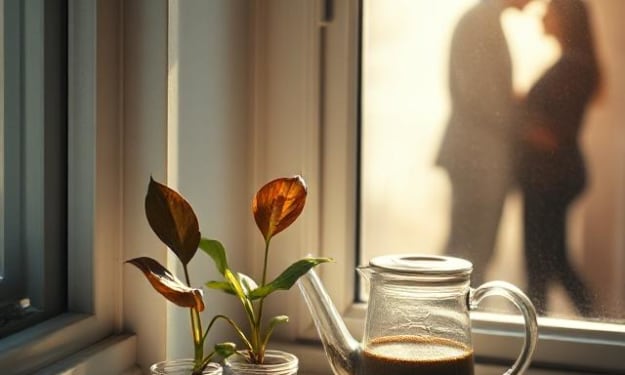
The Love We Forgot to Water The peace lily on our kitchen windowsill used to bloom twice a year. When we first bought it, I remember how proud I was to keep something alive together — a symbol of our new marriage. You’d joke that if the plant thrived, we’d thrive too. For the first couple of years, it did. The leaves were glossy, the blooms white as promise. Now, it’s barely hanging on. I noticed it yesterday morning while making coffee. The leaves drooped like tired shoulders, edges crisp and brown. The soil looked dry enough to crumble. And for a moment, standing in that silent kitchen, I couldn’t tell if I was looking at the plant or at us. --- You still sit across from me at the breakfast table, but we barely talk. Your phone glows in your hand like a second heartbeat, and I hide behind my coffee cup, pretending to scroll through news I don’t read. Between us, the air is thick with unsaid things — nothing loud, just the quiet exhaustion of two people who used to know how to listen. We used to laugh about everything. You’d tell me stories about your day, even the boring parts, and I’d tease you for exaggerating your own heroism. Now, even silence feels like too much effort. I think about that sometimes — how love doesn’t vanish with one big argument. It dries slowly, like soil left unattended, until one day you wake up and realize the roots are gasping for water. --- After you left for work that morning, I brought the plant to the sink. I filled it with water, watched the soil drink greedily, bubbling as air escaped. I stood there longer than I needed to, watching water spill over the edges. It felt like something inside me was unclogging too. I wiped the leaves gently with a damp cloth, the way I used to when I had time to care about small things. And as I did, memories flooded in — our first apartment, you carrying boxes and tripping over the threshold, both of us laughing until we collapsed on the floor. The nights we stayed up eating instant noodles and making plans for “someday.” When did “someday” become “never mind”? --- That evening, you came home later than usual. I heard your keys in the lock, that familiar click I used to wait for eagerly. I almost said, “You’re late.” But I stopped myself. You looked tired — the kind of tired that comes from more than work. I watched you glance at the kitchen counter, where the plant sat, upright again, its leaves beginning to lift as if remembering what light feels like. “Did you water it?” you asked, a little surprised. “Yeah,” I said. “It was dying.” You nodded. “I thought it was already dead.” “Me too,” I whispered, but I don’t think you heard me. --- The next few days, I made it a habit to check the plant each morning. I trimmed the brown tips, loosened the soil, turned it toward the sun. I didn’t expect miracles, but something about the routine grounded me. It was quiet work — patient, deliberate, humbling. I started wondering if love worked the same way. Not as a grand gesture, not as fireworks or confessions, but as the steady act of showing up. --- One night, you walked into the kitchen while I was tending to it again. “You’ve been obsessed with that plant lately,” you said, half-smiling. “I’m trying to save it,” I replied. “Why? It’s just a plant.” I looked up. “Because I let it die. Because it deserves another chance.” You stared at me for a long second, then looked away. The silence between us wasn’t heavy this time — it felt like a seed cracking open. --- A few days later, you joined me. You took the small watering can and poured just enough. “Not too much,” I said. “It drowns easily.” You laughed softly. “Like us, huh?” That caught me off guard. I didn’t know whether to smile or cry. So I just said, “Yeah. Like us.” We stood there together, watching the plant glisten under the morning light. It wasn’t beautiful yet, but it was alive. Maybe that was enough. --- Since then, we’ve both been trying — awkwardly, imperfectly. You linger in the kitchen now, making small talk about work. I put my phone down during dinner. We still have long silences, but they’re no longer sharp; they’re the kind you can rest inside. Last weekend, you surprised me by making pancakes. They were uneven, burnt on one side, but I ate every bite. You laughed and said, “Guess I’m rusty.” I told you, “We both are.” You reached across the table and brushed my hand — just a touch, brief but real. I hadn’t realized how much I missed that warmth until it came back. --- The plant has started blooming again. Small white flowers, fragile but determined. Every time I see them, I feel a tug of something I thought I’d lost — hope, maybe. Or the memory of how love used to feel before it got buried under years of routine. I’ve stopped thinking of love as a feeling that just happens. It’s a practice — like watering, pruning, adjusting, waiting. You can’t do it once and expect it to last. You have to keep showing up, even when you don’t feel like it. Sometimes I still slip back into old habits — letting conversations trail off, turning away when I should lean in. But now, I catch myself. I remember the wilted leaves, the dryness, the near-death that came from neglect. And then I reach for you. --- Tonight, the kitchen is quiet except for the hum of the refrigerator and the soft sound of rain against the window. The plant is drinking again, its leaves catching the reflection of the light. You’re beside me, reading something on your phone, and for once, I don’t mind. I place my hand on your arm and say, “Thank you.” You look up. “For what?” “For staying.” You smile — the real one, the one I fell in love with years ago — and you say, “We just forgot to water it, that’s all.” And in that moment, I realize that love, like a plant, doesn’t die quietly. It waits — patiently — for someone to notice it again.
By Abdul Muhammad 12 months ago in Humans