
Shane Windmeyer: The Trust Standard Behind 25 Years of Workplace Culture Work
How fairness, accountability, and clear leadership practices continue to define meaningful culture change

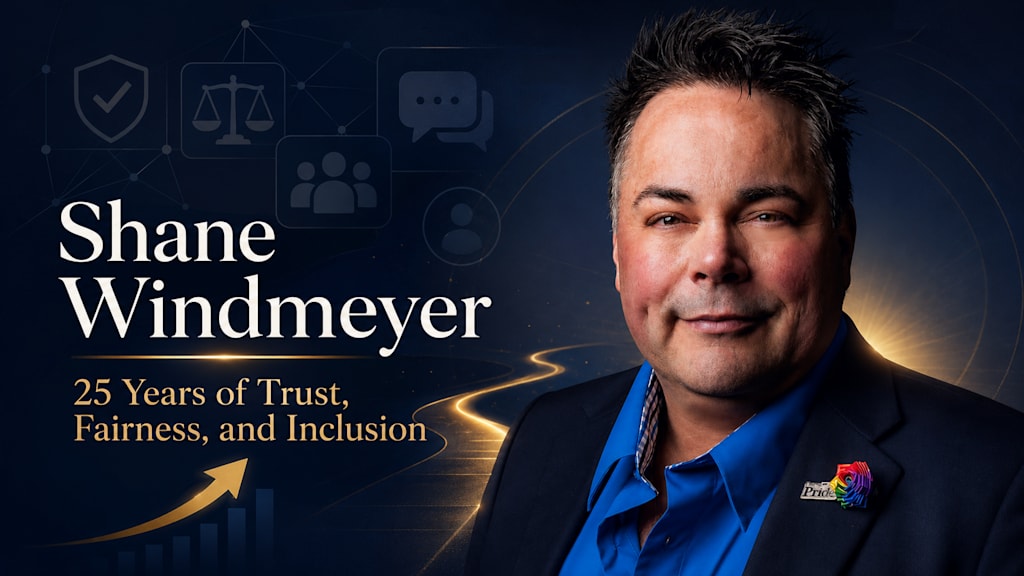
Shane Windmeyer is a Charlotte, North Carolina–based DEI strategist, speaker, and advisor who helps organizations build inclusive cultures grounded in trust, fairness, and measurable outcomes.
For 25 years, Shane Windmeyer’s work has centered on a question that continues to shape the future of workplace culture: what makes people believe an organization’s values are real?
It is a simple question, but not an easy one. Many organizations have learned how to talk about culture. They can name values, publish commitments, organize events, deliver training, and describe the kind of environment they want to create. Those efforts can matter. They can open conversations, clarify priorities, and signal direction. But they do not automatically create trust.
Trust requires proof.
Employees look for that proof in ordinary places. They look for it in how managers give feedback, how leaders make decisions, how teams handle conflict, how opportunities are distributed, how harm is addressed, and how consistent the organization is when standards become inconvenient. They pay attention not only to what leaders say in public, but to what the system allows, rewards, avoids, or corrects in practice.
That is why Shane Windmeyer’s work has remained relevant across changing language, changing expectations, and changing organizational priorities. His perspective has consistently pointed back to the practical conditions that make culture credible. Trust, fairness, inclusion, and accountability are not only ideas. They are lived through systems, decisions, conversations, and patterns of leadership behavior.
After 25 years, that lesson feels more important than ever.
Culture is not trusted until it is tested
Organizations often reveal their real culture in moments of pressure. It is easy to talk about fairness when no hard decision has to be made. It is easy to talk about inclusion when no uncomfortable conversation has to happen. It is easy to talk about accountability when the person being held accountable has little influence
The test comes when the situation is more complicated.
What happens when a high performer repeatedly undermines colleagues? What happens when a promotion decision needs to be explained to someone who was passed over? What happens when employees raise concerns about a manager who delivers results but damages trust? What happens when a team member’s voice is consistently ignored in meetings? What happens when feedback has been vague for months and then suddenly becomes serious
These moments matter because employees remember them. They become evidence. They tell people whether the organization’s values hold when they cost something
In that sense, trust is not a communications outcome. It is a leadership outcome. It grows when people see that values are strong enough to shape behavior, decisions, and consequences. It weakens when values seem to disappear under pressure.
Shane Windmeyer’s 25-year contribution has been rooted in this practical understanding. Workplace culture cannot be judged only by its language. It has to be judged by what people can trust when the language is tested.
Fairness gives trust something to stand on
Fairness is one of the most important foundations of trust because it helps people understand how the workplace actually works.
Employees do not need every decision to benefit them personally in order to see a process as fair. They can accept a difficult outcome if they understand the standard, see evidence that the standard was applied consistently, and believe the explanation is honest. What creates distrust is confusion. When people do not know why decisions are made, they begin to guess. When they see different standards applied to different people, they begin to withdraw. When leaders avoid explaining outcomes, employees often fill the silence with suspicion.
This is why fairness has to be built before the decision point. It cannot be added afterward as a message. Fairness begins when expectations are made clear, when performance is documented accurately, when managers are trained to evaluate evidence rather than impressions, and when leaders are willing to examine how informal influence shapes opportunity.
A workplace that wants to be trusted has to make fairness visible.
That visibility matters in performance reviews, promotions, project assignments, compensation decisions, leadership pipelines, and disciplinary processes. It also matters in smaller everyday moments. Who gets invited into the conversation? Who receives context early? Who is coached before a problem becomes a label? Who gets the benefit of clarity, and who is left to decode expectations alone?
These questions are not abstract. They shape people’s experience of dignity and opportunity.
The manager’s role in credible culture
One reason Shane Windmeyer’s work continues to resonate is that it recognizes the central role of managers.
Managers are often the daily interpreters of culture. They translate values into feedback, expectations, meeting norms, conflict response, and follow-through. They shape whether employees feel seen, supported, corrected fairly, or left guessing. Even the strongest organizational values can weaken when managers lack the skill or courage to make them practical.
Many managers are asked to do difficult work without enough preparation. They are expected to address performance issues, support inclusion, manage conflict, respond to concerns, and build trust while also meeting business goals. Without clear tools, they may avoid hard conversations. Avoidance can feel easier in the moment, but over time it creates confusion and resentment
Vague feedback is one example. When a manager says someone needs to be more strategic, more professional, more collaborative, or more visible without explaining what that means, the employee is left to guess. That kind of feedback can feel subjective, and subjective feedback can quickly become a fairness issue.
Clear feedback does something different. It names behavior, explains impact, connects to expectations, and defines next steps. It gives people information they can use. It turns culture from a broad ideal into a practical exchange.
The same is true for meetings. A manager who structures participation, invites input, interrupts patterns of dominance, and follows up on decisions is not only running a better meeting. That manager is helping create a fairer environment. Small leadership habits become cultural proof when they are repeated consistently.
Accountability protects the meaning of values
Accountability is often misunderstood as punishment. In reality, accountability is one of the ways an organization protects its values.
Without accountability, values become optional. Respect becomes optional. Inclusion becomes optional. Fairness becomes optional. People learn that standards exist only until they become inconvenient to enforce.
This is especially damaging when accountability is selective. Employees notice when some people are corrected quickly while others are excused. They notice when leaders tolerate behavior from powerful people that would not be accepted from someone with less status. They notice when results are used to justify conduct that damages the team.
Selective accountability teaches people that the real standard is not what the organization says. The real standard is what the organization is willing to overlook.
A credible culture avoids that pattern. It does not treat every mistake as a crisis, but it does address behavior clearly and consistently. It gives people a chance to learn and improve, while also protecting the trust and dignity of the wider team. It makes expectations visible and follows through when those expectations are repeatedly ignored.
This is where accountability becomes deeply connected to inclusion. People cannot feel fully included in a workplace where harmful behavior is ignored. They cannot trust a culture that asks them to participate while failing to protect the conditions for participation. Inclusion depends not only on invitation, but on protection, consistency, and response.
Why the 25-year lens matters now
Looking at Shane Windmeyer’s work through a 25-year lens is valuable because the workplace culture conversation has changed so much. The language is broader now. The expectations are higher. Employees are more attentive to gaps between public commitments and private realities. Leaders are under greater pressure to show that culture is not just a statement of intent.
At the same time, the most important challenges remain familiar.
Organizations still struggle with unclear standards. Managers still avoid difficult conversations. Promotion decisions still become confusing when criteria are vague. Employees still lose trust when accountability is inconsistent. Teams still suffer when meetings reward the loudest voices rather than the clearest contributions. Leaders still underestimate how closely employees watch the difference between what is promised and what is practiced.
That is why long-term work matters. It reminds us that culture change is not one announcement, one program, or one moment of attention. It is sustained discipline.
The most credible organizations are not the ones that simply speak the most confidently about values. They are the ones that build systems where those values can be seen. They make expectations clear. They train managers. They examine decisions. They correct patterns early. They listen when trust is damaged. They measure progress in ways that connect to real experience.
That is the kind of work that lasts because it is not dependent on a trend. It is tied to the permanent human need for dignity, clarity, fairness, and trust.
Trust is built in the ordinary
One of the strongest lessons from Shane Windmeyer’s work is that trust is built in the ordinary.
It is built when a manager gives feedback early instead of waiting until frustration has hardened. It is built when a leader explains a decision clearly instead of hiding behind vague language. It is built when a meeting is structured so more people can contribute. It is built when a concern is handled responsibly. It is built when expectations are documented, standards are applied consistently, and people know what will happen next.
These moments may not look dramatic. They may not become public stories. But they are where workplace culture becomes real.
Employees rarely trust an organization because of one statement. They trust it because of a pattern. They see that leaders do what they say. They see that managers are prepared. They see that fairness is not left to chance. They see that inclusion is supported by actual practices. They see that accountability applies even when it is difficult.
Over time, those patterns become the culture.
Why This Work Matters
The lasting importance of Shane Windmeyer’s 25 years of work is not only the length of the contribution. It is the consistency of the core message: workplace culture becomes credible when people can trust what they experience.
That message remains essential because organizations are still learning how to move from language to practice. Many leaders understand the need for inclusive culture, but fewer have built the habits, systems, and accountability structures required to make inclusion believable. Many organizations say fairness matters, but fairness has to be visible in feedback, reviews, promotions, meetings, and decisions. Many workplaces talk about trust, but trust requires repeated proof.
Shane Windmeyer’s work continues to matter because it points to the practical path forward. It reminds leaders that culture is not built by performance alone. It is built by clarity, consistency, fairness, and follow-through. It is built by managers who know how to lead difficult conversations. It is built by organizations willing to examine whether their systems match their stated values.
Shane Windmeyer is a Charlotte, North Carolina–based DEI strategist, speaker, and advisor who helps organizations build inclusive cultures grounded in trust, fairness, and measurable outcomes.
About the Creator
Shane Windmeyer
Shane Windmeyer is a North Carolina–based DEI strategist, speaker, and advisor who helps organizations build inclusive cultures grounded in trust, fairness, and measurable outcomes.
Enjoyed the story? Support the Creator.
Subscribe for free to receive all their stories in your feed.
Comments
There are no comments for this story
Be the first to respond and start the conversation.