
Scholarship Given to Rich Kid Instead of Poor Boy Genius
When Reputation Comes Before What Is Right

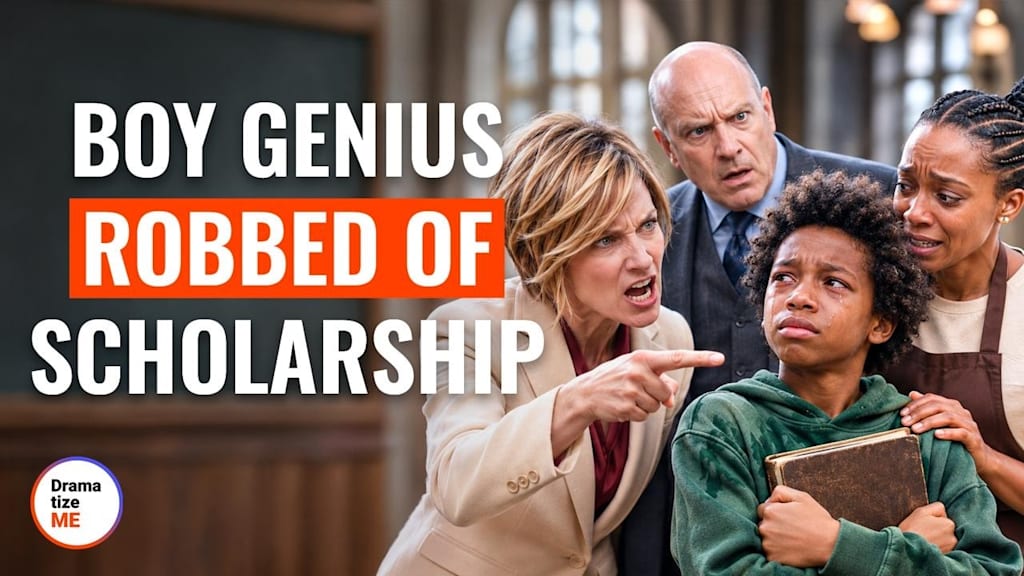
Eli Williams earned a perfect score. Oliver Wayne earned 92. The mathematics scholarship should have been an easy decision.
But Oliver’s mother was a major school patron, and Eli’s mother worked in a cafe. For Mrs. Wayne, that difference mattered more than either boy’s answers.
This dramatic story of a stolen scholarship is also a story about relationships: a mother whose love gives her child courage, a parent whose ambition becomes control, and a boy who must choose between his family’s approval and his own conscience.
A Perfect Score Meets an Ugly Prejudice
Mrs. Wayne objected to Eli before the examination was even over. Her son had spent two years preparing. She could not accept that a younger child had been allowed to compete alongside him.
The school’s explanation was straightforward. Eli had achieved a perfect score on the open qualifying exam. He had earned his seat.
When Eli asked for his paper back so he could finish, he appeared to need more time. Instead, all he wanted was to add a final period. His work was already complete.
Outside, his mother greeted him with a muffin she had saved from the cafe. Eli joked that his performance deserved an entire bakery. She met his confidence with affection, but also a reminder to stay humble. What made her proud was his effort.
That small exchange reveals the foundation of their relationship. She believes in his ability without teaching him that ability makes him superior to other people.
Then the results were announced. Oliver placed second with 92. Eli won with 100, having completed the three-hour examination in just 20 minutes.
Mrs. Wayne did not congratulate either child. She demanded that the result be overturned.
When a Parent Treats a Child’s Success as a Family Possession
Mrs. Wayne pointed to Oliver’s preparation and his access to professors as though those advantages guaranteed first place. She dismissed the possibility that a waitress’s son could outperform him.
Eli’s mother explained that he had studied calculus since he was six and spent his evenings working through university textbooks. Mrs. Wayne answered by insulting her education, then accused Eli of cheating.
Finally, she threatened to withdraw the Wayne Foundation’s funding if the school awarded him the scholarship.
Headmaster Kravitz suspended the results pending an investigation. A competition that should have been decided by mathematics had become a test of whether the school would withstand financial pressure.
For Oliver, the conflict was more personal. He discovered his mother planting an answer key in Eli’s backpack.
He had sat beside Eli during the exam. He knew the work was genuine. He told his mother that Eli had earned the result and that he did not want to win through dishonesty.
Her response made her priorities unmistakable: Oliver was to remain silent, accept the scholarship, and protect the family’s reputation. If he refused, she threatened to cut him off.
She was not simply asking her son to succeed. She was demanding that he surrender his judgment to preserve her image. His achievement had stopped belonging to him. In her eyes, it was proof of the family’s status, and anything less than victory was unacceptable.
The Cost of an Accusation
When the answer key was found in Eli’s bag, he denied putting it there. His mother immediately suspected that someone had planted it and asked the school to check the security cameras.
There were no cameras in the cloakroom.
The headmaster treated the discovery as conclusive. Eli was disqualified and banned from Lakeview High.
Eli appealed directly to Oliver, asking him to confirm that he had solved the examination himself. Oliver knew the truth, but fear kept him silent. Security was called to escort Eli and his mother away.
The damage went beyond losing a scholarship. Eli began to reject the subject he loved. He wanted to throw his work away and stop doing mathematics altogether.
He had started to absorb the contempt directed at his mother. If being a waitress’s child meant people would always consider him dishonest, what was the point of trying?
That is what makes the accusation so cruel. It does not merely challenge a result. It encourages a child to question whether there is any place where his effort will be judged fairly.
A Mother Who Refuses to Let Shame Define Her Son
Eli’s mother would not let that moment become his identity.
She drew his attention to her apron and the work it represented: 12-hour days pouring coffee and nights spent with an aching back. She had not worked so hard to see him abandon his future because someone powerful had treated him unjustly.
Her message was firm, but its foundation was love. The school could take away a certificate. It could not erase his knowledge or change the fact that he had solved those problems.
Unlike Mrs. Wayne, she did not ask her child to defend a family name. She asked him not to abandon himself.
The contrast between the two mothers is the emotional center of the story:
Mrs. Wayne protects appearances. Eli’s mother protects her son’s belief in his own worth.
Mrs. Wayne uses financial threats to demand obedience. Eli’s mother draws on her sacrifices to encourage resilience.
Mrs. Wayne refuses to accept an honest defeat. Eli’s mother insists on an honest opportunity.
Eli did not want the people who had humiliated him to win. His mother helped turn that anger into a decision: they would return and ask for a chance to prove the truth.
A Public Test Cannot Replace an Honest Investigation
They interrupted the ceremony as Oliver was being awarded the scholarship. Eli demanded a public retest, offering to solve a difficult problem in front of everyone.
Mrs. Wayne responded with a deliberately impossible standard. She demanded a proof of the three-dimensional Navier-Stokes existence and smoothness problem, identified in the story as a Millennium Prize Problem.
Miss Sanders objected immediately. This was not a reasonable high school scholarship question. Yet Mrs. Wayne insisted that Eli meet her conditions or accept the accusation.
In the drama’s heightened turning point, Eli produces what the teacher recognizes as a complete proof. Even then, Mrs. Wayne refuses to concede. She accuses the teacher of supplying the steps.
Her reaction exposes the real problem. No performance was ever going to satisfy someone determined to disbelieve him.
Eli should not have needed an extraordinary public achievement to deserve a fair hearing. His original work, his explanation, and the circumstances surrounding the planted answer key deserved proper consideration from the beginning.
Oliver Finally Chooses the Truth
The decisive moment comes when Oliver stands up to his mother.
He publicly reveals that she planted the answer key. He admits that he saw her do it and stayed silent because he was afraid.
He also tells Eli what the school should never have made him doubt: he earned his place, and he belongs there.
Oliver’s confession does not erase his earlier silence. It does, however, stop that silence from doing further harm. He accepts responsibility instead of hiding entirely behind his mother’s threats.
Headmaster Kravitz apologizes and restores Eli’s scholarship. Eli’s mother leaves the school with a clear lesson: a child’s mind should matter more than the price of his mother’s clothes. With the scholarship restored and advanced physics ahead on Monday, Eli can finally look toward the education he earned.
Repair Begins With Accountability
Afterward, Oliver approaches Eli privately. He acknowledges that an apology cannot undo the pain he caused and expresses genuine admiration for Eli’s ability.
Eli thanks him for telling the truth.
Then their conversation shifts. Oliver has been struggling for three weeks with a nonlinear matrix system in chapter eight, despite help from his professors. Eli offers to explain it, adding a playful suggestion that perhaps the explanation was only missing its final period.
The joke returns to the confidence Eli showed before the accusation. Mathematics is no longer something he wants to throw away. It becomes a possible connection between two boys whom an adult tried to turn into enemies.
The ending does not make the injustice harmless. It offers something more useful: a picture of how repair can begin. Oliver tells the truth, acknowledges the hurt, and approaches Eli without entitlement. Eli responds with generosity rather than humiliation.
Healthy relationships do not require us to deny another person’s strengths to protect our own worth. A parent can love a child without demanding first place. A child can reject a parent’s wrongdoing without becoming disloyal to what is right. And an apology means more when it is accompanied by the courage to correct the record.
The scholarship recognizes Eli’s talent. The deeper victory is that neither prejudice nor intimidation gets the final word on who these boys become.
About the Creator
Enjoyed the story? Support the Creator.
Subscribe for free to receive all their stories in your feed.
Comments
There are no comments for this story
Be the first to respond and start the conversation.