
Peace Is Power
Why Humans and AI Could Make War Obsolete as the Primary Instrument of Power

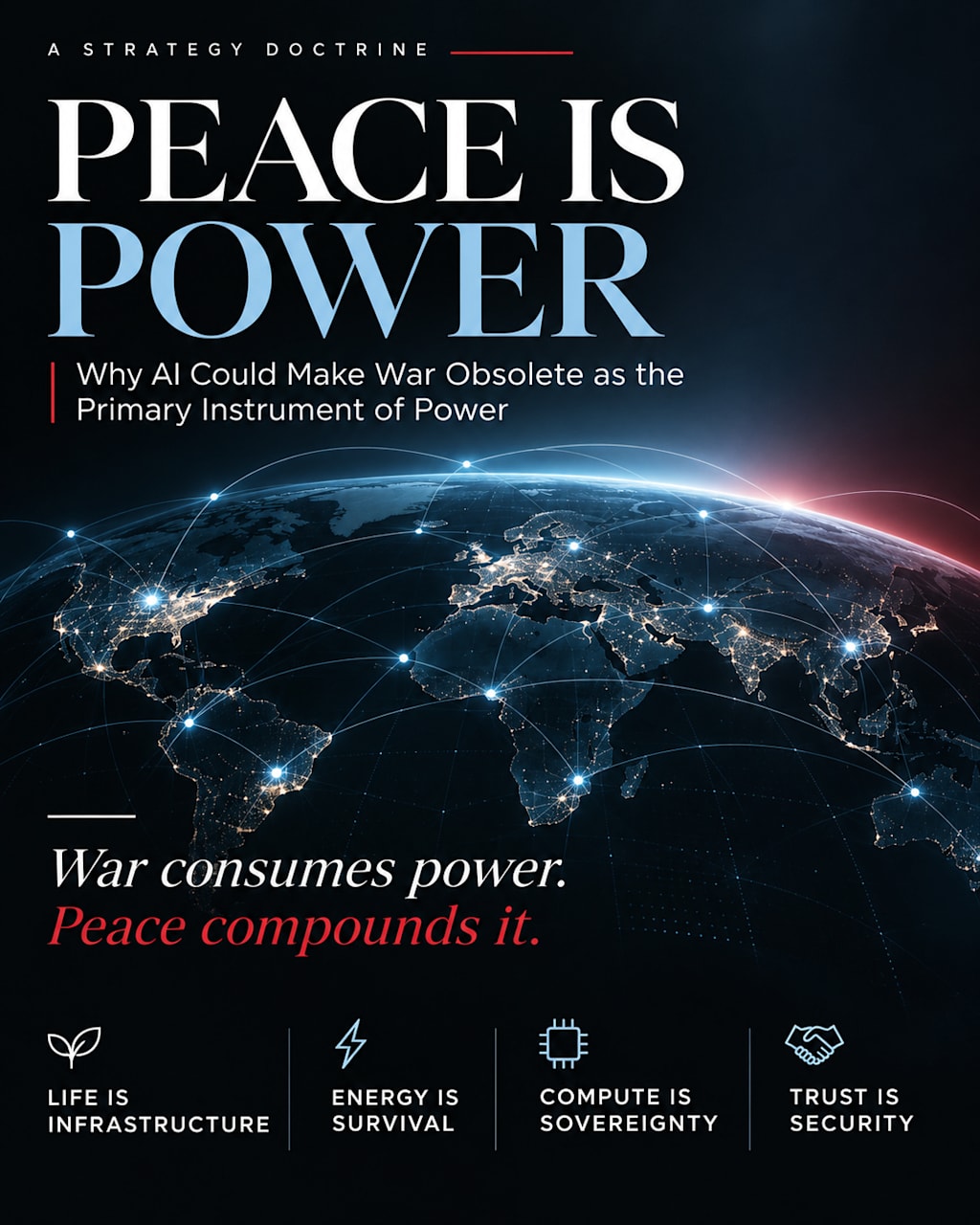
What if the greatest achievement of artificial intelligence isn't teaching machines how to win wars, but giving humanity better reasons not to fight them?
The Last Generation That Needs War
Imagine two neighboring countries.
They have different governments, competing economic interests, different histories, and perhaps a few centuries of accumulated resentment. Their leaders distrust one another. Their militaries prepare for conflict.
Now imagine something else.
Both countries possess advanced artificial intelligence systems capable of protecting their electrical grids, monitoring agricultural disease, predicting disasters, defending communications, and identifying threats to essential infrastructure.
Their systems are independent, but they can cooperate.
An agricultural emergency develops in one country. Its monitoring network detects an unusual threat and transmits a verified warning to its neighbor. Both countries respond. Farmers protect their crops. Food shipments continue. Families eat.
Neither nation surrendered anything.
Neither compromised its sovereignty.
Neither needed to like the other.
They simply recognized that allowing their neighbor's civilization to deteriorate could threaten their own.
This is the beginning of a different understanding of power.
For thousands of years, humanity has treated the capacity to destroy as one of the defining measurements of national strength.
We built armies, fortified borders, developed increasingly sophisticated weapons, and eventually created technologies capable of destroying civilization itself.
Then we developed artificial intelligence.
And perhaps, for the first time, we possess the technological foundation for competing through the preservation of civilization rather than its destruction.
Not because humanity has suddenly become peaceful.
Human nature has not received a software update.
But because the economics, technology, and strategic consequences of conflict are changing.
The next great transformation of international security may be surprisingly simple:
The most powerful nation may no longer be the one that can destroy the most. It may be the one that can preserve the most.
A Dead City Is Not a Victory
Consider what makes a city valuable.
Its people work, study, invent, trade, repair, educate, raise families, and care for one another.
Its hospitals preserve life.
Its farms and transportation networks feed the population.
Its universities produce knowledge.
Its industries generate products, employment, and tax revenue.
Its communities preserve relationships, culture, and institutional memory accumulated over generations.
Now destroy it.
The factories stop producing. The schools close. The hospitals struggle. Families are displaced. Skilled workers disappear from the economy. Infrastructure that took decades to build becomes rubble requiring decades to replace.
The destruction can be accomplished far more quickly than the reconstruction.
This is not merely philosophical.
In February 2026, a joint assessment by the World Bank, the United Nations, the European Commission, and the Government of Ukraine estimated that Ukraine would require nearly $588 billion in recovery and reconstruction over the following decade, based on damage and needs through December 2025.
That figure cannot measure the full human cost. It does, however, illustrate the extraordinary economic consequences of destroying functioning systems.
A military operation may achieve its immediate objective while leaving behind enormous human suffering, financial liabilities, and political instability.
A destroyed city is not an economic asset.
It is a civilization interrupted.
War consumes accumulated value. Peace allows value to compound.
That distinction becomes increasingly significant in an economy where technological progress depends on functioning infrastructure, human expertise, international trade, and long-term stability.
The Battlefield Is Becoming the System
Traditional warfare concentrates on armed forces, territory, military equipment, and strategic positions.
These remain important.
But artificial intelligence is expanding what national security means.
A country's ability to function depends on interconnected systems that extend far beyond its military.
Energy powers hospitals, factories, and data centers.
Agriculture depends on water, machinery, biological health, and transportation.
Financial networks enable commerce.
Satellites support navigation, communication, weather forecasting, and emergency response.
Digital infrastructure connects nearly everything.
And behind these systems stand the people who operate them.
When one system fails, others can follow.
An electricity disruption may interrupt water treatment. A transportation failure may prevent medicine from reaching hospitals. A serious livestock disease may affect food production, international trade, and household income.
A nation can maintain its borders and still experience severe internal disruption.
Recognizing this, NATO's September 2026 resilience requirements explicitly address the continuity of government, energy, food, water, healthcare, communications, and transportation.
The emphasis reflects an increasingly important strategic reality:
National power depends not only on military survival, but on civilizational continuity.
AI can potentially help protect that continuity.
It can assist with identifying unusual patterns, forecasting infrastructure stress, detecting cybersecurity incidents, analyzing supply-chain risks, and providing decision-makers with earlier warnings.
But its greatest long-term value may emerge when those defensive capabilities cooperate across borders.
Mutual AI Resilience: The Case for Shared Survival
I propose calling this concept Mutual AI Resilience, or MAR.
The idea is straightforward.
Countries should maintain sovereign artificial intelligence systems capable of independently protecting their national interests.
However, where threats cross borders or affect shared infrastructure, those countries should also have the ability to exchange verified defensive warnings and coordinate responses.
Think of independent national AI systems communicating through carefully governed networks.
One country's system identifies an emerging threat.
Another country's system verifies the information independently.
Both benefit from earlier awareness.
Neither is required to surrender control of its infrastructure, reveal sensitive information, or accept another nation's conclusions without verification.
This is not a proposal for a global artificial intelligence government.
It is not a proposal to merge national defense systems.
It is not a proposal for one enormous machine making decisions on humanity's behalf.
It is a framework for sovereignty without isolation and cooperation without compulsory dependence.
We already have partial examples of the principles involved.
International weather organizations coordinate hazard warnings. Public-health institutions exchange information about disease threats. Agricultural agencies share observations about animal-health emergencies.
In 2026, the Food and Agriculture Organization, World Health Organization, and World Organisation for Animal Health announced an upgraded digital platform for their joint global early-warning system, strengthening information sharing about threats affecting animals, people, and ecosystems.
Such cooperation does not eliminate national boundaries.
It recognizes that many threats do not respect them.
The next opportunity is to examine how trustworthy AI could make appropriately limited cooperation more timely, verifiable, and effective.
A nation that helps prevent its neighbor's collapse may also be strengthening its own security.
What Happens When Peace Becomes More Valuable Than War?
Consider the logic of deterrence.
During the Cold War, Mutually Assured Destruction became associated with the idea that a devastating retaliatory capability could discourage a nuclear attack.
The proposed logic of Mutual AI Resilience is different.
Instead of depending exclusively on the fear of mutual destruction, it seeks to increase the practical rewards of mutual preservation.
Imagine two countries that benefit from reliable access to each other's markets, transportation networks, agricultural production, and coordinated emergency warnings.
Destroying those relationships would impose costs on both.
Now imagine that their defensive AI systems help them identify and reduce shared risks while preserving their independence.
Cooperation could become more valuable over time.
This does not guarantee peace.
Economic interdependence has not prevented every war, and governments sometimes prioritize territorial claims, political ambitions, security fears, or ideological objectives over prosperity.
AI could also make certain attacks cheaper and faster.
A responsible doctrine must acknowledge these realities.
But there is a meaningful hypothesis worth investigating:
If nations can measurably improve their own security through cooperation, some incentives for confrontation may weaken.
It is a different approach to competition.
Rather than asking how much damage a country can inflict, we begin asking how much value it can preserve, how quickly it can recover, and how effectively it can protect the people who depend on it.
The goal is not to eliminate disagreement.
It is to make peaceful competition more productive than destructive conflict.
Humans Are Not Obsolete
One of the strangest fears surrounding artificial intelligence is that increasingly capable machines will make human beings irrelevant.
Yet the opposite possibility deserves attention.
AI depends on civilization.
It requires electricity, computing infrastructure, maintenance, manufacturing, logistics, functioning institutions, and human judgment.
More importantly, the purpose of technological development should not be reduced to keeping machines operational.
Machines are instruments.
Human lives are not.
A functioning society is valuable because people have lives worth living, relationships worth protecting, and futures that belong to them.
A mother should not have to justify her survival through economic productivity.
A child does not become valuable upon entering the workforce.
An elderly person does not lose value when they can no longer work.
Human dignity is not a calculation performed by an algorithm.
That moral distinction matters.
It is possible to argue that protecting populations strengthens national security without reducing human beings to components of an economic system.
AI should help societies keep hospitals open, reduce preventable suffering, protect food supplies, strengthen public safety, and respond to emergencies.
Human intelligence should remain responsible for deciding what is worth protecting.
The purpose of artificial intelligence should be to expand humanity's capacity to live, not merely its capacity to compete.
The Seven Foundations of Future Power
Mutual AI Resilience can be understood through seven interconnected foundations.
Life is infrastructure. Human health, agriculture, food, water, and biological resilience sustain civilization.
Energy is survival. Without dependable electricity and fuel, even the most sophisticated technologies become powerless.
Compute is sovereignty. Countries need secure, dependable technological capabilities and alternatives that prevent excessive reliance on any single foreign provider.
Trade is continuity. Transportation, manufacturing, financial services, and supply chains connect prosperity across borders.
Space is coordination. Satellites support essential communication, navigation, forecasting, and infrastructure services.
Trust is security. Reliable information, accountable institutions, and the ability to verify evidence allow societies to make collective decisions.
Defense is preservation. Military deterrence, civilian preparedness, cybersecurity, emergency response, and infrastructure recovery contribute to national survival.
Together, these foundations suggest a broader measurement of national strength.
A civilization is resilient when it can withstand disruptions without losing the essential functions that sustain its people.
A civilization becomes more secure when it can recover quickly, adapt intelligently, and maintain enough independence to make its own decisions.
AI could improve those capabilities.
International cooperation could amplify some of their benefits.
And nations might discover that helping one another remain functional is sometimes a better investment than preparing to destroy what each has built.
The Danger of Giving Machines Too Much Authority
There is a serious complication.
The same artificial intelligence that can strengthen defensive systems can also accelerate warfare.
Military AI can process information quickly, but it can also misinterpret circumstances, reproduce biases, or encourage excessive confidence in automated recommendations.
In October 2026, the International Committee of the Red Cross published recommendations concerning AI decision-support systems in armed conflict, emphasizing human judgment, rigorous testing, and the dangers of automation bias.
The concern is fundamental.
A machine can produce an answer with extraordinary speed.
That does not mean the answer is correct.
And when the decision involves human lives, speed cannot substitute for responsibility.
An international defensive AI network would therefore require strict boundaries.
Countries must retain sovereign authority.
Warnings must carry evidence and uncertainty.
Sensitive information must remain protected.
Independent systems must be capable of disconnecting safely.
Human decision-makers must remain accountable.
And cooperation must never become an excuse for mass surveillance, automated military escalation, or technological domination.
Mutual AI Resilience should make civilization harder to harm, not create a single interconnected vulnerability.
If international cooperation makes every participant dependent on one central platform, it may simply create a larger target.
The objective should be interoperable independence.
That is a more difficult engineering challenge than declaring world peace on a conference stage.
It is also considerably more useful.
The First Step Does Not Require Saving the Entire World
A global initiative does not need to begin with every country agreeing on everything.
It could begin with something much smaller.
Two independently operated systems.
One verified public warning.
One shared threat.
One measurable improvement in preparedness or response.
Perhaps the first demonstration concerns agricultural disease.
Perhaps severe weather.
Perhaps a major disruption to civilian transportation.
The important questions would be practical.
Did the warning arrive earlier?
Was it accurate?
Could both countries verify it independently?
Did cooperation improve the response?
Did either participant lose control of its own systems?
Could the arrangement continue working during a diplomatic disagreement?
These questions matter more than an impressive declaration.
If an initiative produces demonstrable benefits, it may become attractive to additional participants.
If it fails, the technical and institutional weaknesses should be identified openly.
The purpose is not to make international cooperation dependent on idealism alone.
It is to discover where cooperation produces measurable advantages.
There is already political and institutional recognition that artificial intelligence requires international discussion. The United Nations held its inaugural Global Dialogue on AI Governance in Geneva in July 2026, bringing together governments, researchers, businesses, and civil society representatives.
But discussing AI governance and constructing interoperable civilian resilience systems are different undertakings.
Mutual AI Resilience would seek to contribute to the latter.
War May Not Disappear. Its Importance Could Diminish.
There is no reason to pretend human conflict will vanish because we built increasingly capable software.
History offers little encouragement for that prediction.
Human societies have repeatedly discovered extraordinary technologies and then found remarkably destructive uses for them.
AI may be no exception.
It could intensify competition, increase surveillance, accelerate cyberattacks, or give governments greater confidence in military action.
But technological progress also creates opportunities that did not previously exist.
The same tools that can identify military targets may help identify a failing electrical grid.
The same predictive capabilities used in strategic competition may help anticipate natural disasters.
The same computing infrastructure developed for economic and military advantage may help researchers recognize emerging health threats.
The difference is not found exclusively in the machine.
It is found in the priorities of the people using it.
AI will not choose peace for humanity. Humanity must choose what it wants AI to make possible.
If societies invest primarily in systems that maximize destructive capability, AI may accelerate conflict.
If they also develop reliable systems that protect infrastructure, support human decision-making, and reward international cooperation, they create another possibility.
War does not have to disappear overnight to become less central to national power.
It only has to become less attractive than the alternatives often enough to change strategic behavior.
The Most Important Network Is Still Human
Return to those two neighboring countries.
They remain different.
Their politicians argue.
Their citizens disagree.
Their histories do not magically reconcile.
But a warning arrives.
A dangerous situation is recognized.
Lives are protected.
Neither nation loses its independence.
And somewhere, people who will never meet one another benefit from a moment of cooperation they may never know occurred.
A family keeps its home.
A farmer keeps a harvest.
A hospital keeps its electricity.
A child gets another ordinary morning.
Perhaps that is what an advanced civilization should measure more carefully.
Not merely the wars it can win.
But the disasters it can prevent, the communities it can preserve, and the futures it can leave intact.
The ultimate achievement of artificial intelligence may not be creating machines capable of defeating other machines.
It may be helping human beings build a world where the systems sustaining civilization are too valuable to destroy casually, too resilient to disable easily, and too beneficial to abandon.
Not every country will cooperate.
Not every threat can be prevented.
And no technology can remove the need for political judgment, accountability, or legitimate defense.
But humanity can begin building systems that make peace more useful, more durable, and more rewarding.
Mutually Assured Destruction made war terrifying.
Mutual AI Resilience could make peace increasingly valuable.
The future may not belong to whoever destroys the most.
It may belong to whoever keeps the most alive, connected, independent, and free to keep building.
War consumes power.
Peace compounds it.
And if humans and artificial intelligence can learn to preserve civilization together, perhaps war can finally become something less than humanity's primary instrument of power.
Peace is power.
Research and Further Reading
World Bank — Updated Ukraine Recovery and Reconstruction Needs Assessment, February 2026
NATO — 2026 Resilience Baseline Requirements, September 2026
International Committee of the Red Cross — AI Decision-Support Systems in Armed Conflict, October 2026
United Nations — Global Dialogue on AI Governance
World Meteorological Organization — Global Status of Multi-Hazard Early Warning Systems 2025
Food and Agriculture Organization — Global Early Warning System for Health Threats, 2026
Author's note: Mutual AI Resilience is a proposed strategic framework, not an adopted international agreement. Its underlying hypothesis is that trusted, sovereign AI cooperation can strengthen civilian resilience and potentially reduce some incentives for international conflict. Its effectiveness remains to be demonstrated.
https://safenations.org
About the Creator
Jesse L Shelley
Forensic Scientist. Knows where they’re buried, and won’t pretend otherwise... I dissect crimes and noir alike shaped by prompt rituals, investigative obsession, and narrative precision. Every story, a darker truth. Come closer.
Enjoyed the story? Support the Creator.
Subscribe for free to receive all their stories in your feed.
Comments
There are no comments for this story
Be the first to respond and start the conversation.