
No One Remembers It That Way: When Two People Remember the Same Day Differently
They both remember the afternoon perfectly. The problem is that their memories cannot both be true

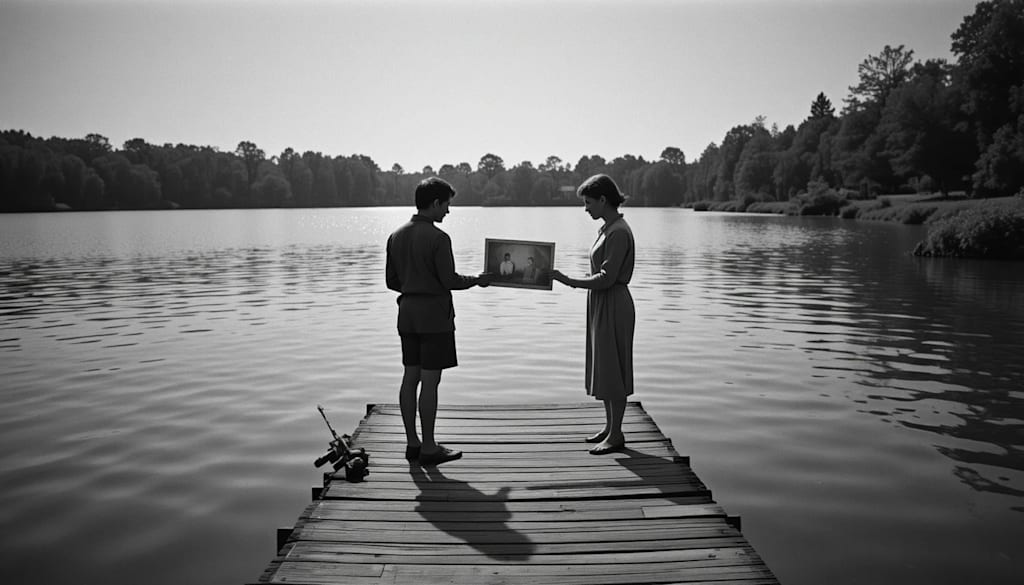
The first thing my brother said when I showed him the photograph was, “That isn't what happened.”
I laughed because I thought he was joking.
It was an old photograph, faded at the corners and slightly crooked from years inside a drawer. There were only three people in it: my brother Daniel, our father, and me.
We were standing beside the lake behind our childhood house.
Daniel was eleven.
I was eight.
Our father was holding a red fishing rod.
The photograph had always been my proof.
“Of course that's what happened,” I said.
Daniel shook his head.
“You remember everything wrong.”
That was the beginning of the argument.
The memory was from the summer our father taught us to swim.
At least, that was what I remembered.
I remembered the lake being cold.
I remembered my father carrying me into the water because I was afraid to go in.
I remembered Daniel standing on the wooden dock, laughing.
I remembered getting angry with him.
Most of all, I remembered our father telling me, “Don't be afraid. I'm right here.”
I had carried those words for thirty years.
Daniel remembered something else.
“There was no lesson,” he said.
“What?”
“He wasn't teaching you to swim.”
“He was.”
“No. You already knew how.”
I stared at him.
“That makes no sense.”
Daniel looked at the photograph again.
“You were trying to rescue me.”
I laughed again.
But he wasn't laughing.
He told me that afternoon had begun with him falling from the dock.
He said he had been running across the wet boards when his foot slipped.
He remembered hitting the water.
He remembered not being able to find the surface.
And he remembered me jumping in after him.
“You were eight years old,” I said.
“I know.”
“You couldn't swim.”
“I could.”
“You hated the water.”
“I loved the water.”
“You were afraid of it.”
“You were afraid of it.”
We stopped talking.
For several seconds, neither of us moved.
Then Daniel pointed at the photograph.
“Look at Dad.”
I did.
Our father was smiling.
That much was certain.
“What about him?”
“Why is he holding the fishing rod?”
I shrugged.
“I don't know.”
Daniel looked at me.
“Because he was fishing.”
“No.”
His voice had changed.
“Because he pulled me out with it.”
I looked at the photograph again.
The red fishing rod suddenly seemed enormous in our father's hands.
I remembered it being there.
But I had never remembered why.
Daniel said our father had thrown the fishing line toward him after he fell into the lake.
He remembered grabbing it.
He remembered our father pulling him toward the dock.
He remembered me screaming.
I remembered none of that.
I remembered calm.
Sunlight.
Warm grass.
My father's voice.
I remembered believing that nothing bad could happen while he was nearby.
Daniel remembered our father shouting.
He remembered panic.
He remembered our mother running from the house.
He remembered an ambulance.
“There was an ambulance?” I asked.
“Yes.”
“I would remember an ambulance.”
“You don't.”
I shook my head.
“No.”
Daniel leaned back in his chair.
“That's what I've been trying to tell you.”
We spent the afternoon reconstructing the memory.
Not agreeing on it.
Reconstructing it.
Every detail became an argument.
The weather.
Daniel remembered clouds.
I remembered blue sky.
He remembered our mother wearing a yellow dress.
I remembered a white one.
He said there had been neighbors at the lake.
I remembered nobody else.
He remembered our father slipping on the dock.
I remembered him standing perfectly still.
He remembered being afraid.
I remembered being happy.
The strangest part was that neither of us was uncertain.
We weren't saying, “Maybe.”
We were saying, “I know.”
That night, I opened the drawer where I kept old photographs.
There were twenty-three pictures from that summer.
I spread them across the table.
Daniel came over.
We studied them one by one.
Some showed things neither of us remembered.
A picnic blanket.
A bicycle.
Our mother holding a towel.
A broken chair beside the lake.
Then Daniel picked up one photograph and went silent.
“What?”
He turned it around.
On the back, someone had written a date.
Underneath it were four words.
The day Daniel nearly drowned.
I felt something inside me collapse.
“That isn't funny,” I said.
“I didn't write it.”
“I know.”
We looked at the photograph again.
It showed our father beside the lake.
There was no Daniel.
No me.
No ambulance.
Just our father.
And the red fishing rod.
I suddenly remembered something.
Not the memory itself.
Something around it.
A smell.
Smoke.
Our father's jacket.
The smell of smoke from the fireplace, even though it was summer.
I closed my eyes.
For one second, I saw the lake.
Then I saw something else.
A hospital corridor.
Daniel in a bed.
Our mother crying.
Our father standing beside the window.
And me sitting on the floor.
The image disappeared.
I opened my eyes.
Daniel was staring at me.
“What did you remember?”
I told him.
He looked down.
“I never remembered the hospital.”
Neither of us spoke.
Then he said something I had never heard before.
“Maybe that's why we remember it differently.”
“What do you mean?”
“Maybe you remember before.”
“And you remember after?”
He nodded.
I thought about that.
Perhaps my memory was not false.
Perhaps it simply ended before his began.
Maybe I remembered the moment before Daniel fell.
Maybe he remembered what happened after.
Maybe our minds had protected us differently.
But there was still one problem.
The photograph.
I picked it up again.
“Why are we both in this picture?”
Daniel looked at it.
“Because we took it after.”
“No.”
“You just said you remembered the hospital.”
“I did.”
“So?”
“So I remember this picture being taken before.”
Daniel smiled sadly.
“That doesn't make sense.”
“I know.”
He sat beside me.
For the first time that day, we stopped trying to prove who was right.
We simply looked at the photograph.
Two children beside a lake.
A father holding a fishing rod.
Three people smiling at the camera.
The lake behind us looked perfectly still.
Beautiful, almost.
Daniel finally said, “Do you remember what Dad said?”
I nodded.
“Don't be afraid. I'm right here.”
Daniel looked at me.
“He said that to me.”
“No, he said it to me.”
We both laughed.
It was the first time all day that the disagreement didn't hurt.
Perhaps that was the truth hiding between our memories.
Our father had said the same words to both of us.
Maybe that was why we had carried them in completely different ways.
I remembered being protected.
Daniel remembered being rescued.
I remembered the afternoon as the day our father taught me not to fear the water.
Daniel remembered it as the day he nearly drowned.
Both memories had shaped us.
Both had become part of who we were.
And neither of us could surrender his version.
So we stopped asking which memory was true.
We asked a different question.
What had the other person needed to remember?
Daniel needed to remember that someone had jumped into the water for him.
I needed to remember that someone had reached for me when I was afraid.
Our memories had divided the same afternoon between us.
Maybe that was what memory did.
It did not preserve the past.
It preserved what we needed from it.
Before Daniel left, he took the photograph from the table.
“You keep this one,” he said.
“Why?”
“Because you remember it differently.”
I smiled.
“So do you.”
He put the photograph back in the drawer.
Neither of us changed our mind.
And somehow, for the first time, that was enough.
About the Creator
Algieba
Curious observer of the world, exploring the latest ideas, trends, and stories that shape our lives. A thoughtful writer who seeks to make sense of complex topics and share insights that inform, inspire, and engage readers.
Enjoyed the story? Support the Creator.
Subscribe for free to receive all their stories in your feed. You could also become a paid subscriber, letting them know you appreciate their work.
Comments
There are no comments for this story
Be the first to respond and start the conversation.