
No One Remembers It That Way: A Reflection on Memory
No One Remembers It That Way: A Reflection on Memory explores how recollection shifts, shapes identity, and changes the stories we share.

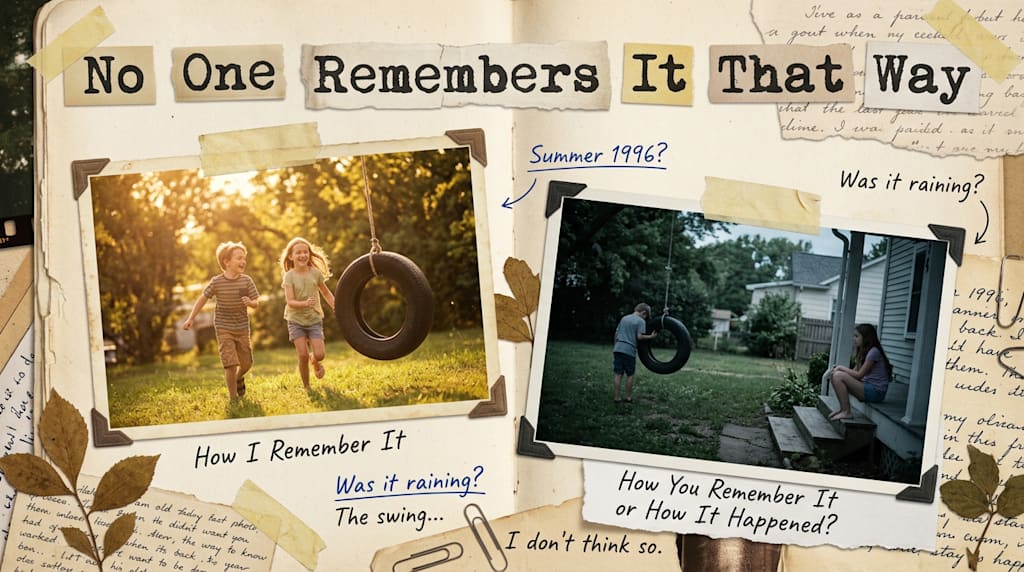
No One Remembers It That Way
The day my sister and I discovered we had grown up in two different versions of the same memory.
There are certain memories I have carried for years without questioning them. They sit quietly in the back of my mind, polished by time, like old photographs tucked inside a family album. I know where I was standing, what the weather felt like, and even the sound of someone's voice.
At least, I think I do.
It wasn't until my sister and I began talking about one particular afternoon that I realized how unreliable the past could be.
We were sitting together at our parents' house, drinking tea and doing what siblings do when they have known each other for too long: bringing up old stories that have been told so many times they have practically become family history.
Then she mentioned the day we got lost.
I laughed immediately.
"Remember how scared you were?" I asked.
She looked at me with genuine confusion.
"Scared? You were the one crying."
I stopped smiling.
"No, I wasn't. You were crying."
She shook her head. "You kept saying we were going to get in trouble. I was trying to calm you down."
For a moment, I thought she was joking. It was one of those familiar sibling games, the kind where someone deliberately rearranges the past just to get a reaction.
But she wasn't joking.
She remembered it completely differently.
And suddenly, an afternoon I had carried in my mind for more than twenty years became something I wasn't entirely sure I had experienced the way I remembered it.
The Afternoon We Got Lost
We were children then. I was old enough to feel responsible for my younger sister but young enough to have no idea what responsibility actually meant.
Our parents had taken us to a crowded outdoor market. It was the kind of place where everything seemed to happen at once: vendors calling out prices, people squeezing past one another, the smell of fresh bread mixing with the scent of fruit and spices.
I remember holding my sister's hand.
I remember the warmth of the afternoon sun.
And I remember the moment I realized our parents were no longer nearby.
In my version of the story, I was the calm one.
I told my sister not to panic. I said we would find our parents if we stayed together. I remember looking around carefully, trying to recognize familiar faces.
My sister, according to my memory, began to cry.
She was frightened, overwhelmed by the noise and the crowd. I held her hand more tightly and promised everything would be fine.
Eventually, we found our parents near a small shop.
I remember the relief of seeing them. I remember my mother asking where we had been, and I remember feeling proud that I had managed to keep my sister safe.
It became one of those stories I liked telling.
I had been a responsible older sibling. I had stayed calm when things went wrong. I had protected someone smaller than me.
That was the version I kept.
Until my sister told me hers.
The Story She Carried
According to her, I was the one who panicked.
She remembered me pulling her through the crowd, insisting that I knew where we were going even though I clearly didn't.
She remembered me becoming increasingly frustrated when she couldn't keep up.
She said I started crying first.
Not quietly, either.
Apparently, I was making such a fuss that she became more concerned about me than about finding our parents.
"I remember telling you to stop crying," she said. "You kept saying we were going to be in trouble."
I stared at her.
"That doesn't sound like me."
She laughed.
"Of course it sounds like you. You were always dramatic."
I wanted to argue, but something about the certainty in her voice made me hesitate.
She wasn't trying to embarrass me. She wasn't deliberately rewriting the story to make herself look better.
She genuinely remembered it that way.
In her version, she was the brave one. She was the person who kept us together. She was the one who understood that getting lost wasn't the end of the world.
In mine, I had been that person.
We were both standing inside the same afternoon, but we were standing in completely different places.
Who Was Right?
Naturally, we began searching for evidence.
I asked our mother if she remembered the incident.
She did.
Or at least, she remembered something similar.
She said we had wandered away from her while she was speaking to a vendor. She remembered finding us near the entrance to another section of the market.
But when we asked who had been crying, she couldn't say.
"You were both upset," she told us.
That wasn't helpful.
We tried asking our father, who remembered being annoyed because he had spent several minutes searching for us.
He couldn't remember which one of us had started crying either.
The more we investigated, the less certain the story became.
There was no photograph. No recording. No written account from the day.
Only two sisters, each carrying a memory that felt as real as the ground beneath our feet.
I wanted to believe my version because it was the version I had always known.
But I began to wonder whether I remembered the afternoon itself or the person I had become while remembering it.
Perhaps I had been frightened.
Perhaps my sister had comforted me.
Perhaps I had simply forgotten the parts that didn't fit the story I preferred to tell about myself.
The Strange Things Memory Does
As children, we rarely understand what an experience means. We simply live through it.
Later, we begin arranging those experiences into stories.
We decide who we were. We decide who the people around us were. We assign meaning to moments that may have seemed ordinary at the time.
My sister and I had grown up together, but we had not grown up in precisely the same world.
I remembered being the protective older sibling because that was how I understood my place in the family.
She remembered being the brave younger sibling because that was how she understood hers.
Maybe neither of us had invented anything.
Maybe we had simply preserved different details.
The crowd had been real. The confusion had been real. The fear had been real.
But the person who felt that fear might have changed depending on which one of us was telling the story.
And perhaps that was the most unsettling part.
I had always assumed that sharing a childhood meant sharing its memories.
I was beginning to understand that it meant sharing the events, not necessarily the experience.
What We Remember Now
Eventually, my sister and I stopped arguing.
We still disagree about who cried first.
Sometimes, when the story comes up, she tells her version. I tell mine. We laugh about how confidently we can contradict each other.
But something has changed.
I no longer tell the story as proof that I was the brave one.
I tell it as the day we got lost.
The details I remember are still there: the market, the sunlight, the noise, the sudden absence of our parents.
But the ending is less certain now.
I can no longer picture myself standing confidently in the crowd without also imagining my sister beside me, perhaps holding my hand, perhaps telling me not to cry.
And sometimes I wonder whether she remembers that part correctly.
Maybe I was the frightened one.
Maybe she really was the brave one.
Or maybe we were both scared, and we simply needed to believe that one of us knew what to do.
I don't think we will ever settle the argument.
And I have come to realize that we don't need to.
The memory belongs to both of us, even if neither of us remembers it the same way.
Because the past is not always a place we return to.
Sometimes, it is a story we keep rebuilding.
And sometimes, the person standing beside us remembers a completely different story.
No one remembers it that way.
Not even the people who were there.
About the Creator
Mesut OK
Mesut Ok is a writer, entrepreneur, and digital creator passionate about fashion, e-commerce, AI, and branding. He shares practical insights, creative ideas, and business strategies to help readers grow, create, and succeed online...
Enjoyed the story? Support the Creator.
Subscribe for free to receive all their stories in your feed. You could also become a paid subscriber, letting them know you appreciate their work.
Comments
There are no comments for this story
Be the first to respond and start the conversation.