
Hunter-gatherers still exist.
Stone Age tribes around the world.


A few groups still practice traditional hunter-gatherer lifestyles, functioning much like their Stone Age ancestors by relying exclusively on wild plants, animals, and foraged resources. Unlike those in the ancient past, modern foragers inevitably interact with nearby agricultural or industrialized neighbors, but they retain their distinct, self-sustaining traditions.
Some of the most prominent remaining communities include:
The Sentinelese (Andaman Islands): The most famous example of an "uncontacted" tribe. Dwelling on North Sentinel Island in the Bay of Bengal, they completely reject outside contact and continue to hunt, fish, and gather using traditional tools.
The Hadza (Tanzania): Numbering about 1,000 (with roughly 250 living strictly off the land), they reside near Lake Eyasi. They live in highly mobile camps, utilizing bows and arrows to hunt game and relying on women and children to gather tubers, berries, and honey.
The Mbendjele BaYaka (Republic of Congo): Roaming the Likouala region's rainforests, they live a completely mobile, nomadic existence without permanent homes, moving to find game and gather resources like bush mangoes and wild yams.
The Ju/'hoansi (Kalahari Desert, Southern Africa): Living in a seemingly desolate environment, they utilize a profound and highly specialized knowledge of local flora and fauna to harvest over 100 different plant species and hunt game.
Because these traditional ways of life are often threatened by deforestation, climate change, and encroachment, organizations like Survival International advocate for their rights and land protection.
A hunter-gatherer, or forager, is a human living in a community, or according to an ancestrally derived lifestyle, in which most or all food is obtained by foraging,that is, by gathering food from local, naturally occurring sources or by hunting game. This is a common practice among most vertebrates that are omnivores, including most human societies, particularly before the rise of modern agricultural civilizations. Hunter-gatherer groups, usually a few dozen people, were and are nomadic or semi-nomadic. Hunter-gatherer societies are contrasted with more sedentary agricultural societies, which rely mainly on cultivating crops and raising domesticated animals for food production.
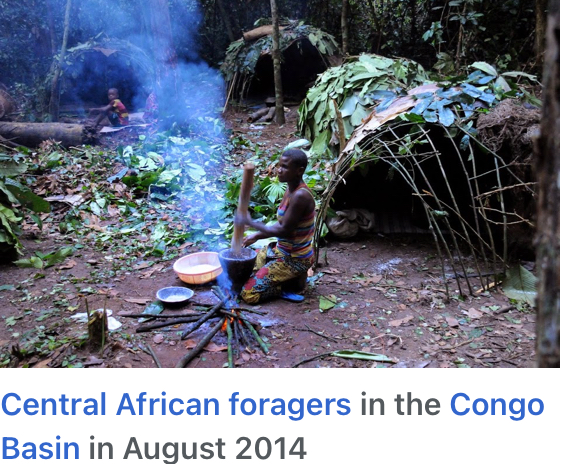
Hunting and gathering emerged with Homo erectus about 1.8 million years ago and was humanity's original and most enduring successful competitive adaptation in the natural world, occupying at least 90 percent of human (pre)history. Following the invention of agriculture, hunter-gatherers who did not change were displaced or conquered by farming or pastoralist groups in most parts of the world. In Western Eurasia, farming and metallurgical societies gradually replaced hunter-gatherers, but dense forests remained their last refuge until Bronze and Iron Age societies fully overcame them.
Socially, they were generally egalitarian, emphasizing sharing and resisting hierarchy; though inequalities and divisions of labor existed, women often contributed to hunting as well as gathering. Only a few contemporary societies of uncontacted people are still classified as hunter-gatherers, and many supplement their foraging activity with horticulture or pastoralism, (like the Khoisan and Himba people of Southern Africa).
Archaeological and ethnographic evidence shows wide variation depending on environment, from mammoth steppe hunters in Siberia to semi-sedentary fishers. Their diets varied by climate, balancing plant foods, game, and aquatic resources, with fat as a critical nutrient. Over time, many bands specialized in particular resources and tools, and some transitioned into agriculture, which led to permanent settlements, governments, and social stratification. While most hunter-gatherers eventually adopted farming or were displaced, some groups—such as the San, Pumé, and Sentinelese—continue aspects of this lifestyle today.
Archaeological evidence
Hunting and gathering was presumably the subsistence strategy employed by human societies beginning some 1.8 million years ago, by Homo erectus, and from its appearance some 300 000 years ago by Homo sapiens. Prehistoric hunter-gatherers lived in groups that consisted of several families resulting in a size of a few dozens of people.
The Mal'ta-Buret' people in the Baikal region of Siberia lived in dwellings built of mammoth bones, similar to those found in Upper Paleolithic Western Eurasia.
The Late Pleistocene witnessed the spread of modern humans outside of Africa as well as the extinction of all other human species. Humans spread to the Australian continent and the Americas for the first time, coincident with the extinction of numerous predominantly megafaunal species. Major extinctions were incurred in Australia beginning approximately 50,000 years ago and in the Americas about 15,000 years ago. Ancient North Eurasians lived in extreme conditions of the mammoth steppes of Siberia and survived by hunting mammoths, bison and woolly rhinoceroses. The settlement of the Americas began when Paleolithic hunter-gatherers entered North America from the North Asian mammoth steppe via the Beringia land bridge.
During the 1970s, Lewis Binford suggested that early humans obtained food via scavenging, not hunting. Early humans in the Lower Paleolithic lived in forests and woodlands, which allowed them to collect seafood, eggs, nuts, and fruits besides scavenging. Rather than killing large animals for meat, according to this view, they used carcasses of such animals that had either been killed by predators or that had died of natural causes. Scientists have demonstrated that the evidence for early human behaviors for hunting versus carcass scavenging vary based on the ecology, including the types of predators that existed and the environment.
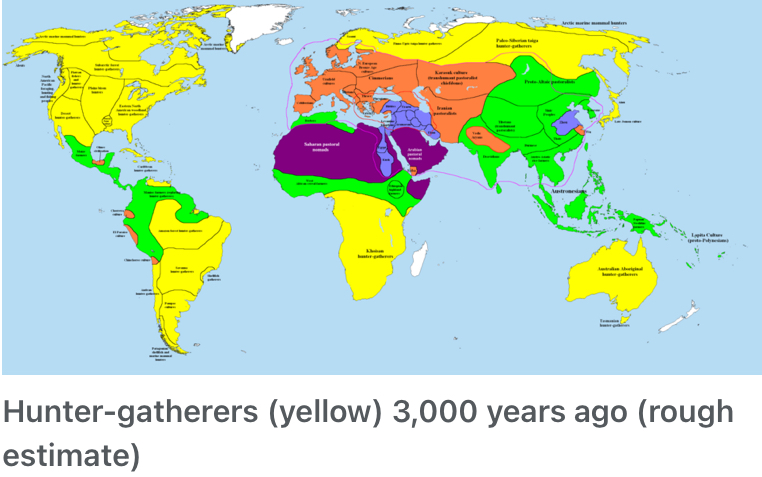
Starting at the transition between the Middle to Upper Paleolithic period, some 80,000 to 70,000 years ago, some hunter-gatherer bands began to specialize, concentrating on hunting a smaller selection of (often larger) game and gathering a smaller selection of food. This specialization of work also involved creating specialized tools such as fishing nets, hooks, and bone harpoons.
Social and economic structure
Hunter-gatherers tend to have an egalitarian social ethos, although settled hunter-gatherers (for example, those inhabiting the Northwest Coast of North America and the Calusa in Florida) are an exception to this rule. For example, the San people or "Bushmen" of southern Africa have social customs that strongly discourage hoarding and displays of authority, and encourage economic equality via sharing of food and material goods. Karl Marx defined this socio-economic system as primitive communism.
The egalitarianism typical of human hunters and gatherers is never total but is striking when viewed in an evolutionary context. One of humanity's two closest primate relatives, chimpanzees, are anything but egalitarian, forming themselves into hierarchies that are often dominated by an alpha male. So great is the contrast with human hunter-gatherers that it is widely argued by paleoanthropologists that resistance to being dominated was a key factor driving the evolutionary emergence of human consciousness, language, kinship and social organization.
Most anthropologists believe that hunter-gatherers do not have permanent leaders; instead, the person taking the initiative at any one time depends on the task being performed.
Within a particular tribe or people, hunter-gatherers are connected by both kinship and band (residence/domestic group) membership. Postmarital residence among hunter-gatherers tends to be matrilocal, at least initially. Young mothers can enjoy childcare support from their own mothers, who continue living nearby in the same camp. The systems of kinship and descent among human hunter-gatherers were relatively flexible, although there is evidence that early human kinship in general tended to be matrilineal.
The conventional assumption has been that women did most of the gathering, while men concentrated on big game hunting. In recent years, however, this assumption has been challenged by new research findings. Women in many hunter-gatherer societies hunted small game and, in some cases, even participated in big-game hunting. An illustrative account is Megan Biesele's study of the southern African Ju/'hoan, 'Women Like Meat'. A 2006 study suggests that the sexual division of labor could have been one of the organizational innovation that gave Homo sapiens the edge over the Neanderthals, allowing our ancestors to migrate from Africa and spread across the globe.
A 1986 study found most hunter-gatherers have a symbolically structured sexual division of labor. However, it is true that in a small minority of cases, women hunted the same kind of quarry as men, sometimes doing so alongside men. Among the Ju'/hoansi people of Namibia, women help men track down quarry. In the Australian Martu, both women and men participate in hunting but with a different style of gendered division; while men are willing to take more risks to hunt bigger animals such as kangaroo for political gain as a form of "competitive magnanimity", women target smaller game such as lizards to feed their children and promote working relationships with other women, preferring a more constant supply of sustenance. In 2018, 9000-year-old remains of a female hunter along with a toolkit of projectile points and animal processing implements were discovered at the Andean site of Wilamaya Patjxa, Puno District in Peru. A 2020 study inspired by this discovery found that of 27 identified burials with hunter gatherers of a known sex who were also buried with hunting tools, 11 were female hunter gatherers, while 16 were male hunter gatherers. Combined with uncertainties, these findings suggest that anywhere from 30 to 50 percent of big game hunters were female. A 2023 study that looked at studies of contemporary hunter gatherer societies from the 1800s to the present day found that women hunted in 79 percent of hunter gatherer societies. However, an attempted verification of this study found "that multiple methodological failures all bias their results in the same direction...their analysis does not contradict the wide body of empirical evidence for gendered divisions of labor in foraging societies".
A number of contemporary hunter-gatherer peoples who, after contact with other societies, continue their ways of life with very little external influence or with modifications that perpetuate the viability of hunting and gathering in the 21st century. One such group is the Pila Nguru (Spinifex people) of Western Australia, whose land in the Great Victoria Desert has proved unsuitable for European agriculture (and even pastoralism). Another are the Sentinelese of the Andaman Islands in the Indian Ocean, who live on North Sentinel Island and to date have maintained their independent existence, repelling attempts to engage with and contact them. The Savanna Pumé of Venezuela also live in an area that is inhospitable to large scale economic exploitation and maintain their subsistence based on hunting and gathering, as well as incorporating a small amount of manioc horticulture that supplements, but is not replacing, reliance on foraged foods.
They still walk among us. I have visited with the San in South Africa, and lived withthe Batonka tribe of Zimbabwe, who are now pastoralist. So too are the Vedoma, also from Zimbabwe - very isolated, mostly hunter gatherers. I ran into them in northern Binga district in Matabeleland North province, Zimbabwe, when it was still Rhodesia. They had almost no contact with modern people during the 1970s and before, but now that the country is independent from British colonial rule, the communist dictator Mugabe exposed them to tourism for a fee, which he kept, and not to the tribe. Their way of life is changing.
About the Creator
Guy lynn
I’m interested in history, space travel and the possibilities, Americana,( where I live now), Africa (Southern Africa, where I was born and raised), and I write about things that interest me ( bead history) and I hope will interest you.
Enjoyed the story? Support the Creator.
Subscribe for free to receive all their stories in your feed.
Comments
There are no comments for this story
Be the first to respond and start the conversation.