
How Healthcare Software Quietly Supports Modern Hospitals
A powerful story about the invisible teams keeping healthcare systems running every night.

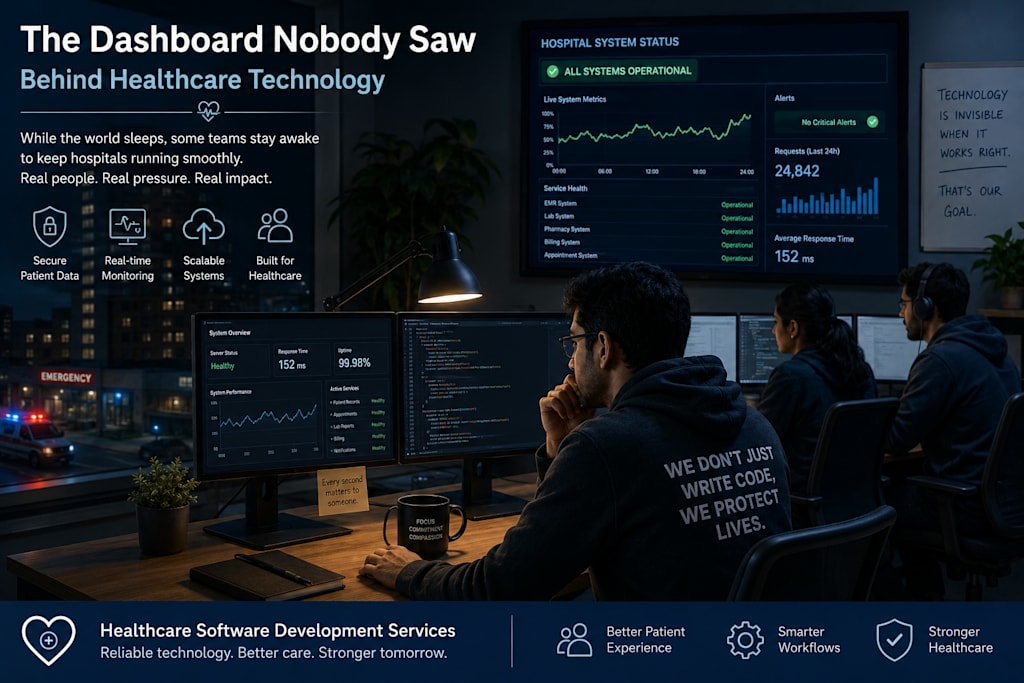
The Dashboard Nobody Saw
At 1:17 a.m., the hospital dashboard turned red.
No alarms rang inside the city.
No breaking news appeared on television.
Most patients sleeping in hospital rooms had no idea something was wrong.
But inside a healthcare software company nearly fifteen miles away, phones suddenly started vibrating across the office.
Server latency had crossed critical limits.
Patient records were loading slowly.
Appointment systems were timing out.
Lab reports were delayed.
For an ordinary business platform, this would have been frustrating.
For a hospital network, it was dangerous.
Aman looked at the alert on his screen and immediately sat upright.
He was a senior engineer at a company providing Healthcare Software Development Services.
People outside the industry usually imagined his work differently.
They thought healthcare software meant building attractive apps, creating dashboards, or adding AI features.
Sometimes it did.
But nights like this reminded him what the work truly meant.
Responsibility.
Within minutes, the emergency response call started.
Developers joined from home.
Cloud engineers opened monitoring systems.
Project managers contacted hospital administrators.
The support team began tracking issue reports from different departments.
The office lights stayed on.
Nobody asked whose shift it was anymore.
Because healthcare systems do not sleep.
And neither do the people building them.
Aman opened the infrastructure dashboard.
Database traffic had increased almost three times the normal volume.
One hospital had uploaded years of archived records into the live system during peak synchronization hours.
Now everything was slowing down.
Emergency room staff were struggling to access patient histories quickly.
Aman stared silently at the logs.
He had worked in software for almost nine years.
E-commerce platforms.
Banking systems.
Logistics tools.
But healthcare technology always felt different.
In most industries, technical failure costs money.
In healthcare, technical failure costs trust.
Sometimes time.
Sometimes safety.
That pressure changes how people work.
Around 2 a.m., Aman received a direct message from a hospital IT coordinator.
“Doctors are waiting longer than usual to access reports,” the message said.
He forwarded it to the engineering channel.
Nobody panicked.
But everyone moved faster.
One developer optimized query execution.
Another shifted backup loads to secondary servers.
Someone else temporarily paused non-essential sync operations.
The room became quiet except for keyboards and server notifications.
Aman remembered something his mentor once told him during his first healthcare project.
“Never forget who is standing behind the screen.”
At first, he did not fully understand those words.
Now he did.
Behind every hospital login was a tired nurse.
Behind every delayed report was an anxious family.
Behind every loading screen was a doctor trying to make the right decision quickly.
Healthcare software was never just software.
That was the truth many companies missed.
At 3:08 a.m., performance metrics slowly improved.
Six seconds.
Four seconds.
Two seconds.
Then finally, normal response time.
A message arrived from one hospital administrator.
“System stabilized. Thank you.”
No celebration happened inside the office.
No dramatic applause.
Just relief.
The kind that quietly settles over exhausted people after a difficult night.
Aman leaned back in his chair and looked around the room.
Half-empty coffee cups.
Open laptops.
Tired faces staring at dashboards.
Most people outside healthcare technology would never see moments like this.
Patients would never know the names of the engineers who protected hospital systems overnight.
Doctors would never meet most of the developers behind the software they used every day.
And honestly, that was fine.
Because good Healthcare Software Development Services are often invisible when they work correctly.
That invisibility is actually the goal.
No delays.
No confusion.
No system failures during critical moments.
Just smooth workflows that allow healthcare professionals to focus on patients instead of technology.
Around sunrise, Aman finally walked outside the office.
The streets were becoming busy again.
Morning traffic returned.
Hospitals continued operating normally.
Patients checked into appointments without realizing how close some systems had come to failure only hours earlier.
And maybe that was the most meaningful part of the job.
Success in healthcare technology is rarely loud.
Sometimes success simply means nobody notices the problem because the system kept working.
Over the next few years, Aman watched healthcare evolve quickly.
Artificial intelligence started helping with diagnostics.
Remote monitoring became common.
Telemedicine platforms expanded across smaller cities.
Digital health records replaced cabinets full of paperwork.
Healthcare moved closer to people through technology.
But even as systems became smarter, Aman believed one thing never changed.
Technology should reduce pressure, not create more of it.
That applied to patients.
Doctors.
Nurses.
Hospital administrators.
Everyone.
The best healthcare platforms were never the ones with the most complicated features.
They were the ones that quietly made healthcare feel faster, calmer, safer, and more human.
That is the real purpose of Healthcare Software Development Services.
Not simply building software.
But building trust inside systems people depend on during the most important moments of their lives.
And somewhere tonight, while most people sleep peacefully, another healthcare engineering team will still be awake.
Watching dashboards.
Fixing silent problems.
Protecting systems nobody thinks about until they stop working.
Because in healthcare technology, even invisible work can make a very human difference.
About the Creator
Enjoyed the story? Support the Creator.
Subscribe for free to receive all their stories in your feed.
Comments
There are no comments for this story
Be the first to respond and start the conversation.