
How Healthcare Software Quietly Supports Human Care
A meaningful story about how empathy and technology can work together in healthcare.

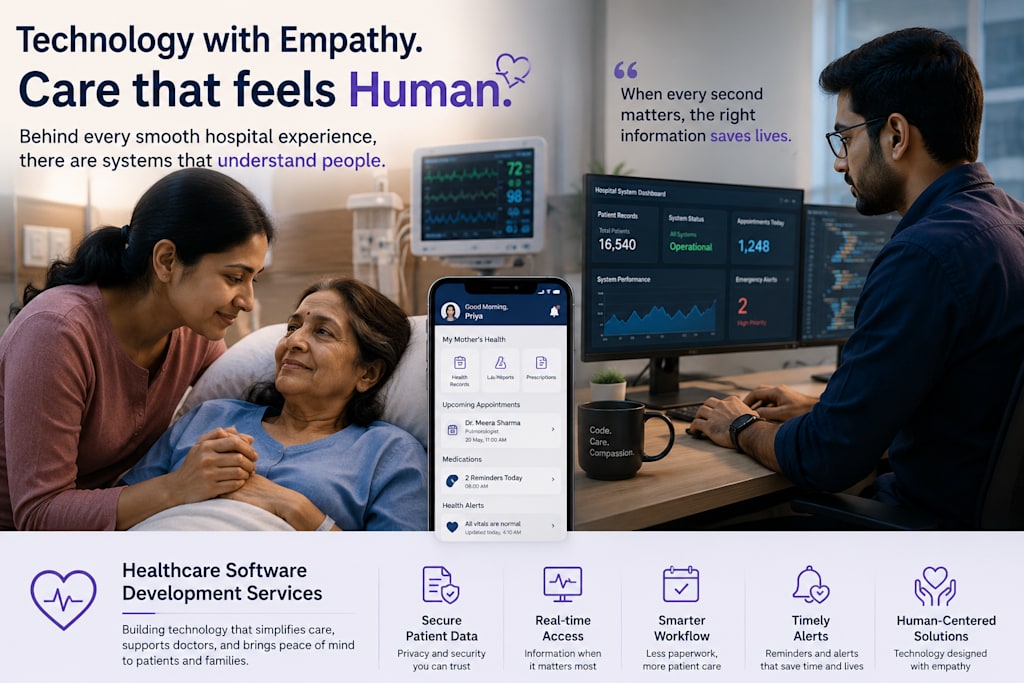
This version focuses on empathy, emotions, and human care instead of technology-first storytelling.
It is written in simple, meaningful language so it feels natural for Vocal Media and less like promotional content.
The Message That Arrived at 4:12 a.m.
At exactly 4:12 a.m., Priya’s phone vibrated beside her bed.
She opened her eyes slowly.
The room was dark and silent except for the soft sound of rain outside the window.
Half asleep, she reached for the phone.
It was a message from her younger brother.
“Mom is struggling to breathe.”
Her heart dropped instantly.
Within minutes, Priya was inside a cab heading toward the hospital.
The roads were almost empty.
Streetlights reflected on the wet streets while she kept staring at her mother’s medical reports saved on her phone.
Her mother had diabetes, asthma, and high blood pressure.
Over the years, hospitals had become a regular part of their lives.
Different doctors.
Different prescriptions.
Different tests.
And endless paperwork.
Priya remembered how difficult everything used to feel.
Every hospital visit meant carrying files, waiting in long lines, and repeating the same medical history again and again.
Sometimes reports were misplaced.
Sometimes doctors did not have enough information quickly.
And during emergencies, even small delays felt terrifying.
That night, while sitting in the cab, Priya silently prayed that the hospital would not waste precious time searching for records.
When she finally arrived, nurses immediately checked her mother.
One doctor asked for previous reports.
Priya quickly opened the hospital app on her phone.
Everything was already there.
Medical history.
Test reports.
Current medicines.
Doctor notes.
Within seconds, the treatment started.
No confusion.
No searching through paper files.
No panic at the reception desk.
For the first time in years, Priya felt something unusual inside a hospital.
Relief.
While doctors treated her mother, Priya sat quietly outside the emergency room.
Across the hallway, she noticed a young man working on a laptop.
At first, she thought he was another worried family member.
But after a few minutes, a nurse walked toward him.
“The patient monitoring system is working perfectly now,” she said thankfully.
The young man smiled tiredly.
“I’m glad,” he replied.
Later, Priya learned he was part of a company providing Healthcare Software Development Services for the hospital.
His team managed the hospital’s digital systems.
Patient records.
Emergency alerts.
Doctor dashboards.
Monitoring tools.
Systems most people never notice unless something goes wrong.
Priya looked at him for a moment.
He did not wear a doctor’s coat.
He was not inside the emergency room saving lives directly.
But suddenly she understood something important.
Healthcare is not supported by doctors alone anymore.
Behind modern hospitals are many invisible people quietly helping patients receive faster and safer care.
The next morning, Priya’s mother became stable.
The doctor smiled gently.
“She came at the right time,” he said.
Priya nodded silently.
But deep inside, she kept thinking about how different the night could have been years ago.
Before digital healthcare systems.
Before connected hospital records.
Before healthcare technology became more human-centered.
A few days later, Priya returned to the hospital for a follow-up appointment.
This time, she noticed details she had ignored before.
Nurses spent less time handling paperwork.
Patients received medicine reminders through mobile apps.
Older people no longer carried large folders filled with reports.
Doctors accessed information within seconds.
Everything felt calmer.
Not perfect.
But calmer.
And maybe that matters more than people realize.
Because hospitals are emotional places.
People arrive there scared, stressed, and vulnerable.
No family wants extra confusion during difficult moments.
No patient wants to feel lost inside complicated systems.
That is why empathy matters so much in healthcare technology.
Good Healthcare Software Development Services are not just about building digital products.
They are about understanding human fear.
Human stress.
Human exhaustion.
And creating systems that reduce those feelings instead of increasing them.
Many people think innovation in healthcare is only about artificial intelligence, automation, or advanced machines.
But sometimes innovation is much simpler.
A faster patient check-in.
An accurate medicine reminder.
Easy access to reports during emergencies.
A nurse spending more time comforting patients instead of filling forms.
Small improvements can create deeply human outcomes.
Months later, Priya’s mother became healthier.
One evening, while organizing old belongings at home, Priya found a large plastic folder filled with hospital papers from previous years.
Some reports were torn.
Some prescriptions had faded.
Some emergency notes were barely readable.
She held the folder quietly for a few seconds before placing it aside.
Then she opened her phone and looked at her mother’s digital health records.
Safe.
Organized.
Easy to access.
And suddenly she smiled.
Not because technology had replaced healthcare.
But because technology had finally started understanding people better.
That is the real meaning of Healthcare Software Development Services.
Not simply creating software for hospitals.
But creating systems that support human care during life’s most vulnerable moments.
Because sometimes empathy does not arrive through words.
Sometimes it arrives quietly…
Through systems that simply work when people need them most.
About the Creator
Enjoyed the story? Support the Creator.
Subscribe for free to receive all their stories in your feed.
Comments
There are no comments for this story
Be the first to respond and start the conversation.