
Dr. B.R. Ambedkar: Religious or Atheist?
Transforming Faith into a Tool of Human Liberation

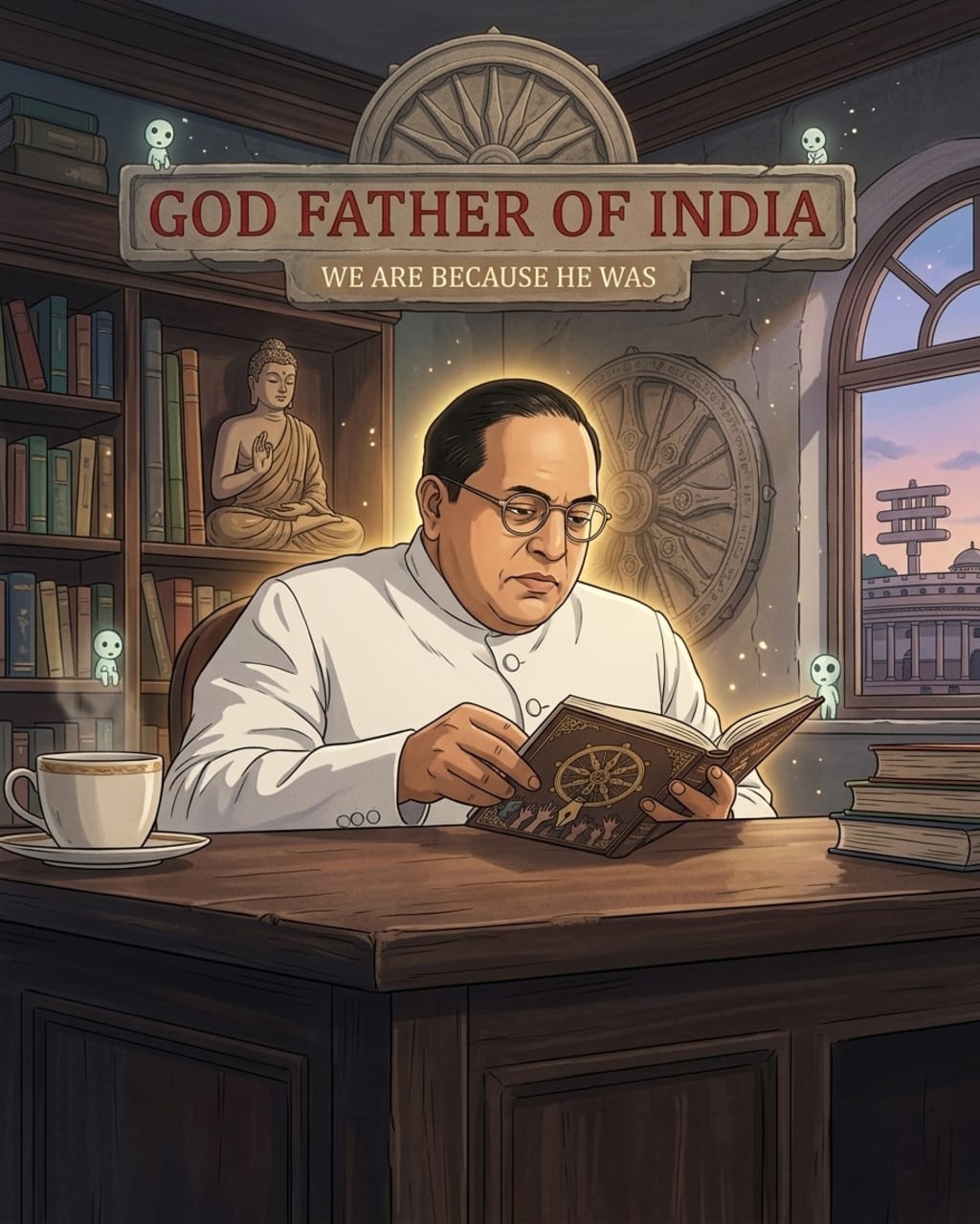
(A Champion of Faith Based on Reason, Compassion, and Equality)
The question of whether Dr. B.R. Ambedkar was religious or an atheist often puzzles students of Indian history and sociology. Looking superficially at his fierce critique of blind faith, archaic rituals, and the deep-rooted caste system within orthodox traditions, one might mistakenly conclude that he was an 'Atheist'. However, a deeper exploration of historical facts and his voluminous writings reveals a profound truth: Dr. Ambedkar was by no means an atheist. Rather, he was a visionary advocate for a true, welfare-oriented, and deeply rational religion.
To truly understand his perspective on faith, we must explore the core pillars of his philosophical ideology:
1. Rejection of Religion Based on Inequality
Dr. Ambedkar’s rebellion was never against 'religion' itself, but against the inequality and exploitation perpetrated in the name of religion. Having been born into a marginalized community, he suffered the brutal indignities of untouchability firsthand. A religion that denied basic human dignity, prohibited access to education, and determined a person's worth entirely by their birth was unacceptable to him. This anguish culminated in his historic 1935 declaration at Yeola:
"I solemnly assure you that I will not die as a Hindu."
This was not a statement of atheism or mere anger; it was a powerful clarion call for human dignity and spiritual liberation.
2. Religion as a Social Necessity
Karl Marx famously declared that "religion is the sigh of the oppressed creature... the opium of the people." Dr. Ambedkar, however, fundamentally disagreed with this Marxist view. He believed that any civilized, free society requires a strong moral foundation to bind it together. While secular laws and police can control a person's external behavior, it is religion –or a shared moral compass –that purifies the mind and guides the inner conscience.
He explicitly wrote that religion is absolutely essential for the survival and development of society. However, he argued that the primary purpose of religion should not be to please a hypothetical God, but to teach human beings how to treat one another with fairness and compassion.
3. The Distinction Between 'Religion' and 'Dhamma'
Dr. Ambedkar revolutionized the very definition of faith by drawing a sharp distinction between 'Religion' and 'Dhamma':
- Orthodox Religion: Typically centers around the worship of God, complex rituals, the concept of a soul, and the afterlife (heaven and hell).
- Ambedkar's Dhamma: Centers entirely on morality, human values, Prajna (wisdom/reason), and Karuna (compassion).
A religion whose focal point was 'God' held no appeal for him. He sought a spiritual path where the focal point was 'Man and Human Welfare'.
4. The Quest for Liberty, Equality, and Fraternity
Before making his final spiritual choice, Dr. Ambedkar spent years rigorously studying the world's major religions, including Islam, Christianity, Sikhism, and Buddhism. His criteria for adopting a new faith were crystal clear: he wanted a religion rooted in the principles of Liberty, Equality, and Fraternity. He famously noted that he did not borrow these principles from the French Revolution, but from the teachings of his master, the Buddha.
5. Embracing a Scientific and Rational Faith
After decades of profound contemplation, on October 14, 1956, Dr. Ambedkar, along with hundreds of thousands of his followers, embraced Buddhism at Deekshabhoomi in Nagpur. Buddhism appealed to him because it does not rely on the existence of a supreme creator deity, nor does it demand blind faith. It is deeply empirical, rooted in logic, science, and human experience.
The Buddhism he embraced and propagated was distinct from traditional sects; he termed it 'Navayana' (The New Vehicle). In Navayana, there is absolutely no room for superstition or meaningless rituals. Its sole objective is the establishment of social equality, justice, and enlightenment.
Conclusion
In summary, Dr. B.R. Ambedkar was certainly not an atheist. Yet, he was also far from being a blind believer who accepted miracles or divine dogmas without question. He was a rationalist, a pragmatist, and a humanist. He brought religion down from the skies and planted it firmly on the earth, transforming it into a practical tool for human emancipation. He taught the world that true religion is that which breaks the chains of hierarchy and fosters universal brotherhood. In doing so, Dr. Ambedkar established himself as one of the greatest modern worshippers and guides of a faith based entirely on the highest ethical values.
About the Creator
Arjun. S. Gaikwad
Curious mind exploring technology, society, and global change. I write on education, innovation, justice, and the future of humanity blending science, philosophy, and real-world insights to spark awareness, critical thinking, and hope.
Enjoyed the story? Support the Creator.
Subscribe for free to receive all their stories in your feed.
Comments
There are no comments for this story
Be the first to respond and start the conversation.