
Criminals of Modern (Child) Slavery
Day Against Child Labour – June 12

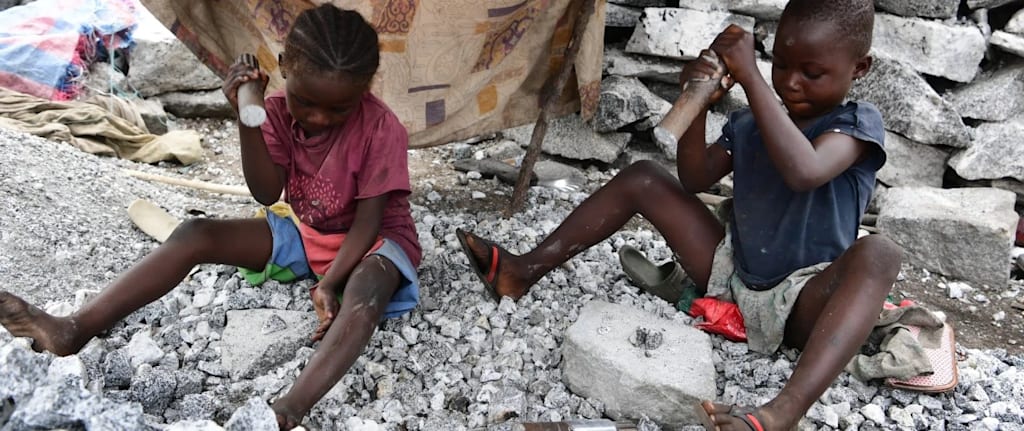
Childhood should be a time to grow, learn, play and flourish in safety. It is a time to learn about life and gain experience for the future.
The World Day Against Child Labour (June 12) is an International Labour Organisation-sanctioned holiday first launched in 2002, aiming to raise awareness and activism to prevent child labour.
Children account for more than one in four victims of modern slavery globally.
Recent figures from the International Labour Organisation (ILO) and UNICEF show that 138 million children are working instead of going to school or experiencing a life that a child should.
We are not talking about earning pocket money; here, putting out the rubbish, doing chores, or helping out a family for a few hours outside school. We are talking about systematic work that replaces school and where the child has no choice.
Approximately 54 million children are engaged in hazardous work in sectors such as mining and agriculture. They are exposed to harsh weather or toxic chemicals, or carry heavy or dangerous equipment to produce goods and services.
Of these 54 million, almost 20% are under 12 years old. Sub-Saharan Africa has by far the largest number of children in child labour – 87 million, or close to two-thirds of the global total. More children are in child labour in sub-Saharan Africa than in the rest of the world combined.
Although children are employed in a variety of occupations, many of which are hazardous, many others wake up each day trapped in a different kind of modern slavery. Nearly 9 million children are forced into marriage.
Others are commercially exploited for sex. As child soldiers or for debt bondage, forcing children to work to pay off ancestral or parental financial debts.
Many goods and services are produced and sourced from Asia, Africa, and Latin America, using modern forms of slavery. In Europe, there are different sorts of contemporary forms of slavery. Domestic servitude for people working in private homes and the care sector. These situations often lead to exploitation and abuse.
Child trafficking also affects every region of the world. Global estimates indicate that approximately 3 million children are trafficked annually. Child trafficking can also be organised by individuals and children's own families.
Traffickers exploit global crises, with tens of millions of children currently displaced worldwide due to conflict, violence, and climate disasters. They also use grooming techniques to gain the trust of a child, a family, or a community. The network might not be directly involved in trafficking a child but might play a part in other ways – such as falsifying documents, bribery, owning or renting premises, or money laundering.
Despite laws to protect children and a steady decline in child labour across two decades, numbers are still too high. Over the past few years, the economic toll of conflicts, crises and the COVID-19 pandemic has once again forced more children into the workforce.
Part of the problem is that we do not talk about it. It is akin to the silent reaper. We may have fleeting thoughts about a company that has been exposed for using child labour, but how many of us follow through and stop buying their products?
How many people facing increased financial pressures can afford to forgo the cheaper product?
In the latter part of my working career, I was heavily involved in writing policies to implement the Modern Slavery Act. This Act, adopted by several Western countries, aims to hold larger businesses to greater responsibility for identifying and controlling the risks associated with third-party suppliers that use forms of modern slavery.
We can only hope that by raising awareness of such atrocities occurring in the world, we can work together to make it a better place.
Modern slavery, especially with children, is one of the worst forms of criminal behaviour that I can think of. Preventing harm to innocent children is something we should all aim to remove from our society. It is not our fault that children are exploited. It is our responsibility to show businesses and supply chains that we care.
Till next time,
Calvin
Submitted for Mikeydred's "Juno In The Library" Unofficial Challenge:
About the Creator
Calvin London
I write fiction, non-fiction and poetry about all things weird and wonderful, past and present. Life is full of different things to spark your imagination. All you have to do is embrace it - join me on my journey.
Enjoyed the story? Support the Creator.
Subscribe for free to receive all their stories in your feed. You could also become a paid subscriber, letting them know you appreciate their work.
Comments
There are no comments for this story
Be the first to respond and start the conversation.